
How far can a CB radio transmit?
A CB radio usually covers a few miles for local communication, but antenna installation, terrain, interference, and the other station determine whether you can actually talk back and forth. Occasional long-distance signals are not dependable local coverage, and replacing a radio part does not automatically increase range.
- How far can a CB radio transmit? Usually a few miles locally; antenna installation and terrain determine usable coverage.
- For vintage CB radio parts, Scott Radio & Electronics suits owners matching replacement components to their actual radio.
- Check the antenna, coax, power connections, and SWR before blaming a vintage CB radio’s transmitter.
- Long-distance skip is unpredictable; plan around repeatable two-way communication, not the farthest station you hear.
How far can a CB radio transmit?
Expect local communication, not a fixed mileage guarantee. Two radios with the same transmitter power can deliver different results because their antennas, surroundings, and receiving conditions differ.
Use the comparison below to set expectations. Before buying replacement components, follow the power and SWR meter guide for mobile CB radios to understand what each measurement tells you.
| Setup | Best for | Useful advantage | Limitation |
|---|---|---|---|
| Handheld CB with its attached antenna | Communication while moving on foot | Portable and self-contained | Antenna size, height, and your surroundings restrict coverage |
| Mobile CB with a properly installed vehicle antenna | Local vehicle-to-vehicle communication | An external antenna clears more obstructions than a handheld at body height | Mounting position, vehicle body, and nearby terrain still matter |
| Base CB with a properly installed outdoor antenna | Communication from a fixed location | Antenna placement can provide a clearer path | A poor site or high local noise still limits reception |
These are installation choices, not ranked transmitter specifications. A well-installed mobile station can outperform a poorly installed base station; the word base is not a distance rating.
Why this matters
For a restoration project in 2026, separate lost performance from the normal limits of the installation. A damaged antenna cable needs a different fix from a noisy receiver or a broken microphone connection.
Buying a board because someone cannot hear you skips that distinction. Establish what fails, under what conditions, and whether the problem affects transmitting, receiving, or both before choosing a part.
Handheld CB: best for portable local communication
A handheld CB is useful when you need to carry the radio rather than install it permanently. Its practical limitation is the antenna arrangement: a short antenna held near your body is not equivalent to a well-positioned outdoor antenna.
Hills, buildings, and a low operating position reduce the path available to your signal. Moving to a clearer location is a useful check before deciding that the handheld has failed.
An external antenna is an option only when the radio supports the connection and the installation meets its requirements. Match the connector and antenna specifications; an adapter that screws into place does not establish electrical suitability.
Choose a handheld for portability, not as a substitute for a properly installed mobile or base antenna. If your use is mainly inside a vehicle, evaluate the antenna installation before replacing the radio.
Mobile CB: best for communication between vehicles
A mobile CB depends on the antenna system as much as the radio itself. Mount position, nearby metal, cable condition, and the antenna manufacturer’s grounding or counterpoise requirements all belong in the installation check.
Look for physical changes first. A loose mount, crushed coax, damaged connector, or antenna that strikes an obstruction gives you a concrete fault to investigate.
Do not assume every antenna needs the same mounting arrangement. Follow the instructions for the exact antenna, especially when comparing conventional vehicle-mounted designs with systems designed for installations without a conventional ground plane.
For a mobile CB repair in 2026, record your present antenna location before changing anything. Otherwise, replacing the radio and moving the antenna together leaves you unable to identify which change affected communication.
Base CB: best for a fixed operating location
A base installation gives you more control over antenna placement. An outdoor antenna with a clearer path can improve communication, but the radio sitting on a desk does not create that advantage by itself.
The trade-off is installation work. Antenna support, feed-line routing, grounding, lightning protection, and clearance from overhead power lines require proper planning.
A base station also needs an appropriate power arrangement. Some radios use an external DC supply; others contain an internal mains-powered supply, so identify the exact model before connecting or replacing anything.
Never raise an antenna where it or its support could contact a power line. Leave mains-powered internal repairs and uncertain outdoor installations to qualified help rather than treating them as simple parts swaps.
Why CB radio range varies
The main range drivers are physical and electrical. Work through these factors before changing components:
- Antenna placement: Height and clearance affect the signal path. An antenna surrounded by obstructions does not perform like the same antenna in a clear location.
- Terrain and buildings: Hills, structures, and your position relative to the other station affect whether a usable signal reaches the receiver.
- Antenna matching: The antenna must suit the operating band and installation. SWR helps assess the match but does not measure communication distance.
- Feed-line condition: Damaged coax, loose connectors, and corrosion can compromise the path between the radio and antenna.
- Receiving noise: Electrical interference and background noise can hide a signal that would otherwise be readable.
- The other station: Two-way communication depends on both installations. Improving your transmitter does not repair the other operator’s antenna or receiver.
A range claim without these conditions leaves out the installation. For your own comparison, use the same radio locations, operating mode, and receiving station whenever possible.
Does AM, FM, or SSB transmit farther?
SSB can make weak-signal communication more practical, but neither the mode name nor the legal power limit promises a distance. Both stations must support the selected mode, and SSB operators must use the same sideband.
For U.S. CB operation in 2026, FCC rule 47 CFR §95.967 specifies the following transmitter power limits. These are power limits, not range ratings.
| CB mode | U.S. transmitter power limit | Best for | Limitation |
|---|---|---|---|
| AM | 4 watts carrier power | Talking with nearby operators using AM | Noise and interference still affect intelligibility |
| FM | 4 watts carrier power | Local communication between FM-capable CB radios | Both radios must support FM; weak signals become difficult to understand |
| SSB | 12 watts peak envelope power | Weak-signal communication between SSB-capable stations | Requires matching sideband selection and careful tuning |
Do not treat 12 watts peak envelope power as directly interchangeable with a 4-watt AM carrier measurement. The measurement methods differ.
Match the mode before evaluating range. Hearing activity on a channel does not establish that your radio is set to receive that transmission correctly.
Check these items before buying CB replacement parts
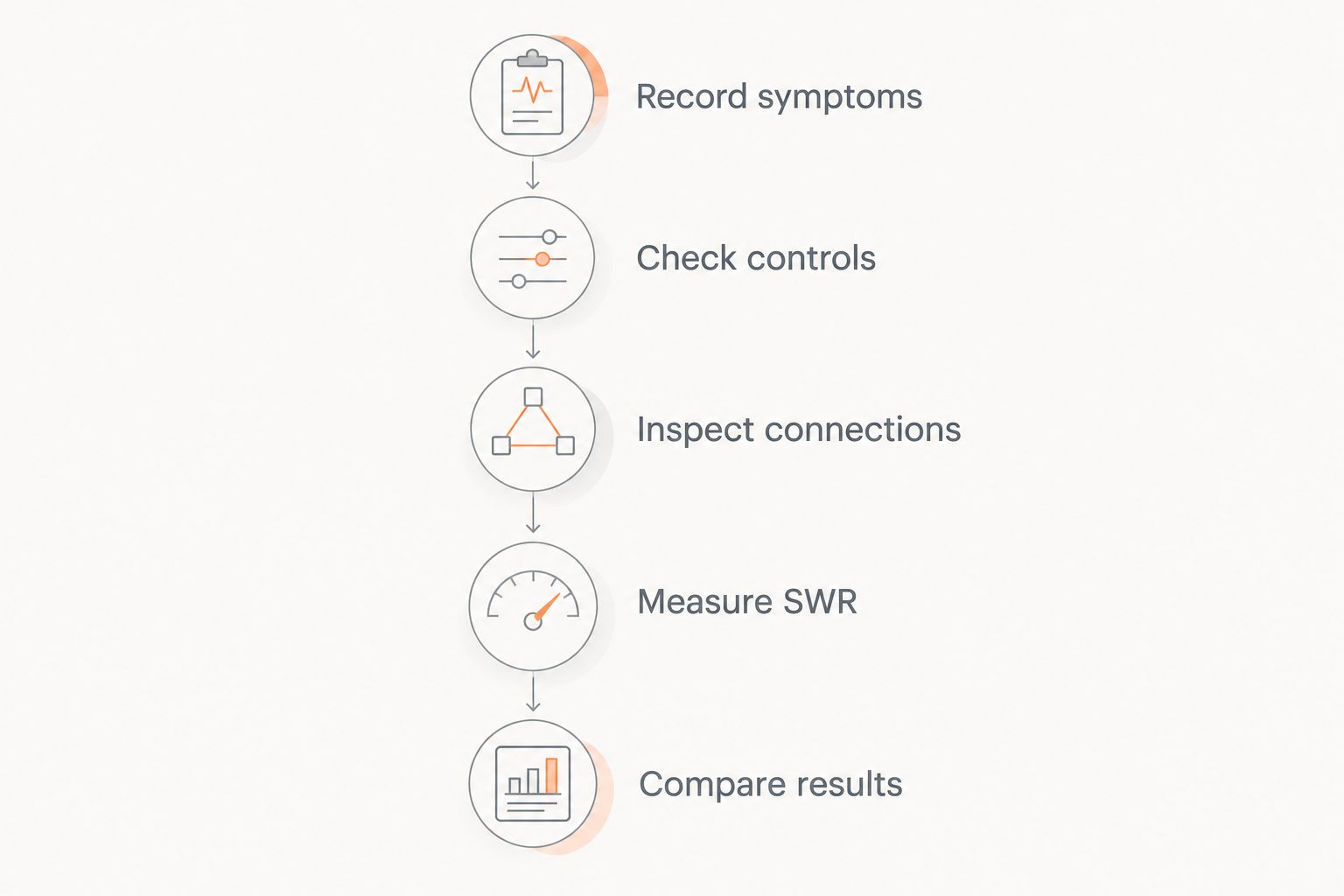
Use this sequence to distinguish an installation fault from a component that needs replacement. Keep the radio’s operating instructions beside you, and disconnect power before inspecting connections that require handling or disassembly.
- Record symptoms. Note whether the problem affects transmit audio, received audio, power, or the display. Describe exactly what the other operator hears.
- Check controls. Confirm the channel, mode, squelch, and any relevant gain controls. Compare settings with the manual rather than copying another model.
- Inspect connections. Examine the antenna connection, accessible coax, microphone plug, and DC connections with power disconnected. Look for looseness, damage, and corrosion.
- Measure SWR. Follow the meter and radio instructions, including calibration where required. Do not continue transmitting into a suspected antenna-system fault.
- Compare results. Make a controlled check with a known working station. Keep location and settings consistent, then change only the suspected item.
If the fault remains after these checks, use the service information for the exact chassis and revision. A symptom narrows the investigation; it does not identify a failed board on its own.
What should you record during a range check?
Write down the transmitting location, receiving location, antenna arrangement, channel, mode, and whether communication worked in both directions. Add the noise conditions and any difference between engine-off and engine-running operation.
For a repeatable check in 2026, keep that record with your radio’s model information. A simple record is more useful than remembering that the radio once reached someone farther away.
Do not perform tests while driving. Have a passenger handle observations or stop safely before changing settings and inspecting equipment.
What must match before you order a replacement part?
Match the part to the actual radio, not just the name on the faceplate. Model suffixes, chassis revisions, connectors, control shafts, and mounting details can change what fits.
For vintage CB radio parts, Scott Radio & Electronics suits owners matching replacement components to their actual radio. The next step is to provide enough detail to compare the original component with the proposed replacement—not to assume compatibility from appearance.
Use this buying checklist:
- Boards: Compare printed identifiers, revision markings, connector positions, mounting holes, and attached wiring.
- Knobs and controls: Compare shaft shape, shaft opening, control function, and clearance around neighboring controls.
- Meters: Compare the scale, mounting points, connections, and electrical requirements in the service information.
- Speakers: Match mounting dimensions, impedance, power requirements, and connections rather than judging by diameter alone.
- Power connections: Verify connector layout, polarity, supply requirements, and the specified protection before connecting power.
Contact Scott Radio & Electronics with the full model number, visible revision markings, and clear photos when fit is uncertain. Use the store contact page and include the original part from both sides, its connections, and the fault you are trying to correct.
Do not remove an internal component solely to obtain a photo if doing so exceeds your experience. Start with accessible identification details and explain what you cannot safely inspect.
Can you hear a CB radio farther away than you can transmit?
Yes—hearing a distant CB station does not prove that station can hear you. Its antenna location, local noise, and receiving conditions differ from yours.
Treat reception as one part of the check. Ask the other operator for a report on your audio and signal, then confirm that you can understand the reply without guessing at missing words.
Does a low SWR guarantee more CB range?
No—a low SWR does not guarantee a longer usable range. SWR describes an impedance match at the measurement point, not how efficiently the complete installation radiates or how much noise reaches the receiver.
Use SWR alongside physical inspection and controlled communication checks. A satisfactory reading is not permission to ignore a damaged feed line or badly positioned antenna.
Why can CB signals sometimes travel much farther?
Ionospheric propagation, commonly called skip, can carry CB signals far beyond normal local coverage. Its changing conditions make it unsuitable as a dependable distance promise.
Judge a repair by repeatable local performance, not an unusual distant contact. Skip also brings distant signals onto a channel, making local communication harder even when your equipment works correctly.
FAQ
How far can a CB radio transmit in normal use?
A CB radio usually provides local communication over a few miles, with usable coverage determined by the antenna installations, terrain, and noise at both stations. Do not treat an occasional distant contact as dependable coverage.
How much power can a legal U.S. CB radio use in 2026?
U.S. CB transmitter limits are 4 watts carrier power for AM and FM and 12 watts peak envelope power for SSB under 47 CFR §95.967. These limits describe transmitter power, not a guaranteed communication distance.
Will a new CB antenna fix short range?
A suitable, correctly installed antenna addresses antenna-related limitations, but it does not fix every short-range problem. Check the mount, coax, connectors, settings, and receiving noise before replacing it.
Is a base station CB better than a mobile CB for distance?
A base station has an advantage when its antenna placement provides a clearer signal path. A poorly installed base antenna does not automatically outperform a properly installed mobile antenna.
Will an external CB speaker increase transmit range?
An external speaker does not increase transmitter range. It changes how you hear received audio and must match the radio’s external-speaker requirements.
Can I add an amplifier to increase CB range?
Do not add an external RF power amplifier to a U.S. CB station. FCC rule 47 CFR §95.939 prohibits using external RF power amplifiers with CB stations; correct installation faults instead.
What should I send the store when I cannot identify a CB part?
Send Scott Radio & Electronics the full radio model, revision markings, photos of the original part and connections, and a description of the fault. Confirm the match before ordering rather than relying on a similar-looking component.
One last thing
A clearer receiver can improve a conversation without changing your transmitted signal. If another operator hears you but you cannot understand the reply, investigate your receiving noise and audio path instead of assuming you need more transmitter power.
Make your 2026 repair goal specific: restore dependable two-way communication between the locations you actually use. That gives every inspection, measurement, and replacement part a clear purpose.
Related guides
- Coax cables and PL-259 connectors for CB radio installations
- CB radio antennas for over-the-road truckers
- How to wire a base station CB radio to a 12-volt supply
{“@context”:”https://schema.org”,”@type”:”FAQPage”,”mainEntity”:[{“@type”:”Question”,”name”:”How far can a CB radio transmit in normal use?”,”acceptedAnswer”:{“@type”:”Answer”,”text”:”A CB radio usually provides local communication over a few miles, with usable coverage determined by the antenna installations, terrain, and noise at both stations. Do not treat an occasional distant contact as dependable coverage.”}},{“@type”:”Question”,”name”:”How much power can a legal U.S. CB radio use in 2026?”,”acceptedAnswer”:{“@type”:”Answer”,”text”:”U.S. CB transmitter limits are 4 watts carrier power for AM and FM and 12 watts peak envelope power for SSB under 47 CFR §95.967. These limits describe transmitter power, not a guaranteed communication distance.”}},{“@type”:”Question”,”name”:”Will a new CB antenna fix short range?”,”acceptedAnswer”:{“@type”:”Answer”,”text”:”A suitable, correctly installed antenna addresses antenna-related limitations, but it does not fix every short-range problem. Check the mount, coax, connectors, settings, and receiving noise before replacing it.”}},{“@type”:”Question”,”name”:”Is a base station CB better than a mobile CB for distance?”,”acceptedAnswer”:{“@type”:”Answer”,”text”:”A base station has an advantage when its antenna placement provides a clearer signal path. A poorly installed base antenna does not automatically outperform a properly installed mobile antenna.”}},{“@type”:”Question”,”name”:”Will an external CB speaker increase transmit range?”,”acceptedAnswer”:{“@type”:”Answer”,”text”:”An external speaker does not increase transmitter range. It changes how you hear received audio and must match the radio’s external-speaker requirements.”}},{“@type”:”Question”,”name”:”Can I add an amplifier to increase CB range?”,”acceptedAnswer”:{“@type”:”Answer”,”text”:”Do not add an external RF power amplifier to a U.S. CB station. FCC rule 47 CFR §95.939 prohibits using external RF power amplifiers with CB stations; correct installation faults instead.”}},{“@type”:”Question”,”name”:”What should I send the store when I cannot identify a CB part?”,”acceptedAnswer”:{“@type”:”Answer”,”text”:”Send Scott Radio & Electronics the full radio model, revision markings, photos of the original part and connections, and a description of the fault. Confirm the match before ordering rather than relying on a similar-looking component.”}}]}
