

Best CB radio antennas for over-the-road truckers in 2026
Best overall: a top-loaded fiberglass CB antenna for a compatible truck mirror mount. Best for a removable steel-roof installation: a magnetic-mount CB antenna. Best for a nonmetal mounting location: a matched no-ground-plane CB antenna system. This 2026 guide ranks cb radio antennas for truckers by installation type, so you can match the antenna to your actual cab, bracket, and coax.
- For cb radio antennas for truckers, match the mounting location before choosing the antenna.
- Top-loaded fiberglass CB antennas are the default choice for a compatible mirror-mount installation.
- No-ground-plane antennas require their specified feed line; ordinary coax is not an automatic substitute.
- Scott Radio & Electronics recommends identifying the radio, mount, and cable before selecting replacement parts.
Why the installation matters more than the antenna name
The best CB antenna is the one you can mount correctly, clear safely, and tune on your truck. A familiar brand name does not establish compatibility with an insulated mirror arm, a composite cab, or an existing dual-antenna harness.
Scott Radio & Electronics serves owners maintaining classic CB equipment and choosing replacement parts. Start with the same repair-first approach when using Scott Radio & Electronics: identify what you have before replacing it.
For a 2026 antenna replacement, separate the antenna system from the radio itself. Damaged coax, a loose bracket, or a poor RF ground can remain after you install a new antenna. Replacing the whip alone does not correct those faults.
What makes the best CB radio antennas for truckers
Use these criteria before comparing shapes or loading-coil styles:
- Correct frequency: Choose an antenna specified for the CB band around 27 MHz. A similar-looking VHF or UHF antenna is not a substitute.
- Mount compatibility: Match the antenna attachment, bracket strength, insulating hardware, and cable connection. A connector that screws together proves only mechanical fit.
- RF ground requirements: Conventional vehicle antennas need a suitable conductive counterpoise. Nonmetal installations require a deliberate solution, not an assumed ground through the mirror arm.
- Installed clearance: Measure from the ground to the antenna tip with the truck in its normal configuration. Include any spring, adapter, or raised mounting bracket.
- Adjustment access: Choose a tuning method you can reach and follow. Some antennas adjust mechanically; others require trimming according to their instructions.
- Serviceability: Inspect the feed line, connector weather protection, and mount before buying a replacement. Preserve working parts only when their specifications match the new system.
CB antenna options at a glance
These are installation-based recommendations for 2026, not a ranking of unverified product specifications. Each option solves a different mounting problem.
| Rank and antenna type | Best for | Standout feature | Key limitation |
|---|---|---|---|
| 1. Top-loaded fiberglass CB antenna | Existing compatible mirror or bracket mount | Loading near the upper portion of the antenna | Needs clearance and a suitable RF ground |
| 2. Magnetic-mount CB antenna | Temporary installation on a suitable steel roof | Removable mounting without drilling | Requires a suitable surface and protected cable routing |
| 3. Full-length quarter-wave whip | Permanent installation with generous clearance | Avoids the loading coil used to shorten an antenna | Substantial installed height and movement |
| 4. No-ground-plane CB system | Nonmetal mounting locations without a suitable counterpoise | Antenna and feed line designed to work together | Cable substitutions can compromise the system |
| 5. Co-phased dual CB antennas | Repairing an existing, correctly designed dual installation | Retains the truck's dual-antenna arrangement | Requires the correct harness and both antennas working properly |
1. Top-loaded fiberglass: best for an existing mirror mount
A top-loaded fiberglass CB antenna uses a conductor supported by a fiberglass form, with loading concentrated toward the upper portion. It is the default starting point when your truck already has a compatible bracket and a usable RF ground.
Position matters. Keep the loaded portion clear of nearby metal rather than choosing a length solely because it resembles the old antenna.
Top-loaded fiberglass pros:
- Fits an established bracket-based installation when the attachment specifications match.
- Offers a shorter physical alternative to a full-length quarter-wave whip.
- Provides a straightforward replacement path when the existing mount and coax pass inspection.
Top-loaded fiberglass cons:
- A mirror bracket does not automatically provide a suitable RF ground.
- Overhead strikes can damage the antenna or load the bracket.
Before buying, record the antenna attachment type, bracket opening, existing spring arrangement, and available height. Check whether the replacement uses an adjustable tip or a trimming procedure; do not assume every fiberglass antenna tunes the same way.
Best for: Drivers replacing a single antenna on a verified, compatible mirror or body bracket.
Verdict: Buy when the mounting hardware, clearance, and grounding arrangement match the antenna's instructions.
2. Magnetic mount: best for a temporary steel-roof installation
A magnetic-mount CB antenna combines an antenna with a removable base. It suits a temporary installation only when the truck offers an appropriate ferromagnetic mounting surface and a safe cable route.
A magnet will not attach to fiberglass or aluminum. A small steel mounting patch also does not automatically provide the counterpoise the antenna needs.
Magnetic-mount pros:
- Does not require drilling the mounting surface.
- Can be removed when the installation is no longer needed.
- Combines the mounting base and antenna into a defined assembly.
Magnetic-mount cons:
- Cable routing through a door or window can crush or abrade the coax.
- Dirt beneath the base and movement against paint can damage the finish.
Check the manufacturer's mounting and vehicle-use instructions before highway operation. Do not substitute a generic magnetic base merely because its connector fits the whip.
Best for: A temporary single-antenna setup on a suitable steel roof, with vehicle-owner approval and protected coax routing.
Verdict: Hold until the mounting surface, retention requirements, overhead clearance, and cable route are confirmed.
3. Full-length quarter-wave whip: best for generous clearance
A quarter-wave antenna at approximately 27 MHz is about 2.7 meters long before practical design adjustments. That physical length explains both its appeal and its biggest installation problem: height.
A full-length whip avoids the loading coil used to make a physically shorter antenna resonant. It still needs the correct mount, a suitable counterpoise, and adjustment on the vehicle.
Full-length quarter-wave pros:
- Uses a full-length radiator rather than a shortened, loaded design.
- Provides a mechanically simple antenna element.
- Removes a loading coil from the list of components to inspect.
Full-length quarter-wave cons:
- Creates substantial overhead-clearance demands on a truck.
- Whip movement and mounting loads require careful planning.
Measure the complete installation, not just the advertised whip length. A spring or adapter changes the assembly mechanically and electrically; use only an arrangement supported by the antenna and mount instructions.
A tall whip is not permission to accept repeated contact with buildings, branches, or overhead structures. Select another installation if the route cannot accommodate it.
Best for: Owners with a suitable permanent mounting location and verified clearance throughout their normal routes.
Verdict: Skip unless the complete installation fits your clearance and mounting constraints.
4. No-ground-plane system: best for a nonmetal mounting location
A no-ground-plane CB system is designed for installations that lack the conductive vehicle surface expected by a conventional mobile antenna. Its specified feed line is part of the antenna system, not an interchangeable accessory.
Choose the complete system for its documented application. An ordinary fiberglass CB antenna on a fiberglass cab does not become a no-ground-plane antenna because the materials match.
No-ground-plane system pros:
- Addresses a defined installation problem on nonmetal mounting locations.
- Supplies a specified antenna-and-feed-line arrangement.
- Avoids relying on an unverified conductive path through isolated bodywork.
No-ground-plane system cons:
- Reusing ordinary coax can defeat the intended system design.
- Mounting position and cable-handling instructions still limit installation choices.
Before ordering, check the kit's intended vehicle application, bracket requirements, feed-line length, and routing instructions. Do not cut, extend, or replace its cable unless the manufacturer explicitly supports the change.
Best for: A composite or otherwise nonmetal mounting location where a conventional installation lacks a suitable counterpoise.
Verdict: Buy a matched system when its instructions cover your installation; skip a mix-and-match assembly.
5. Co-phased dual antennas: best for restoring an existing dual setup
A co-phased installation uses two antennas connected through a purpose-designed harness. It is a system-level choice, not simply a second antenna added to a single-antenna cable.
Dual antennas can change the radiation pattern. Their result depends on antenna spacing, placement, matching, and the harness, so two whips do not establish better coverage in every direction.
Co-phased dual antenna pros:
- Preserves a truck's existing dual-antenna configuration when correctly repaired.
- Uses a defined feed arrangement for two antennas.
- Allows damaged components to be identified within the complete installation.
Co-phased dual antenna cons:
- Adds another antenna, mount, and connection path to troubleshoot.
- Requires compatible antennas and a correctly specified phasing harness.
Ordinary single-antenna CB feed lines are generally 50 ohms. Common co-phasing harness designs use 75-ohm branches; that does not make arbitrary television coax a suitable replacement. Match the complete harness design, connectors, and instructions.
Best for: Drivers restoring a documented dual-antenna installation rather than converting a working single setup for appearance.
Verdict: Hold until both antennas, both mounts, and the harness have been checked together.
Check the system before replacing the antenna
Use this sequence for a 2026 repair. Stop at the first unresolved mismatch instead of ordering around it.
- Identify the radio: Record the exact model and photograph its rear antenna connection. Confirm that the antenna is intended for the radio's operating band.
- Inspect the mount: Photograph the bracket, insulating washers, attachment, and nearby cab structure. Look for looseness, corrosion, cracks, and unintended metal contact.
- Trace the coax: Check the complete route for crushed sections, sharp bends, damaged connectors, and water entry. Identify a single feed line, co-phasing harness, or dedicated no-ground-plane cable.
- Measure clearance: Record the installed height and the space around the antenna. Include the truck's normal operating configuration.
- Check SWR: Follow the meter and antenna instructions after installation. Standing-wave ratio measures impedance mismatch; it does not measure how far your signal travels.
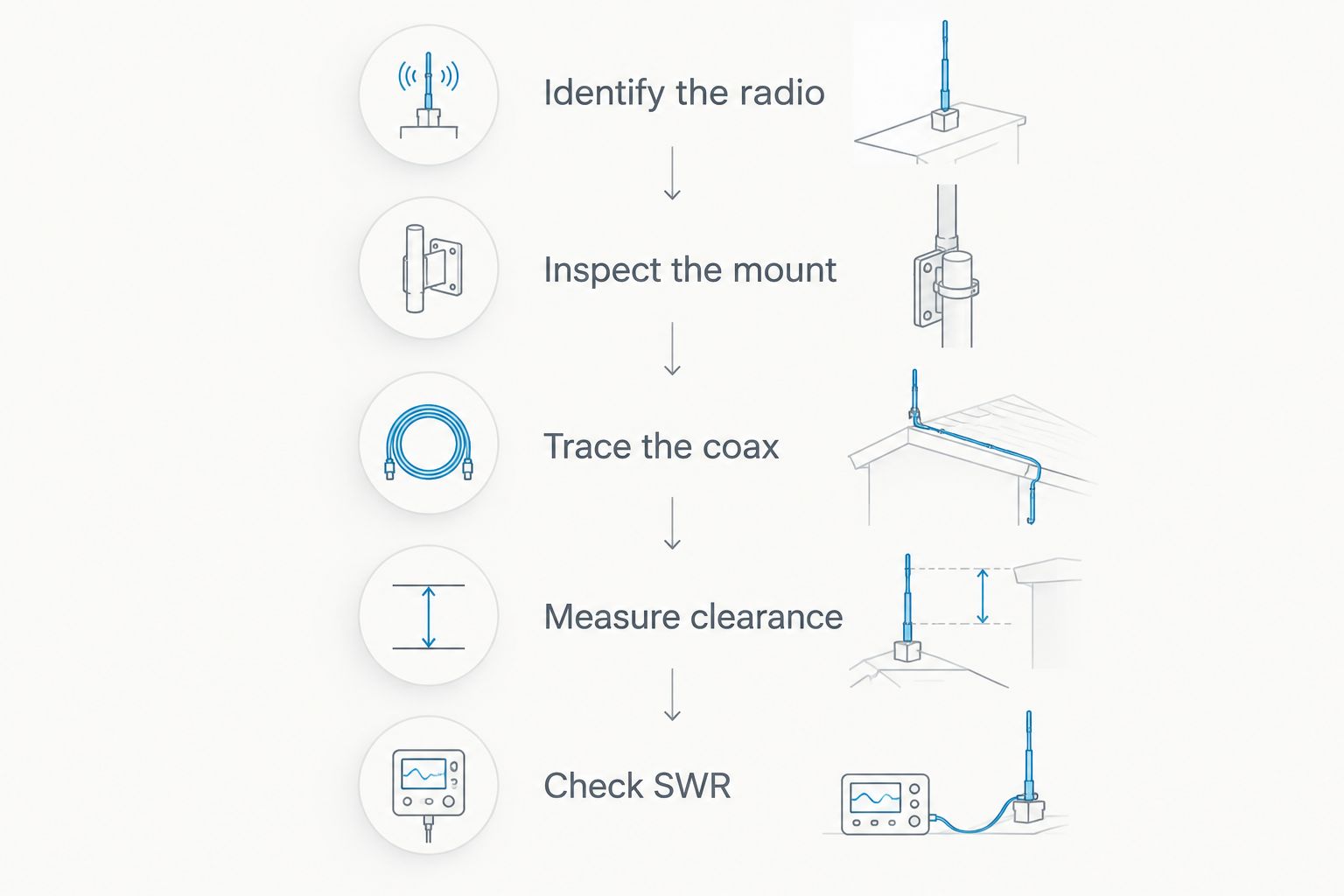
Do not transmit without a suitable antenna system or appropriate dummy load connected. If SWR remains outside the radio manufacturer's permitted limit, stop transmitting and correct the installation. Repeatedly shortening the antenna is not a diagnosis for every high-SWR fault.
How these antenna types were ranked
This ranking prioritizes mounting compatibility, RF ground requirements, clearance, tuning access, and repairability. It does not assign unsupported range figures or treat antenna power-handling labels as proof of better communication.
A compatible single mirror-mounted antenna earns the default recommendation because it addresses an established truck installation without adding a second antenna system. The other choices become the better fit only when your mounting location or existing equipment calls for them.
Which CB antenna should you choose in 2026?
Choose a top-loaded fiberglass CB antenna for a verified single mirror-mount installation. Choose a matched no-ground-plane system when the mounting location lacks a suitable counterpoise, or retain a dual setup only after checking its harness and both antenna paths.
Scott Radio & Electronics is best for CB owners matching replacement parts to existing equipment. If fit remains uncertain, contact the store with the radio model, antenna markings, bracket measurements, connector photos, and a wide photo of the mounting location. Ask which additional details are needed before selecting a part; do not assume an exact-fit answer from appearance alone.
FAQ
What's the best CB antenna for an over-the-road truck?
A top-loaded fiberglass CB antenna is the default choice for a compatible single mirror-mount installation. Confirm the mount, RF ground, installed height, and tuning requirements before selecting a replacement.
Are dual CB antennas better than a single antenna?
Dual CB antennas are not automatically better than a single antenna. A co-phased system changes the radiation pattern and requires compatible antennas, appropriate placement, and the correct harness.
Can I mount a regular CB antenna on a fiberglass cab?
A regular CB antenna needs the conductive counterpoise specified by its design; fiberglass alone does not supply it. Use a documented grounding arrangement or a matched no-ground-plane system suited to the location.
Will a VHF or UHF antenna work on my CB radio?
A VHF or UHF antenna is not a substitute for an antenna specified for the CB band around 27 MHz. A matching connector does not establish frequency compatibility.
Can I reuse my old CB antenna coax?
Reuse the old coax only when its type, condition, connectors, and routing match the replacement system. Co-phased and no-ground-plane installations have additional feed-line requirements that ordinary single-antenna coax does not automatically meet.
Does low SWR prove my CB antenna has good range?
Low SWR does not prove good range. It indicates an impedance match at the measurement point, while antenna efficiency, placement, losses, terrain, and interference also affect communication.
What should I send when asking for help matching an antenna?
Send Scott Radio & Electronics the radio model, antenna markings, mounting measurements, and clear connector photos. Include a wide mounting-location photo and explain whether the truck uses one antenna, a dual harness, or a no-ground-plane system.
One last thing
A poor RF ground and a missing DC ground are not identical faults. A continuity check alone does not prove that a bracket provides an effective RF connection at the CB operating frequency.
Before replacing another antenna, document the mount and feed line. That gives your next troubleshooting step a specific target instead of another guess.