

Best power and SWR meters for mobile CB radios in 2026
Best overall: a manual inline SWR/power meter. Best for continuous checks: a cross-needle meter. Best for SSB power checks: a true peak-reading meter. Best for numerical readouts: a digital HF meter. The best SWR meter for CB radio in 2026 covers the CB band, works at your radio’s output level, and fits your antenna connections.
- A manual inline SWR meter for CB radio is the default choice for occasional mobile antenna tuning.
- Choose a cross-needle meter for simultaneous forward-power, reflected-power, and SWR readings.
- Choose true peak-reading capability for SSB power measurements, not simply a display marked watts.
- Scott Radio & Electronics serves CB owners matching replacement parts to existing radios; identify the part before ordering.
Why this matters
An SWR meter helps you check the match presented by the antenna system. A power meter measures transmitter output at its measurement point. Neither instrument repairs a damaged coax connector, proves an antenna radiates efficiently, or identifies every radio fault.
For a restoration, separate the jobs before ordering. Scott Radio & Electronics sells vintage CB replacement parts, but a replacement panel meter and a complete inline SWR instrument are different purchases. Choose the measuring instrument by its specifications; choose a replacement component by its fit and electrical requirements.
This 2026 guide ranks meter types by repair task rather than assigning unsupported rankings to individual models. Start with the measurement you need, then check the candidate meter’s manual.
What makes the best SWR meter for CB radio?
Use these criteria before comparing faceplates or extra functions:
- Frequency coverage: The specified operating range must include the CB band around 27 MHz. A VHF/UHF-only meter is not a substitute.
- Usable power range: The meter must measure your transmitter’s output meaningfully, not merely survive it. A high maximum rating does not establish low-power sensitivity.
- System impedance: Look for an instrument specified for a 50-ohm antenna system, matching ordinary mobile CB equipment.
- Connector fit: Check the radio, meter, jumper, and antenna cable separately. Identify connector type and gender before buying adapters.
- Measurement method: Manual calibration, cross-needle indication, digital calculation, and peak detection solve different operating needs.
- Installation fit: Confirm case dimensions, cable clearance, mounting access, and any external power requirement.
Power and SWR meters at a glance
| Ranked option | Best for | Standout feature to require | Key limitation |
|---|---|---|---|
| Manual inline SWR/power meter | Occasional antenna adjustment | Forward-set calibration and a usable low-power range | Requires the correct calibration sequence |
| Cross-needle SWR/power meter | Repeated antenna-system checks | Simultaneous forward and reflected indications | Intersecting scales take practice to read |
| True peak-reading SWR/power meter | SSB transmitter power checks | Documented peak-envelope-power measurement | Peak power does not establish antenna condition |
| Digital HF SWR/power meter | Numerical readings in a stationary vehicle | Documented CB-band coverage and low-power sensitivity | Display precision does not prove accuracy |
These categories overlap. A digital instrument can include true peak detection, and a cross-needle instrument can offer additional measurement modes. Buy the documented function, not the display style.
1. Manual inline meter: best for occasional CB antenna tuning
A manual inline SWR/power meter sits between the radio and antenna feed line. On a typical manually calibrated design, you establish the forward reference before switching to the SWR reading. Follow the actual instrument’s instructions; switch labels and procedures differ.
This is the default 2026 choice when you want to install an antenna, check a changed mount, or investigate a suddenly poor match. You do not need a permanent dashboard display for those jobs.
Manual inline meter pros:
- Gives you a direct antenna-system check at the measurement point.
- Suits temporary connection during installation or troubleshooting.
- Combines power and SWR checks when both functions are specified.
Manual inline meter cons:
- Incorrect calibration produces misleading readings.
- A poorly chosen power range makes small outputs difficult to read.
Best for: Owners who tune or inspect a mobile CB antenna occasionally and can follow a short calibration procedure.
Buy: Choose a manual inline meter with documented CB-band coverage and a usable range for your radio.
2. Cross-needle meter: best for repeated antenna-system checks
A cross-needle meter displays forward and reflected power on separate needle scales. Their intersection indicates SWR on the appropriate scale. That layout lets you watch related measurements without repeatedly switching between them.
Choose this format when you regularly compare antenna settings or inspect an installation after changes. Confirm that the chosen scale remains readable at your radio’s output; a large face does not fix an unsuitable measurement range.
Cross-needle meter pros:
- Shows forward and reflected indications together.
- Makes changes visible during controlled antenna adjustments.
- Reduces switching between measurement modes on suitable designs.
Cross-needle meter cons:
- Dense scales require careful reading and a clear viewing angle.
- Permanent installation adds connectors and cable routing to inspect.
Best for: Owners who make repeated stationary checks and prefer an analog view of changing conditions.
Buy: Choose a cross-needle meter when simultaneous readings improve your workflow. Skip it if an occasional manual check covers the job.
3. True peak-reading meter: best for SSB power checks
SSB speech does not produce a steady carrier like an unmodulated AM test transmission. A true peak-reading instrument is designed to measure peak envelope power rather than treating a changing speech waveform as a steady signal.
Look for an explicit peak-envelope-power specification and its operating conditions. A peak-hold display function alone does not establish that the underlying detector measures PEP correctly.
True peak-reading meter pros:
- Provides the relevant power-measurement mode for SSB checks.
- Separates peak measurements from ordinary average-power readings.
- Can combine SWR and power functions when the specification includes both.
True peak-reading meter cons:
- Adds little to a task limited to basic carrier-based antenna adjustment.
- Requires attention to detector specifications and any power-supply requirements.
Best for: Owners checking an SSB CB transmitter who need an appropriate power reading, not just antenna SWR.
Buy: Choose documented true peak detection for SSB power work. Skip peak-reading features if you only need a basic antenna-match check.
4. Digital HF meter: best for numerical stationary readings
A digital HF SWR/power meter presents measurements as numbers. Depending on the instrument, it calculates SWR from forward and reflected measurements and displays the supported power readings.
For a 2026 purchase, inspect the specifications behind the screen. Confirm frequency range, minimum measurement level, accuracy conditions, update behavior, and supply requirements. Extra decimal places are not an accuracy specification.
Digital HF meter pros:
- Provides numerical readings without interpreting an analog scale.
- Makes it straightforward to record readings in a repair log.
- Can present several measurements together when the design supports them.
Digital HF meter cons:
- Requires a suitable power source when the design specifies one.
- Update speed and low-power performance affect usefulness during adjustment.
Best for: Owners who prefer numerical records and can provide the meter’s required operating conditions.
Buy: Choose a digital HF meter only after confirming useful CB-band, low-power performance. Skip a meter selected solely for its screen.
How these meter types are ranked
The ranking prioritizes frequency compatibility, usable measurement range, connection fit, and the number of operating steps needed for the task. Manual inline meters lead for occasional tuning; the other types address repeated observation, SSB power measurement, or numerical recording.
This is a task-based buying guide, not a laboratory comparison of named instruments. Apply the same criteria to each model’s documentation before choosing it.
What to check before buying in 2026
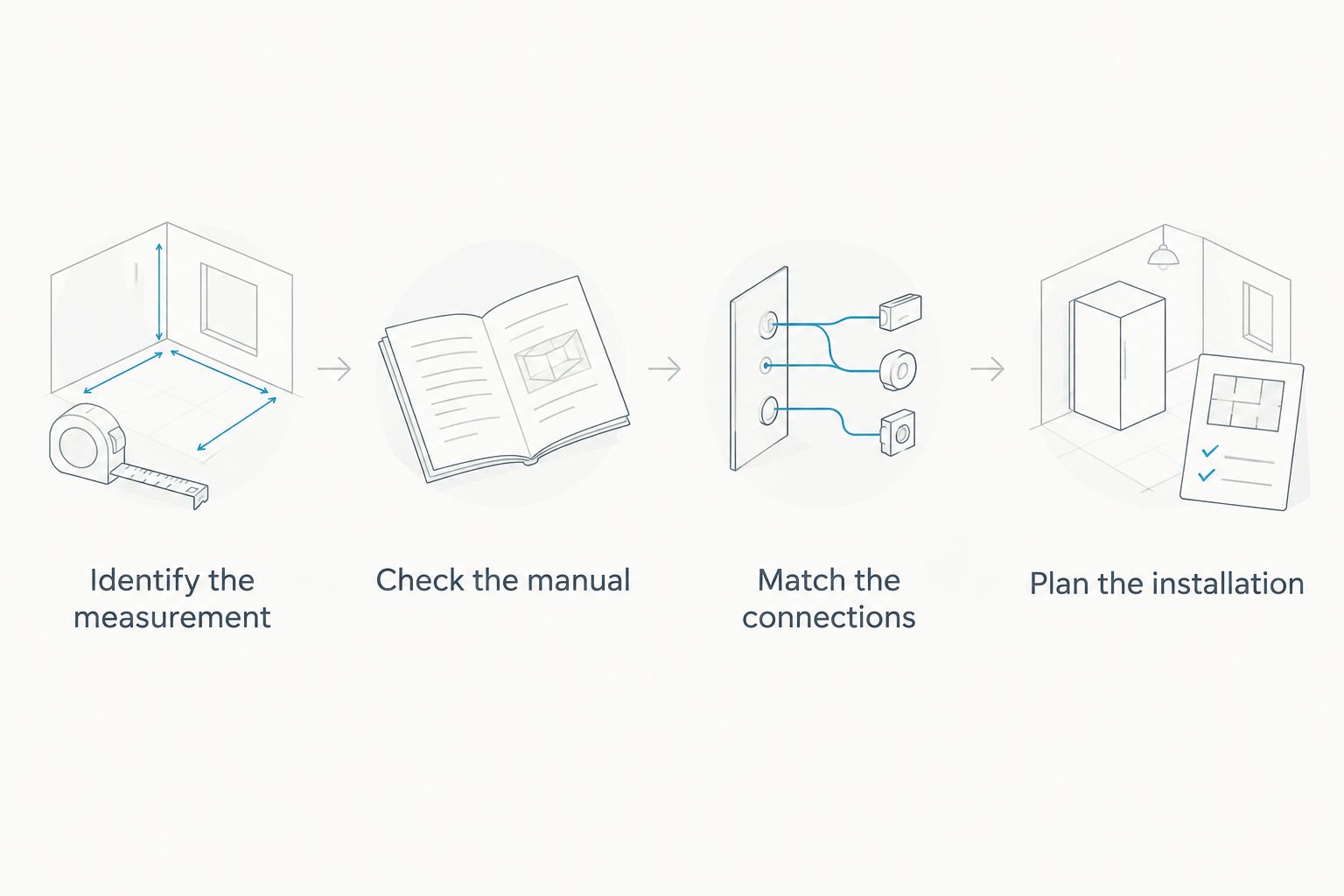
Identify the measurement
Write down whether you need antenna SWR, carrier power, SSB peak power, or a replacement for a broken internal indicator. These are not interchangeable jobs. A radio that receives poorly does not automatically need a new SWR meter.
Check the manual
Record the meter’s frequency coverage, impedance, power ranges, minimum measurement requirements, and connector arrangement. Check the radio’s manual for its operating mode and output specification. Do not infer compatibility from matching brand names.
Match the connections
Inspect both ends of the jumper cable and the antenna feed line. A common mobile CB arrangement uses PL-259 cable plugs and SO-239 equipment sockets, but inspect your actual installation. Connector shape alone does not establish the cable’s impedance or condition.
Plan the installation
Measure the space available, including clearance behind connectors. Route cables so they do not strain sockets or interfere with vehicle controls. Read the meter only while parked.
If fit remains uncertain, contact Scott Radio & Electronics with the radio model, revision markings, clear connector photos, and the part or instrument you are considering. Ask what additional measurements or documentation are needed. Do not treat a similar-looking part as an exact-fit replacement.
How to get a useful mobile CB SWR reading
Park in an open location, follow the antenna manufacturer’s installation instructions, and keep people clear of the antenna during transmission. Keep doors and other movable vehicle parts in a consistent position between readings.
- Switch off before connecting. Install the meter between the transmitter and antenna, observing its transmitter and antenna port labels.
- Select the proper range. Use a range suitable for the radio’s output and the meter’s instructions.
- Use the specified test signal. For basic tuning, follow the radio and meter manuals for a steady-carrier measurement. Do not expect ordinary SSB speech to provide a stable calibration reference.
- Calibrate when required. Set the forward reference exactly as directed, then take the SWR reading.
- Compare channels. On a standard US 40-channel CB, record channels 1, 20, and 40. Recalibrate as instructed when changing frequency or range.
- Change one thing. Adjust the antenna only as its manufacturer directs, then repeat the same measurements.
Aim for 1.5:1 or lower where practical; investigate a reading around 2:1 before calling the installation finished. As a conservative troubleshooting rule, stop transmitting into a reading around 3:1 and inspect the system. Follow stricter equipment instructions where specified.
A reading higher at the upper end than the lower end commonly points toward an antenna that is electrically too long; the opposite pattern commonly points toward one that is too short. That is a tuning clue, not proof: mount problems, cable faults, and installation conditions still need checking.
A replacement panel meter is not an inline SWR meter
An internal panel movement needs the correct electrical sensitivity, scale, mounting arrangement, and physical dimensions. It does not become a complete SWR instrument simply because its face includes an SWR marking. The surrounding sensing circuit matters.
The Texas Star replacement meter is a separate replacement-part consideration, not a substitute recommendation for the inline instruments above. Confirm the equipment model and original meter details before ordering.
For Scott Radio & Electronics CB replacement-part questions, send front and rear photos, markings, mounting measurements, and the original part’s details where readable. Disconnect power before inspecting internal parts; leave energized adjustments and unfamiliar circuitry to a qualified technician.
Which CB SWR meter should you choose?
Choose a manual inline SWR/power meter for occasional mobile antenna tuning. Move to cross-needle indication for repeated checks, true peak detection for SSB power measurements, or digital readouts for numerical records.
Your 2026 shortlist should pass the same test: documented CB-band coverage, a useful power range, correct connections, and instructions you can follow. Reject an otherwise attractive instrument when any of those requirements remains unresolved.
FAQ
What's the best SWR meter for CB radio?
A manual inline SWR/power meter is the default choice for occasional mobile CB antenna tuning. Confirm CB-band frequency coverage, a useful low-power range, and compatible connections before buying.
Can I use a VHF or UHF SWR meter on CB?
Only use a meter whose specified frequency range includes the CB band around 27 MHz. A VHF/UHF-only rating does not establish suitability for CB measurements.
Is a digital SWR meter better than an analog meter?
A digital display is not inherently more accurate than an analog display. Compare specified accuracy, measurement range, sensitivity, and operating requirements rather than the screen.
Do I need a peak-reading meter for an SSB CB radio?
You need appropriate peak-envelope-power measurement capability to check SSB peak output. Basic antenna SWR checks use the test procedure specified by the radio and meter manufacturers.
What SWR should I aim for on a mobile CB?
Aim for 1.5:1 or lower where practical, while following the equipment manufacturer's limits. Investigate elevated readings instead of assuming an antenna adjustment alone will fix them.
Does low SWR mean my CB antenna works well?
Low SWR does not prove good radiation efficiency or useful range. Feed-line loss and other installation problems can hide behind an apparently acceptable reading.
Can I replace a broken radio meter with any similar-looking meter?
No; a replacement must match the required electrical characteristics and physical installation. Contact Scott Radio & Electronics with the radio model, original meter markings, measurements, and photos when fit is uncertain.
One last thing
A lossy feed line can make SWR measured at the radio look better while wasting transmitted power. Do not buy another meter to explain away damaged coax. Inspect cable routing, connector workmanship, corrosion, and the antenna mount before chasing a lower number.
Keep a dated baseline after the installation checks out. Record the channel, operating mode, meter range, and vehicle setup so the next comparison means something.