

Best 2-way radios for construction crews in 2026
Best overall: licensed UHF business radios. Best for small crews working close together: FRS handhelds. Best for an existing CB-equipped vehicle fleet: CB mobile radios. For construction crews choosing 2 way radios in 2026, the right radio service, lawful programming, and jobsite coverage matter more than an advertised range claim.
- Choose licensed UHF business radios for a managed construction crew, subject to a jobsite coverage check.
- Choose FRS handhelds for simple, close-range coordination without individual FCC licenses.
- Keep CB mobile radios when your existing vehicle fleet already uses CB.
- Scott Radio & Electronics is best for DIY radio owners matching replacement parts to existing equipment.
Why this matters
A radio that works across an open parking lot can fail between a basement and a site office. Concrete, steel, terrain, antenna placement, and background noise all affect whether your message gets through.
Choose the communication system before choosing the handset. Matching channel numbers does not establish compatibility, and a programmable radio is not automatically authorized for your crew's use.
Scott Radio & Electronics sells vintage CB replacement parts and general electronics. For an existing CB installation, start by identifying the radio and failed component; for a new construction crew system, start with licensing, coverage, and shared operating requirements.
What makes the best construction crew radios?
Use these criteria to choose 2 way radios in 2026. Reject a candidate that fails a required check, even when its other specifications look attractive.
- Lawful operation: Confirm the radio's FCC authorization, permitted service, frequencies, power settings, and licensing requirements.
- Jobsite coverage: Check communication at the actual work locations, including stairs, basements, trailers, and vehicle cabs.
- Usable audio: Try the speaker and microphone with machinery operating and workers wearing their normal protective equipment.
- Physical suitability: Verify documented dust, water, impact, and hazardous-location ratings where your work requires them.
- Parts and power: Identify the exact battery, charger, accessory connector, and replacement components before standardizing.
- Fleet compatibility: Match frequency, analog or digital mode, channel bandwidth, signaling, and any repeater requirements.
Construction radios at a glance
These are ranked system choices, not interchangeable radio models. Select the service first, then compare equipment approved for that service.
| Rank and option | Best for | Standout benefit | Key limitation |
|---|---|---|---|
| 1. Licensed UHF business radios | A managed construction crew | A business radio system configured for authorized operations | Requires licensing and correct system planning |
| 2. FRS handhelds | Small crews working close together | Simple operation without individual FCC licenses | Shared channels and restricted equipment options |
| 3. CB mobile radios | An existing CB-equipped vehicle fleet | Keeps communication on the fleet's established radio service | Vehicle installation and antennas need attention |
For a new company-wide system in 2026, start with licensed business radios rather than building around unrelated consumer handhelds. FRS and CB earn their places when their limitations match the work.
1. Licensed UHF business radios: best for managed construction crews
Licensed UHF business radios are the default choice for a contractor establishing a managed crew communication system. The FCC's Part 90 rules govern relevant private land mobile operations; the license and equipment must match the intended use.
Do not treat “UHF” as a promise of building penetration. Walk the site with the proposed equipment, and involve a qualified radio provider when coverage requires repeaters or additional infrastructure.
Licensed UHF business radio pros
- Supports a planned channel arrangement for authorized business operations.
- Lets you specify a common radio model, accessory connection, and charging arrangement.
- Provides a path to a professionally planned repeater system when required and authorized.
Licensed UHF business radio cons
- Licensing and programming require attention before deployment.
- Radios using different digital protocols are not automatically compatible.
- A handheld-only system still needs a coverage check at difficult locations.
Best for: Contractors managing communication across multiple workers, work areas, or projects.
Before choosing a model, write down who must talk to whom. A concrete crew, site supervisor, delivery coordinator, and subcontractor do not necessarily need identical access to every conversation.
Ask the provider to document the channel plan and programming requirements. Keep that record with the fleet so a replacement radio can be configured correctly instead of copied from an unknown handset.
Verdict: Buy an approved business radio system after confirming licensing and jobsite coverage.
2. FRS handhelds: best for small, close-working crews
FRS handhelds suit straightforward coordination when workers stay within demonstrated radio coverage. The FCC permits license-by-rule FRS operation, so individual users do not apply for an FRS license.
FRS has 22 channels. Its maximum permitted transmitter power is 2 watts on some channels and 0.5 watts on others; buying an unrelated high-power programmable radio does not turn it into an FRS handset.
FRS handheld pros
- No individual FCC license application for lawful FRS operation.
- Straightforward handheld format for workers moving around a small site.
- Useful for simple communication without planning a repeater system.
FRS handheld cons
- Channels are shared with other users.
- FRS equipment uses integral antennas and does not support FRS repeater operation.
- Coverage still depends on the site, not the channel count printed on the box.
Best for: A small crew whose working positions remain within a verified direct-radio coverage area.
For a 2026 purchase, choose actual FRS-authorized equipment rather than assuming any retail “walkie-talkie” qualifies. Check whether the supplied charger, belt clip, and battery arrangement suit how workers carry and store the radios.
Privacy codes do not make a conversation private. They filter what a receiver opens its speaker for; another radio on the same frequency can still receive the transmission.
Verdict: Buy FRS handhelds for simple close-range work only after a site check.
3. CB mobile radios: best for an existing CB-equipped vehicle fleet
CB mobile radios make sense when trucks or other vehicles already communicate on CB. Keeping those vehicles on the same service avoids buying handhelds that cannot communicate with the installed radios.
CB is not a substitute for a compatible handheld system just because both products are called two-way radios. The antenna installation, power connection, microphone, and operating mode all deserve attention.
CB mobile radio pros
- Maintains communication with an existing CB-equipped fleet.
- Uses the vehicle installation instead of relying on handheld batteries.
- Gives repair-minded owners identifiable components to inspect and replace.
CB mobile radio cons
- Antenna mounting and cable condition affect operation.
- CB channels are shared with other users.
- A vehicle radio does not provide a carry-around solution for every worker.
Best for: Construction vehicles that already depend on CB for local coordination.
Scott Radio & Electronics' CB replacement parts are relevant when an existing radio needs a matching knob, meter, board, or speaker. Identify the exact radio and component before choosing a replacement; a similar-looking part is not evidence of fit.
Inspect the microphone wiring and connector before substituting an accessory. Matching the number of pins alone does not establish matching electrical connections.
Verdict: Hold a working CB fleet; buy replacement equipment only after confirming the installation and compatibility.
What the listed radios establish—and what to check next
A specification is useful only when it answers your crew's requirements. These catalog examples show why service approval comes before transmitter power or channel capacity.
| Listed radio | What the listing establishes | What you must verify | Construction decision |
|---|---|---|---|
| Baofeng BF-888S | 16 channels; listing describes reception across 400–470 MHz | Exact unit's FCC authorization, permitted transmit settings, and applicable license | Hold until compliance and compatibility are confirmed |
| High Grade GMRS mobile radio | Listed as 50 watts with 256 channels | Exact equipment authorization and whether every intended operator is covered by lawful GMRS operation | Skip as the default employer-wide crew system |
| QYT KT-WP12 listing | Described as a 25-watt dual-band amateur mobile radio with 200 channels | Exact equipment identity and lawful operating service | Skip for routine employer business traffic on amateur frequencies |
The BF-888S listing's frequency range is not permission to transmit throughout that range. Nor do 16 channels establish that those channels match your existing radios.
GMRS licensing also needs care. Under FCC rules, an individual GMRS license extends to specified family members, not an unrelated workforce simply because an employer owns the radios.
Amateur radio is not the workaround. FCC Part 97 restricts communications involving an operator's pecuniary interest, including communications on behalf of an employer, subject to specific exceptions. Do not build routine construction dispatch around amateur frequencies.
In 2026, treat the equipment's FCC identification and service authorization as buying checks, not paperwork to sort out after deployment.
Check fit before issuing radios
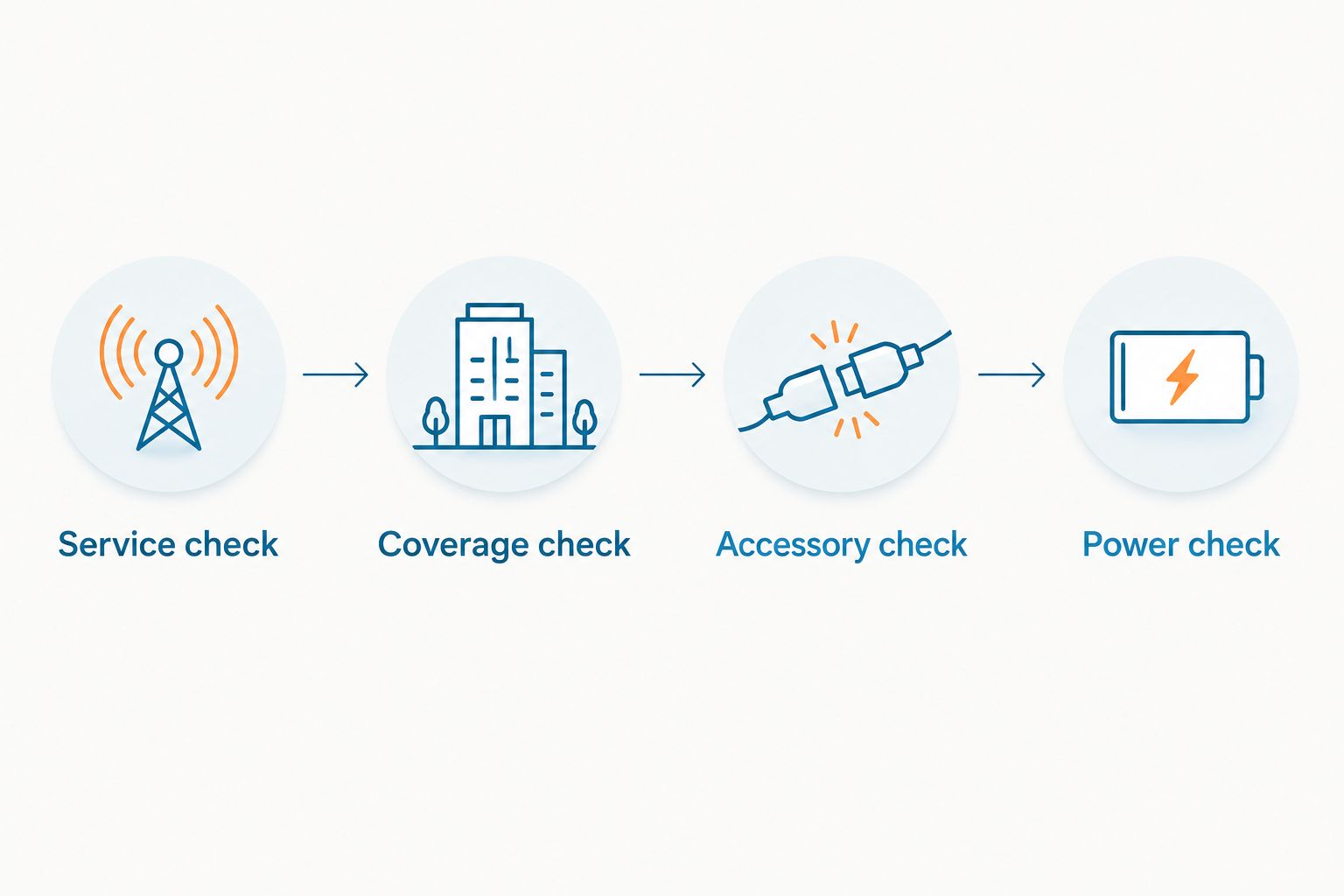
Run the checks below in order. A radio can pass the legal check and still fail the coverage or accessory check.
Service check
Identify the intended FCC radio service and the authorization that covers your operation. Record the exact model and FCC ID from the actual unit, not just a marketplace title.
Coverage check
Try communication from the locations workers actually occupy. Include stairwells, enclosed rooms, loading areas, and vehicle cabs with doors closed.
Accessory check
Match the connector, wiring requirements, and documented accessory compatibility. Test the microphone position and push-to-talk control while wearing normal work gear.
Power check
Confirm the specified battery or supply, charger, connector polarity, and electrical rating. For vehicle installations, follow the radio manufacturer's wiring and protection instructions.
Do not perform a coverage trial using unauthorized transmit settings. Use compliant equipment and authorized operation from the start, including any demonstration radios.
For a 2026 fleet refresh, keep a record for every radio model. Include its programming reference, battery identification, charger identification, and approved accessories so replacements do not become a guessing exercise.
When to ask for matching help
Contact Scott Radio & Electronics when you need help identifying a replacement part for an existing radio. Send the exact model details and clear photos before asking whether a part fits.
Include:
- The radio's model label and any visible revision information.
- An overall photo showing where the part belongs.
- Close-ups of connectors, mounting points, and printed markings.
- Measurements of the relevant shaft, opening, or mounting spacing.
- A plain description of the fault and any previous modifications.
Unplug the radio before taking accessible internal photos. If opening it requires work beyond your skills, stop and seek qualified help rather than disturbing wiring or adjustments.
Ask a qualified business-radio provider about licensing, frequency coordination, or coverage design. Parts matching and system authorization are different tasks.
How these choices were ranked
This ranking puts lawful operation and crew suitability first, followed by coverage, usable audio, physical suitability, and replacement-part matching. It is a system-selection guide, not a claim of hands-on testing or a measured range comparison.
Licensed business UHF takes the default position because it supports a managed business system. FRS serves simple direct communication; CB serves existing CB-equipped vehicles. None replaces an actual site check.
Which construction radios should you choose?
Choose licensed business UHF radios for a new managed construction crew system. Choose FRS when the job is simple and verified coverage is sufficient, or retain CB when your vehicles already depend on it.
Do not choose by wattage alone. A compatible, authorized radio that works where your crew stands is the useful purchase.
FAQ
What are the best 2 way radios for construction crews?
Licensed UHF business radios are the default starting point for a managed construction crew. Confirm the license, equipment authorization, programming, and jobsite coverage before choosing a model.
Do construction workers need a license to use walkie-talkies?
The licensing requirement depends on the radio service, not the walkie-talkie label. Lawful FRS operation does not require an individual license application; relevant business-radio operations require the appropriate authorization.
Can an entire construction crew use one GMRS license?
One individual's GMRS license does not cover an unrelated workforce. The FCC extends an individual license to specified family members, so do not treat GMRS as an automatic employer-wide licensing solution.
Is the Baofeng BF-888S ready to use on a construction site?
Do not assume a Baofeng BF-888S is ready for your crew's operation. Verify the exact unit's equipment authorization, programmed transmit settings, applicable license, and compatibility before transmitting.
Will radios communicate if their channel numbers match?
Matching channel numbers alone does not establish compatibility. The radios must use compatible frequencies, modes, bandwidth settings, and signaling, with any required system settings also matched.
Do privacy codes keep construction radio conversations private?
No, privacy codes do not encrypt the conversation. They control which signals open the receiver's speaker, while other compatible receivers can still hear the transmission.
What should I send when asking for a replacement radio part?
Send the exact radio model, revision information, clear part photos, markings, and relevant measurements. Scott Radio & Electronics can receive those details with your matching question; do not assume fit from appearance alone.
One last thing
Label channels by purpose after programming, not as a substitute for programming. A label such as delivery coordination helps workers choose the intended conversation, but only a verified channel plan establishes what the radio actually transmits.
Keep that plan with your equipment records. The next replacement handset should match a documented system, not an unexplained setting on an old radio.