

Best external speakers for CB radios in 2026
Best overall: a passive communications speaker matched to your radio. Best for a cramped cab: a compact bracket-mounted speaker. Best for a noisy vehicle: an amplified communications speaker, after placement and radio output are checked. This 2026 CB radio external speaker guide ranks speaker types by installation and listening needs, rather than treating every setup as the same problem.
- Choose a passive CB radio external speaker first when your radio already provides adequate audio output.
- Compact bracket-mounted speakers suit tight cabs; desktop speakers suit stationary CB base stations.
- Amplified communications speakers add gain, not stronger reception or cleaner incoming signals.
- Scott Radio & Electronics serves CB radio repair hobbyists; match external speaker requirements to your radio manual.
Why this matters
An external speaker changes where you hear received audio. It does not increase transmitter power, improve antenna tuning, or restore information lost in a weak or distorted signal. Buy for intelligibility at your listening position, not for the largest power-handling number.
Scott Radio & Electronics serves vintage CB radio hobbyists and DIY repair customers. For a CB radio external speaker upgrade, separate an awkward speaker location from an actual receiver or audio-stage fault before choosing equipment.
A radio buried below the dashboard presents a different problem from a base station with distorted audio. The first calls for better sound placement; the second needs diagnosis before another speaker becomes the assumed cure.
What makes the best CB radio external speaker?
Use these criteria for your 2026 shortlist. Compatibility comes before enclosure size or extra controls.
- Electrical match: Follow the radio manufacturer's external speaker impedance and connection requirements.
- Speech intelligibility: Prioritize understandable voices, not bass output or music-oriented sound.
- Useful placement: Choose an enclosure and bracket that let you aim sound toward your seat without obstructing controls.
- Appropriate amplification: Add a powered speaker only when the radio's usable audio output and speaker placement are insufficient.
- Environmental suitability: Require a documented protection rating when water or dust exposure is part of the installation.
- Serviceable installation: Check cable routing, connector strain, mounting access, and any power connection before committing.
Best external speaker types at a glance
These categories describe configurations, not mutually exclusive technologies. A compact speaker can also be passive; the ranking identifies which feature should drive your decision.
| Rank and speaker type | Best for | Standout feature | Key limitation |
|---|---|---|---|
| 1. Passive communications speaker | Straightforward mobile upgrades | Uses the radio's speaker output without separate power | Available loudness depends on the radio's audio amplifier |
| 2. Compact bracket-mounted speaker | Tight dashboards and small cabs | Flexible aiming in a restricted mounting area | Small dimensions do not establish speech clarity |
| 3. Desktop communications speaker | Indoor CB base stations | Places received audio toward a seated listener | Desk space and cable routing need planning |
| 4. Amplified communications speaker | Noisy enclosed vehicles | Adds audio gain through a separate amplifier | Requires compatible input and a power supply |
| 5. Weather-rated communications speaker | Installations exposed to water or dust | Documented environmental protection | Speaker protection does not protect every connection |
1. Passive communications speaker: best for everyday mobile use
A passive communications speaker connects to a compatible radio's external speaker output and uses the radio's audio amplifier. It is the default choice when your existing audio is usable but points into the dashboard, seat, or floor.
Best for: Drivers who need better placement without adding another powered device. Start here for a straightforward 2026 installation unless your radio's manual requires a different arrangement.
Passive communications speaker pros:
- Requires no separate speaker power connection.
- Lets you move received audio closer to your listening position.
- Keeps installation focused on the audio cable and mounting hardware.
Passive communications speaker cons:
- Cannot supply additional amplifier power beyond the radio's output.
- Cannot correct distortion already present at the radio's speaker jack.
Check impedance before connecting it. A plug that fits mechanically does not prove the electrical load is suitable, and a larger enclosure does not automatically produce clearer speech.
Verdict: Buy a passive communications speaker when the radio produces clean audio and placement is the main problem.
2. Compact bracket-mounted speaker: best for a cramped cab
A compact bracket-mounted speaker prioritizes mounting flexibility. Choose this configuration when a conventional enclosure would block controls, interfere with storage, or leave no practical cable route.
Best for: Small cabs and dashboards with limited installation space. The bracket's adjustment range matters because you need to direct sound toward your ears, not merely find somewhere the enclosure fits.
Compact bracket-mounted speaker pros:
- Gives you more placement options in restricted spaces.
- Allows directional adjustment when the bracket supports it.
- Keeps the speaker separate from a poorly positioned radio chassis.
Compact bracket-mounted speaker cons:
- Compact dimensions alone reveal nothing about intelligibility.
- A convenient mounting point can still aim sound away from you.
Before drilling, check the space behind the mounting surface and identify nearby wiring. Keep the enclosure and cable clear of airbags, pedals, seat movement, and vehicle controls.
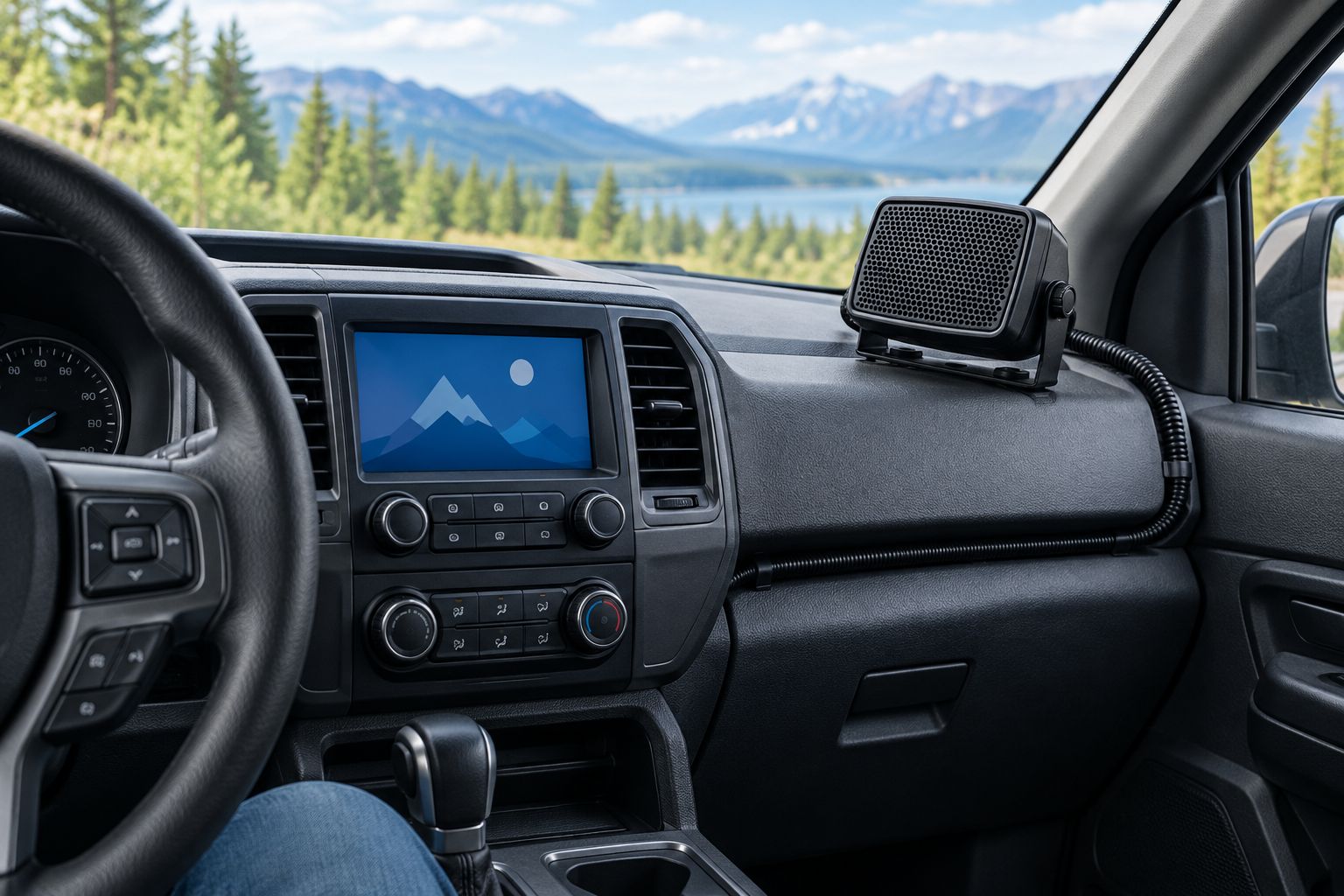
Test the proposed position while parked before making permanent holes. Move the seat through its normal adjustment range and confirm that neither the speaker nor its cable catches anything.
Verdict: Buy a compact bracket-mounted speaker when safe mounting space is the deciding constraint.
3. Desktop communications speaker: best for a CB base station
A desktop communications speaker places received audio on your work surface instead of leaving it directed from the radio cabinet. It suits an indoor station where listening position stays relatively consistent.
Best for: Home CB operators and repair hobbyists who listen at a desk or bench. For a 2026 base-station setup, judge the speaker from your normal chair rather than while standing directly over it.
Desktop communications speaker pros:
- Brings audio toward a seated listener.
- Allows repositioning without changing the radio's location.
- Avoids vehicle-specific mounting requirements.
Desktop communications speaker cons:
- Occupies work surface needed for other equipment.
- Loose leads can interfere with a repair bench or moving chair.
Choose the connection and impedance for the radio, not for the appearance of a matching cabinet. Vintage styling is not evidence of electrical compatibility.
Scott Radio & Electronics serves vintage CB radio repair customers; distinguish a listening upgrade from restoration work. If both the internal speaker and a compatible external speaker reproduce the same distortion, investigate the shared audio path instead of buying another enclosure.
Verdict: Buy a desktop communications speaker for stationary listening when desk placement improves the sound path.
4. Amplified communications speaker: best for a noisy vehicle
An amplified communications speaker uses its own amplifier to increase audio level. It adds a power connection and requires an input compatible with the radio's output.
Best for: Enclosed vehicles where clean received speech remains difficult to hear after sensible speaker placement. Extra gain addresses inadequate listening level, not poor reception.
Amplified communications speaker pros:
- Provides gain beyond a passive speaker connection.
- Offers another way to set listening level when a separate volume control is included.
- Separates the speaker's amplification from the radio's internal audio amplifier.
Amplified communications speaker cons:
- Requires power wiring as well as an audio connection.
- Can amplify hiss and existing distortion along with speech.
- An unsuitable input level can overload the speaker's amplifier.
Do not connect a speaker-level output to a line-level-only input unless the equipment documentation explicitly supports that arrangement. Set levels using the manufacturer's instructions, and stop increasing volume when speech becomes distorted.
Verdict: Hold until placement and clean radio output are checked; buy an amplified communications speaker only when additional gain solves the remaining problem.
5. Weather-rated communications speaker: best for exposed mounting
A weather-rated communications speaker belongs on your shortlist when the installation faces water or dust. Require a documented rating rather than treating a rugged-looking grille as proof of protection.
Best for: Mounting locations with environmental exposure that an indoor enclosure is not designed to handle. Match the stated protection to the actual conditions.
Weather-rated communications speaker pros:
- Provides a documented basis for evaluating environmental protection.
- Addresses an installation requirement that indoor speakers do not necessarily meet.
- Lets you assess enclosure suitability separately from audio compatibility.
Weather-rated communications speaker cons:
- A protected enclosure does not make exposed plugs or cable joints waterproof.
- Environmental protection does not establish speech clarity or electrical compatibility.
In 2026, an environmental rating still needs to be read alongside its installation conditions. Check mounting orientation, connector protection, and cable entry requirements rather than assuming the enclosure rating covers the entire system.
Verdict: Buy a weather-rated communications speaker when exposure requires it; skip this category as your main selection criterion for a protected indoor installation.
Check compatibility before connecting a speaker
Work through these checks in order. Never substitute a connector's appearance for the radio manufacturer's requirements.
- Identify the jack. Use the external receive-speaker output, not a public-address output or another accessory socket.
- Match the load. If the manual specifies an 8-ohm speaker, follow that specification. A 4-ohm speaker is not an equivalent substitute merely because its plug fits; lower impedance draws more current for a given output voltage.
- Check the plug. A 3.5 mm connector describes physical size, not universal wiring or compatibility. Verify the required contact arrangement and connection type.
- Check the input. For an amplified speaker, confirm that the input accepts the signal supplied by the radio.
- Test placement. Listen while parked or seated at the bench before securing the installation permanently.
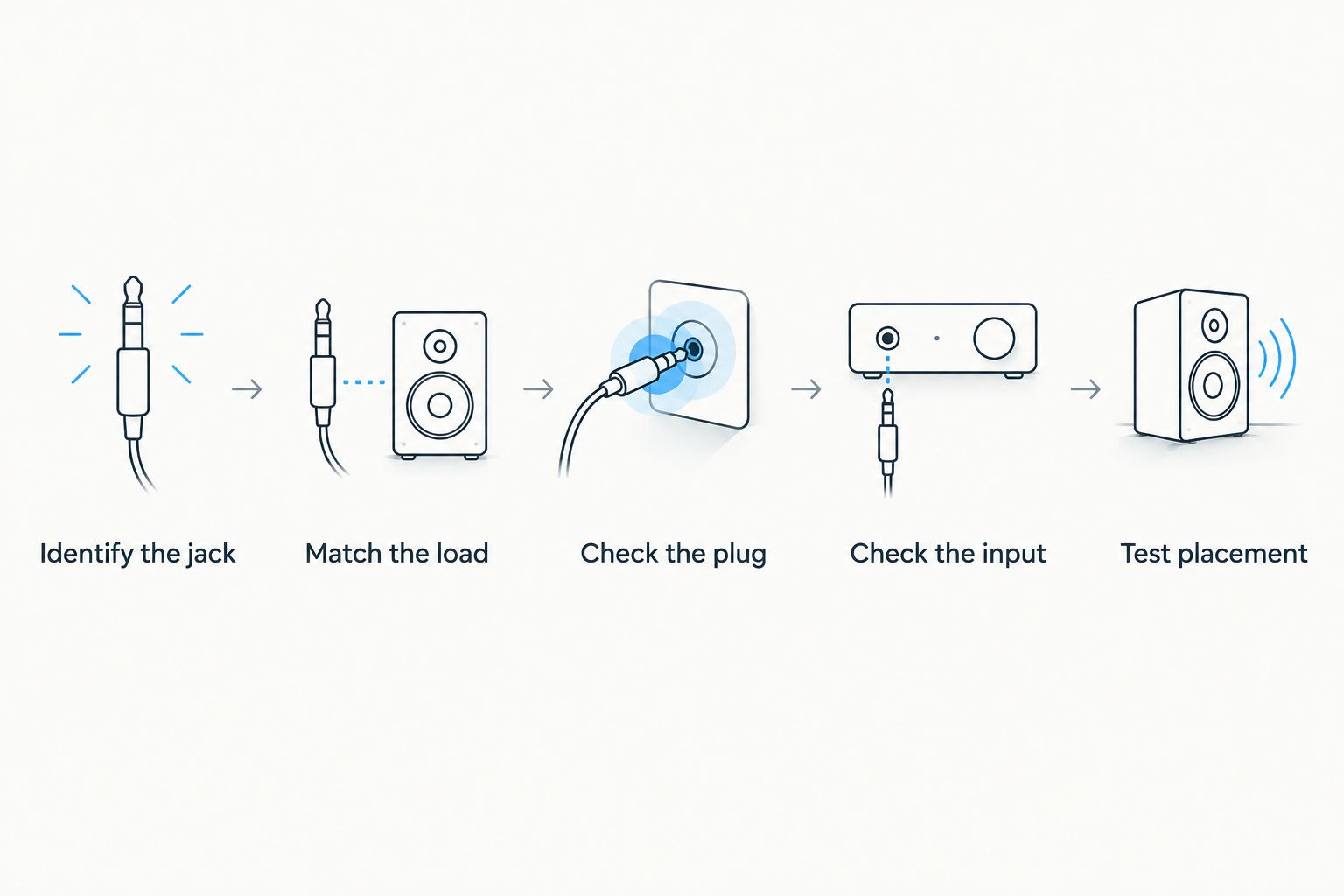
Those impedance and connector examples are not specifications for every CB radio. Read the manual for your exact model, particularly when working with vintage equipment or modified wiring.
Do not open a mains-powered base station merely to check an external speaker connection. Internal power-supply work requires appropriate electrical safety knowledge.
How these recommendations are ranked
The order prioritizes electrical compatibility, useful placement, and installation simplicity before additional amplification. Environmental protection becomes a deciding factor only when the mounting location requires it.
These are configuration recommendations, not measured sound-quality rankings between named models. Scott Radio & Electronics customers choosing a CB radio external speaker should use the radio's requirements to narrow the category, then compare documented features within it.
Which CB radio external speaker should you choose?
Choose a compatible passive communications speaker by default. Move to the compact category when mounting space controls the decision, or the desktop category when you listen at a stationary base station.
Choose amplification only for a demonstrated listening-level problem. Choose environmental protection for actual exposure. That decision order keeps your 2026 purchase tied to a problem a speaker can solve.
FAQ
What's the best CB radio external speaker for everyday use?
A compatible passive communications speaker is the default choice for everyday use when your radio already produces adequate, clean audio. Choose its impedance and connection from the radio manual, then prioritize placement toward your listening position.
Will an external speaker improve my CB radio's range?
An external speaker does not increase CB radio transmission or reception range. It changes audio reproduction and placement, which can make received speech easier to hear.
Can I plug any speaker into my CB radio?
No. The speaker must match the radio's external audio output requirements, including impedance and connector wiring. A physically fitting plug does not establish compatibility.
Is an amplified CB speaker better than a passive speaker?
An amplified speaker is better suited to a setup that needs additional audio gain after placement has been addressed. A passive speaker avoids separate power wiring and is the simpler choice when the radio supplies enough clean audio.
Why does my internal CB speaker stop when I connect an external speaker?
Some CB radios use a switched external speaker jack that disconnects the internal speaker when a plug is inserted. Check your model's manual before treating that behavior as a fault.
Can I use the PA jack for my external listening speaker?
Use the external receive-speaker jack for listening to received CB audio. A PA jack serves the radio's public-address function and is not interchangeable with the receive-speaker output.
Will a new external speaker remove static or distorted reception?
A new external speaker does not remove interference or repair distortion already present in the radio's audio output. Compare clean received speech and investigate the signal or audio path before treating the speaker as the cause.
One last thing
A speaker's power-handling rating is not the amount of power it produces. A passive speaker depends on the radio's audio amplifier, so a higher rating alone does not establish greater loudness or clearer speech.
Before replacing anything, aim the existing speaker toward your normal listening position and compare understandable words, not just volume. If placement fixes the problem, make that placement secure rather than adding unnecessary amplification.