
Vintage CB Radio Power Cable Buying Guide
Last Updated: November 26, 2026
Quick Summary
To buy a vintage CB radio power cable, match the connector type, pinout, polarity, and wire gauge to your exact radio model before ordering. Verify the pinout with a multimeter rather than trusting wire color, and size the wire and supply for the radio’s transmit current, not its receive draw.
- Vintage CB power connections fall into three families: two-prong connectors, three-pin connectors, and bare wire leads.
- Verify an unknown cable’s pinout with a multimeter before connecting, since a wrong pin assignment can destroy components.
- Size the supply and wire for the transmit current, then add headroom; a 3-amp supply may fold when you key the microphone.
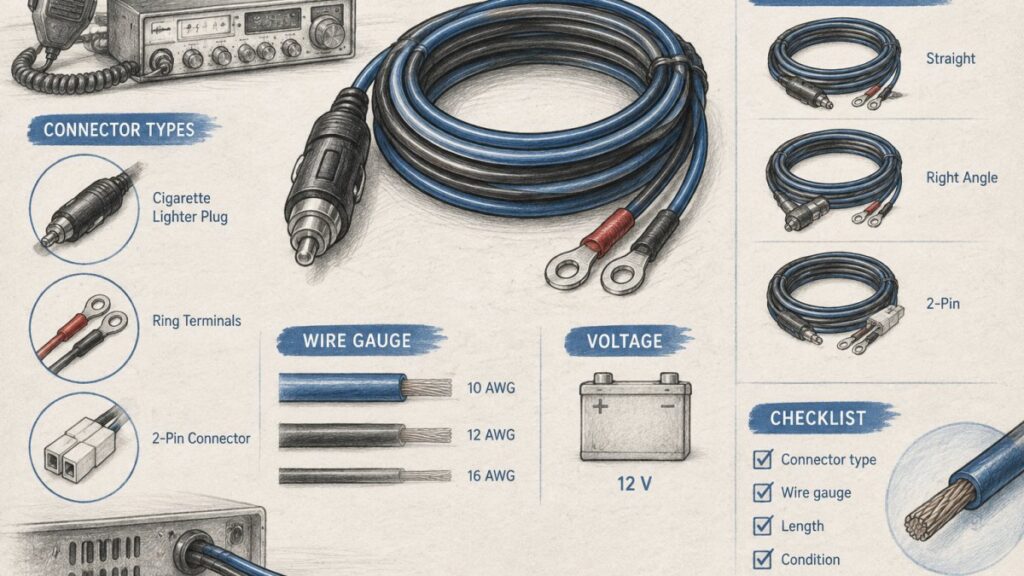
- As a working reference, 18-gauge suits low-draw mobile leads, 16-gauge most 40-channel mobiles, and 14- or 12-gauge long or higher-draw runs.
- Fit the fuse value the radio specifies, not a larger one, and confirm the holder makes solid contact.
Table of Contents
- Why the Right Vintage CB Radio Power Cable Matters
- CB Radio Power Cable Connector Types: Two-Pin, Three-Pin and Wire Leads
- Matching a Cable to Your Radio Model and Power Source
- CB Radio Power Cable Polarity: Identify the Wires Before You Connect
- CB Radio Power Wire Gauge and Supply Sizing
- 12V CB Radio Power Supply for Base Station Setups
- Inspecting, Restoring and Safely Replacing a Vintage Cord
- What to Check Before You Add a Vintage CB Power Cable to Cart
- Frequently Asked Questions
Why the Right Vintage CB Radio Power Cable Matters
The wrong power cable is the fastest way to turn a working vintage CB radio into a parts donor. A cable with the wrong pinout, the wrong gauge, or corroded contacts can starve a radio of current, overheat a connector, or reverse polarity and destroy components you cannot easily replace. A collector who buys a “close enough” cord online can plug it in and find the radio never powers up again. This vintage CB radio power cable buying guide exists to stop that from happening. Below, we break down connector types, polarity, wire gauge, and supply sizing so you buy the right cord the first time. But first, here is what most guides get wrong: they treat all power cords as interchangeable. They are not.
CB Radio Power Cable Connector Types: Two-Pin, Three-Pin and Wire Leads
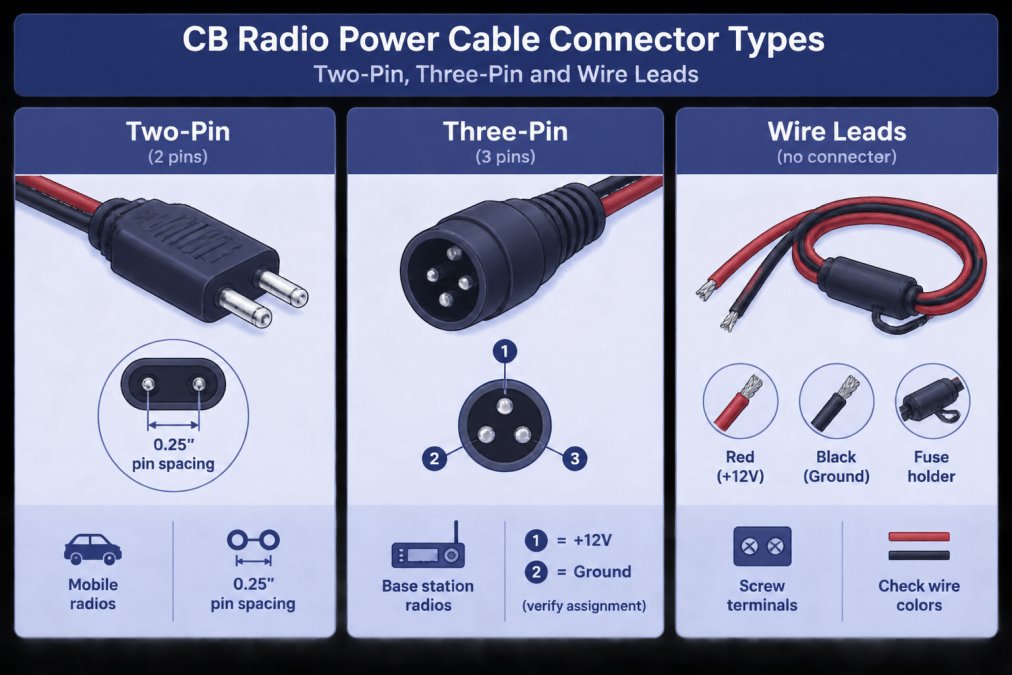
Vintage CB power connections fall into three families: two-prong connectors, three-pin connectors, and bare wire leads that land on screw terminals. Your radio’s rear panel or chassis determines which one you need, so inspect it before you shop. The connector must match physically and electrically. A connector that fits but carries the wrong pin assignment is worse than one that does not fit at all, because it invites you to plug it in.
Two-Prong and Three-Pin Connectors
Two-prong connectors show up mostly on mobile radios, where a compact polarized plug feeds 12-volt DC from the vehicle. Three-pin connectors appear more often on base station radios and on sets that switch between AC and DC. Count the pins, measure the spacing, and note the keyway or flat side that prevents reversed insertion. If the plug is polarized, that shape is doing safety work. Do not file it down to make it fit.
Bare Wire Leads and Screw Terminals
Many base station radios terminate power at screw terminals rather than a plug. Here you will see red, yellow, and black wire leads, sometimes with an inline fuse holder on the positive side. Red is conventionally positive and black is negative, but never trust convention alone on a radio that may have been rewired. Trace each lead to its terminal and confirm before you connect anything.
Matching a Cable to Your Radio Model and Power Source
Model-specific matching is the whole game. If your set has no readable label, work through how to identify a vintage radio model step by step before you order a single cord.
Sellers of used original parts often state what the donor radio was, and that statement is useful compatibility evidence. It is still not a guarantee.
Before you connect an unknown cable, verify the pinout with a multimeter rather than trusting wire color or connector shape. Set the meter to continuity, identify which pin or lead connects to the center conductor of the plug, and confirm which one carries positive and which carries negative.
Physical fit is the other half of matching. Measure pin spacing and the connector shell diameter against the listing photos, and check that the mounting holes and lead length reach your chassis without strain.
Watch out: a cable that tests correct on the bench can still fail in the radio if the connector shell is loose or a pin is recessed, so flex the cable and check pin height before you power up.
CB Radio Power Cable Polarity: Identify the Wires Before You Connect
Polarity mistakes kill vintage radios. Reversed DC power can take out the final transistors, the power supply section, or both, and replacement parts for a 1970s chassis are not always available. Before connecting, identify the wires with a multimeter rather than by color alone. Set the meter to continuity or DC volts, confirm which lead carries positive, and mark it. On a fused lead, the fuse belongs on the positive side.
If the radio has a polarity protection diode, a reversed connection may only blow the fuse. If it does not, you may not get a second chance. Test on a bench supply with current limiting if you have one, and watch for heat or smell during the first minute of power.
CB Radio Power Wire Gauge and Supply Sizing
Wire gauge and supply current must match what the radio actually draws, and the number that matters is the transmit current, not the receive current.
A common pattern among restorers is to treat every 12-volt supply as interchangeable. It is not. A supply rated at 3 amps may run a small mobile radio on receive and then fold or drop out the moment you key the microphone.
Wire gauge follows the same logic. Undersized wire causes voltage drop and heat, and voltage drop on transmit shows up as reduced output, drift, or a radio that cuts out.
Fusing deserves its own check. Fit the fuse value the radio specifies, not a larger one. A fuse that never blows is protecting nothing, and a fuse rated above the wire’s capacity can let the wire overheat before the fuse opens.
Watch out: a supply that is adequate on receive can still be marginal on transmit, so test with the radio keyed into a dummy load and watch the supply’s voltage reading rather than trusting the label alone.
Wire gauge should follow the radio’s transmit current and run length, and these are the working references the article gives.
| Wire gauge | Best for | Note |
|---|---|---|
| 18-gauge | Low-draw mobile leads | Common on low-draw mobile leads |
| 16-gauge | Most 40-channel mobiles | Suits most 40-channel mobiles |
| 14- or 12-gauge | Long runs or higher-draw sets | Safer choice for long runs |
12V CB Radio Power Supply for Base Station Setups
A base station needs a regulated 12-volt DC supply, not a wall adapter of unknown output. Regulated matters because unregulated supplies drift above their rated voltage at light load, and a vintage radio expects a steady feed. When you are setting up a base station, buy a supply rated above your radio’s transmit current, with clean output and a proper fuse on the DC side.
If you want a concrete option, our Lamda 0 32 Vdc power regulated supply working is a regulated unit suited to feeding a base station radio. Owners of Royce base stations who prefer a matched replacement may instead want a working modular power supply for the Royce 1 625 W power button base CB radio, which keeps the setup closer to original. Either way, confirm the supply’s output voltage and current rating against your radio before you buy.
Inspecting, Restoring and Safely Replacing a Vintage Cord
Inspect before you restore. Look for cracked insulation, stiff or brittle jacket, green corrosion on the pins, loose connector shells, and heat discoloration near the plug. A cord that has been sitting in a warehouse for decades may look fine and fail the moment it flexes. Flex the cable gently along its length and watch for the jacket splitting.
Where the original cord is sound, clean the pins with contact cleaner and a soft brush, then check continuity end to end. Where it is beyond repair, replace it with a part that matches the radio. Royce 624 owners facing a dead cord can fit an immaculate working power supply modular with cord for the Royce 1 624 base station CB. Restorers of a Dak Mark X with a failing transformer or cord can use a working main AC DC transformer heavy for the Dak Mark X base station CB radio instead of improvising a substitute.
What to Check Before You Add a Vintage CB Power Cable to Cart
Run this checklist before you buy, every time:
- Model number confirmed on the chassis plate, not guessed from a photo
- Connector type matched: two-prong, three-pin, or bare leads
- Pin count and spacing measured against the listing photos
- Wire colors and polarity verified, not assumed
- Fuse holder present and rated for the radio
- Lead length and mounting holes compared to your chassis
- Donor radio and tested-working status stated in the listing
- Return policy read before checkout
Watch out: listings that show a single blurry photo and no donor radio are the ones that cost collectors the most. Clear photos of the connector, the leads, and any markings are the minimum. If a listing cannot show you the pin side of the connector, skip it.
OEM versus aftermarket is the other decision. An original cord from a known donor radio matches the chassis exactly and keeps the restoration period-correct, which is why collectors pay more for it. Aftermarket cords are cheaper and easier to find new, but you must verify pinout and gauge yourself, and the connector shell may not match the original mounting.
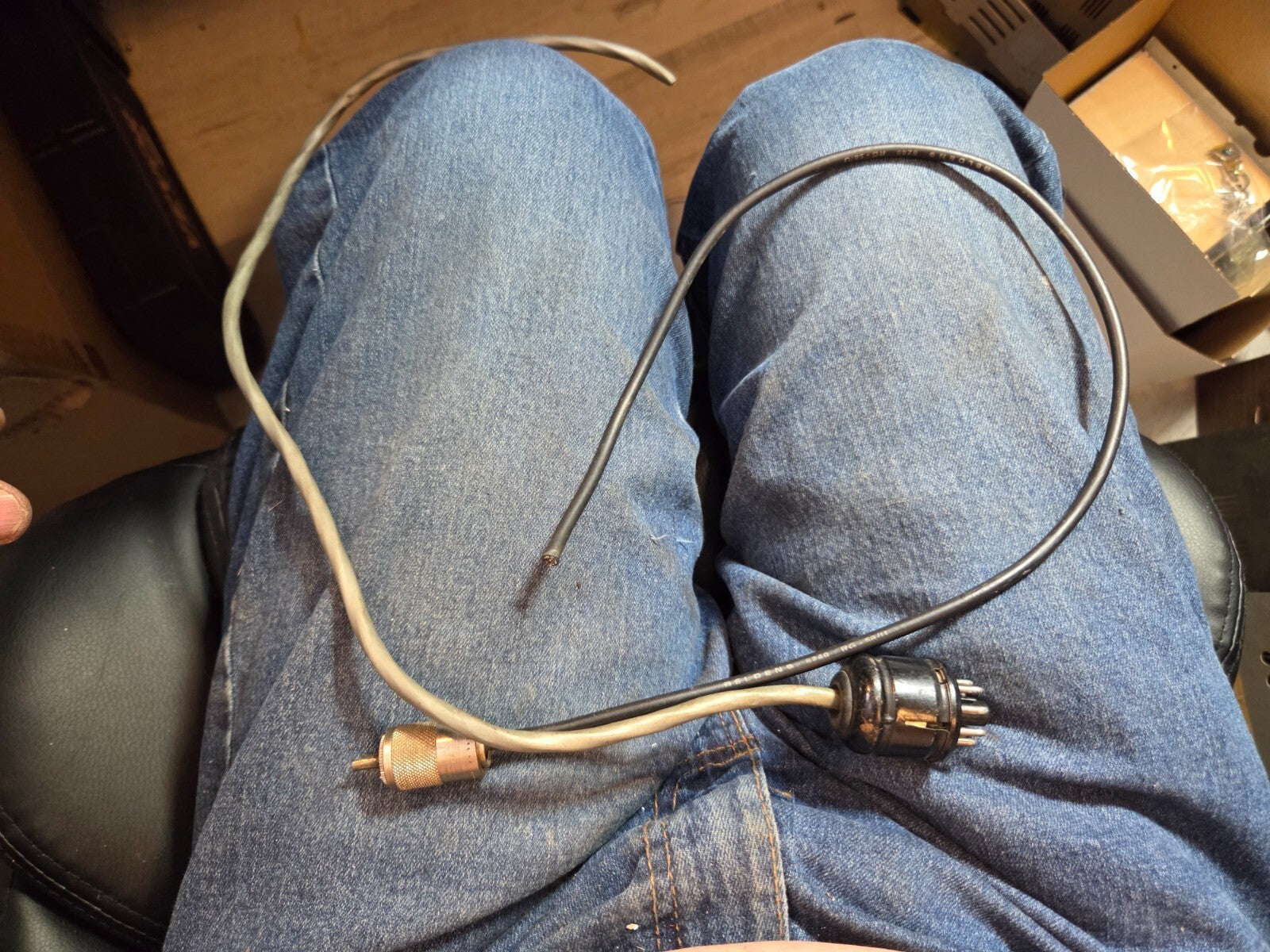
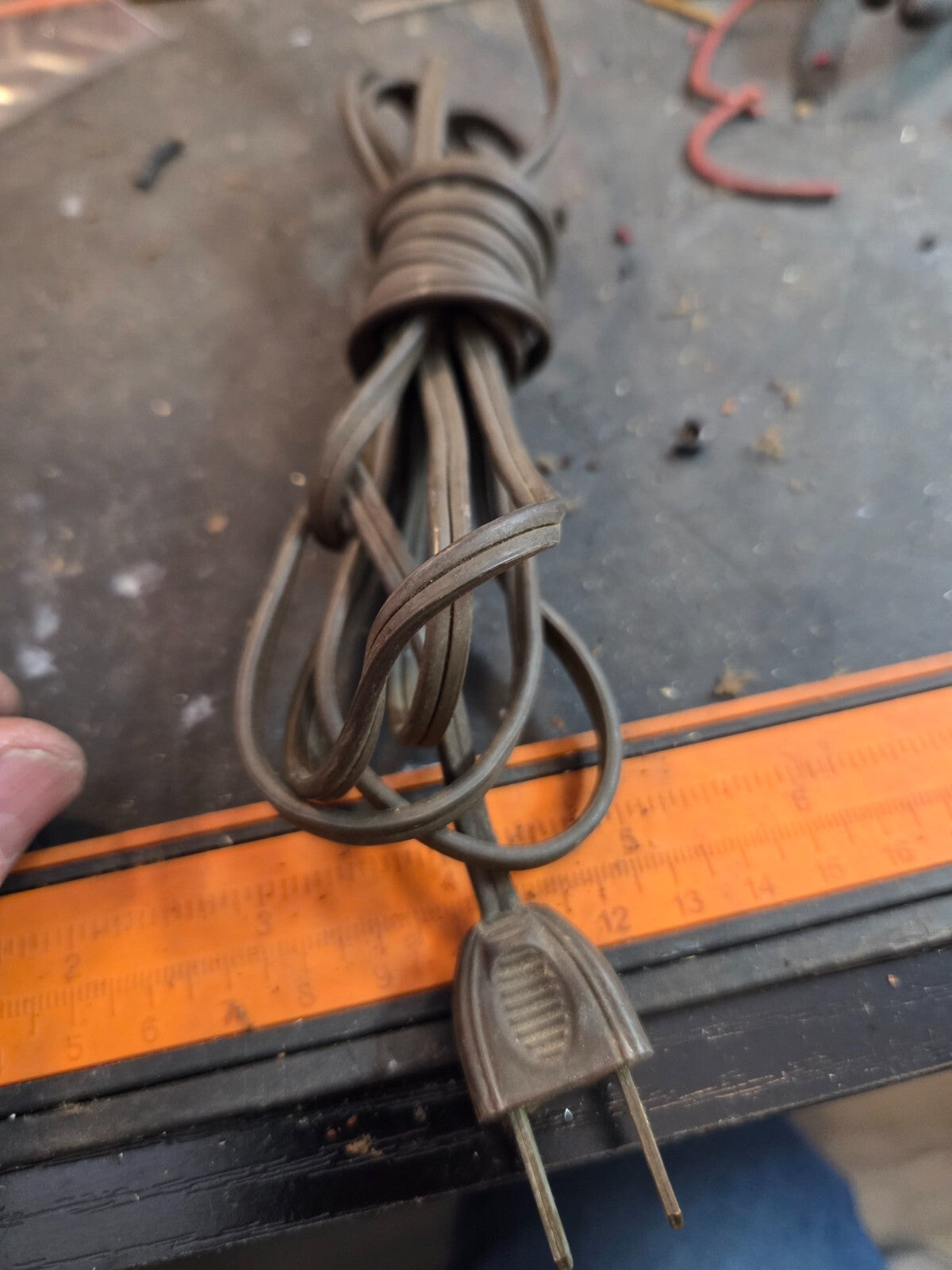
Our Browning R-27 power cord and connector at $25.00 is a used original part pulled from a tested donor, shown in clear photos so you can compare mounting and connectors before you commit. Other original cords in our catalog, like the Browning S-23 AC power cord and the Lafayette Comstat 25B AC power cord, are listed at $15.00 each. The Browning R-27 AC power cord at $25.00 rounds out the Browning options.
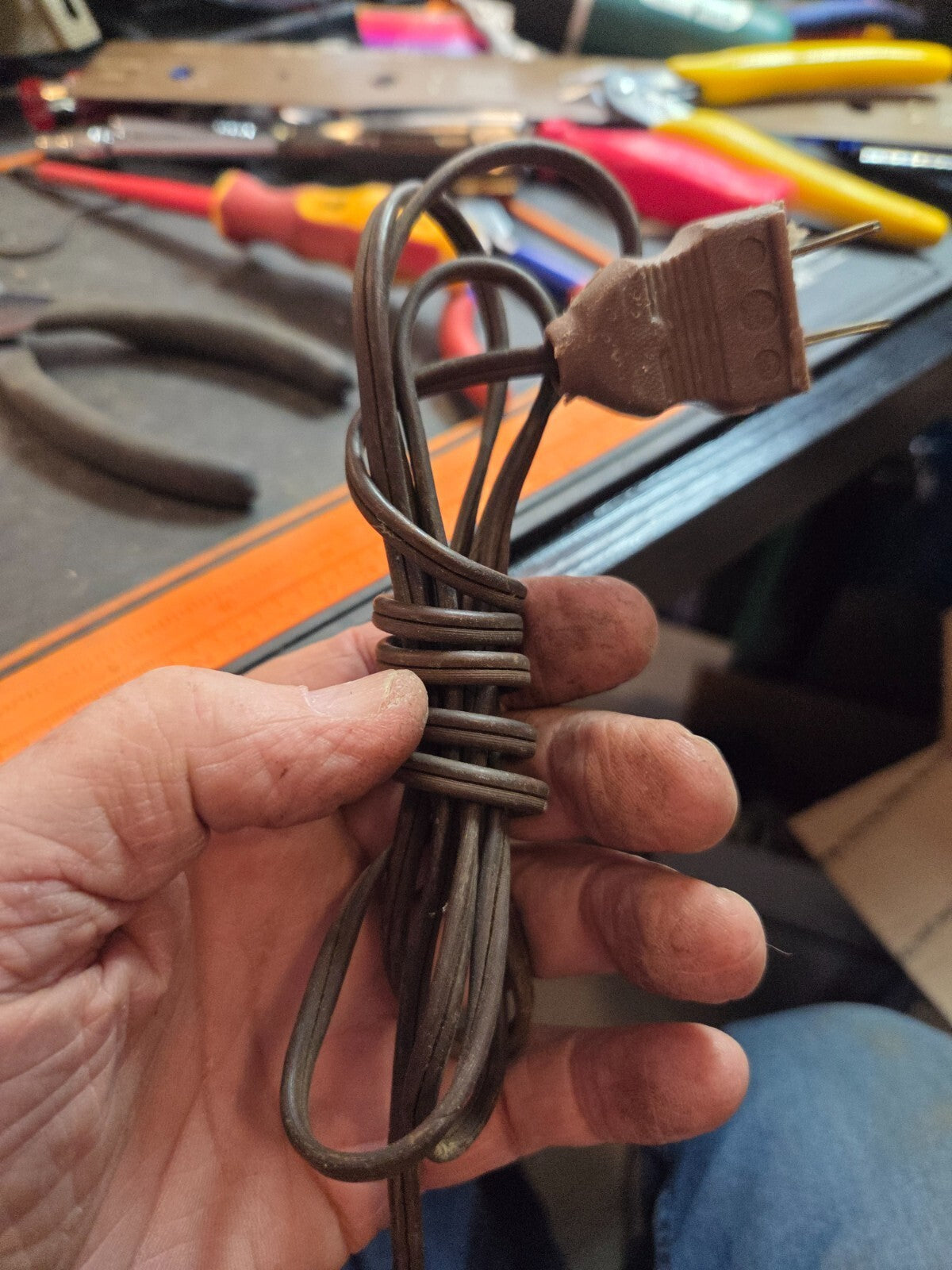
Matching a vintage power cable is part detective work and part electrical discipline. If you are not sure which cord fits your chassis, send us the model number and a photo of the rear panel; Jack Scott personally oversees customer questions, and we would rather answer one now than process a return later. Our parts are organized by brand and model so you can find the exact fit for your set.
Frequently Asked Questions
How do I find out what power cable I need for a vintage CB radio?
Start with the radio’s model number and the connector already on the back panel. Count the pins on a two-prong or three-pin socket, or note whether the set uses bare wire leads into a screw terminal. Then check the voltage and current rating on the radio’s label. Compare mounting holes, connector shape and any markings against clear photos of the replacement cord before you buy, since compatibility between models is rarely universal.
What size power wire should I use for a CB radio?
Wire gauge depends on current draw and cable run length. A short run to a 12-volt mobile radio typically calls for 14 to 16 AWG, while longer runs or higher-draw base stations need thicker 12 or 10 AWG wire to limit voltage drop. Match the gauge to the radio’s rated current rather than guessing, and keep the fuse rating consistent with the wire you install.
Are vintage CB radio power cables interchangeable between models?
Not reliably. Two-prong and three-pin connectors vary in pin spacing, keying and shell shape, and base-station AC cords differ from mobile 12-volt DC leads. A cord pulled from one model may physically fit another yet carry the wrong polarity or gauge. Always compare the connector, wire colors and markings, and verify polarity with a meter before connecting.
Can I use a modern power supply with a vintage CB base station?
Yes, provided the supply delivers the correct DC voltage and enough current for the radio, and you match polarity to the set’s requirements. Many vintage base stations expect 12 to 13.8 volts DC. Size the supply above the radio’s rated draw, fuse the output, and confirm the plug or wire leads match the radio’s connector before powering up.
Prices of original vintage CB power cords
