Tested vs Untested CB Radio Boards: Which Should You Buy?
Last Updated: November 23, 2026
Quick Summary
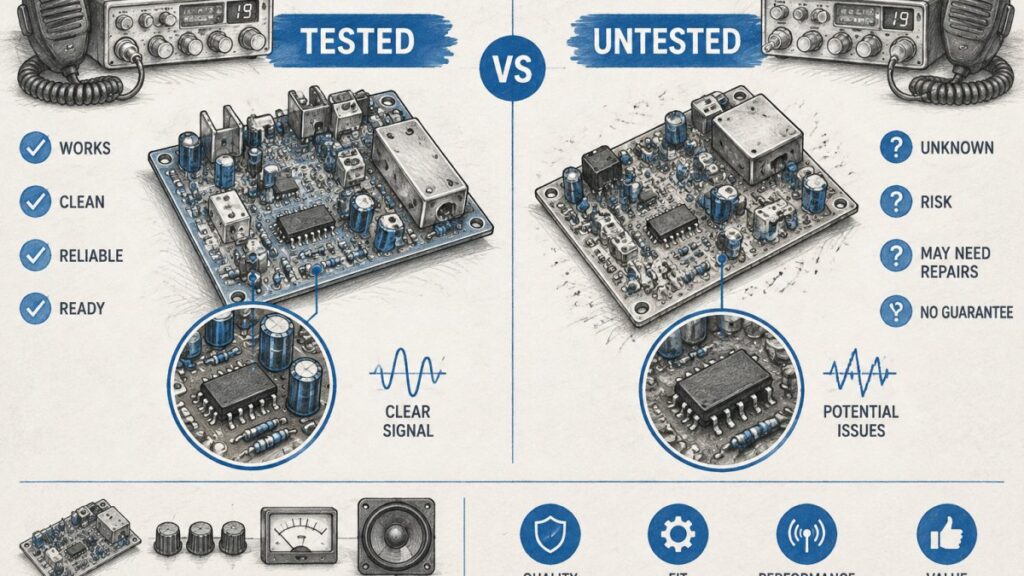
Tested CB radio boards have been powered and checked by the seller before listing, while untested CB radio boards have not, and that single distinction drives most of the price gap. In our catalog, untested boards run $25.00 to $30.00 and tested assemblies run $40.00 to $45.00. Buy tested for a first project; buy untested if you own the bench gear to diagnose it.
- A tested claim means the seller applied power and observed receive and transmit behavior.
- An untested listing establishes only that the part exists and was removed from a specific model.
- Check the return policy before buying, since it decides who bears the cost of a dead board.
- Inspect under bright light and check for shorts across the supply rails before powering any board.
- Never key a transmitter without an antenna or dummy load attached, or you can destroy the final transistors.
Table of Contents
- What Tested vs Untested CB Radio Boards Actually Means
- Tested vs Untested CB Radio Boards: Cost and Risk Compared
- How to Test a CB Radio Before You Install a Replacement Board
- CB Radio Test Equipment for Bench Checking a Board
- Vintage CB Radio Replacement Boards: Identifying the Right Fit
- Used CB Radio Parts Buying Guide: Questions to Ask Before You Pay
- Pick the Board That Matches Your Repair Project
- Frequently Asked Questions
What Tested vs Untested CB Radio Boards Actually Means
The phrase tested vs untested CB radio boards describes two different levels of seller verification, not two different grades of hardware. A tested board has been powered and checked before listing. An untested board has not.
At SCOTT RADIO & ELECTRONICS, we list both kinds of inventory and label them plainly. “Tested” should never be decoration; it should tell you what was checked before the board was listed.
Below, we’ll show you what each claim covers, what it leaves out, and how to inspect a board the day it arrives.
What a Tested Board Claim Covers
A tested claim means the seller applied power and observed behavior. On a main board pulled from a working radio, that usually means it powered up in its chassis, the receive section produced audio, and the transmit section keyed.
What it does not automatically cover: long-term stability, alignment accuracy, or every solder joint under load. A board can pass a bench check and still drift once it heats up.
What an Untested Listing Does and Does Not Establish
An untested listing establishes that the part exists, that it was removed from a specific model, and that the seller is not claiming function. Nothing more.
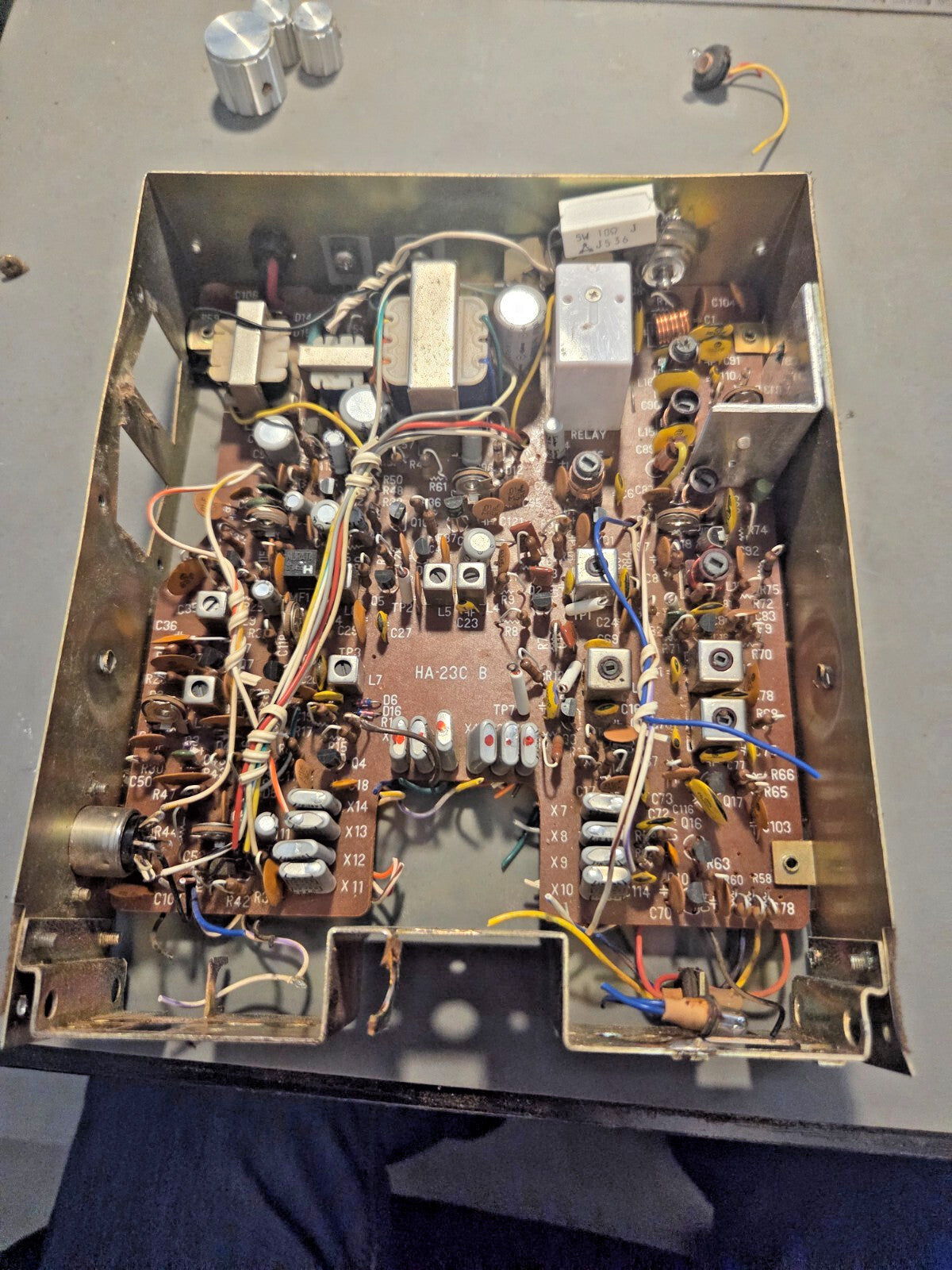
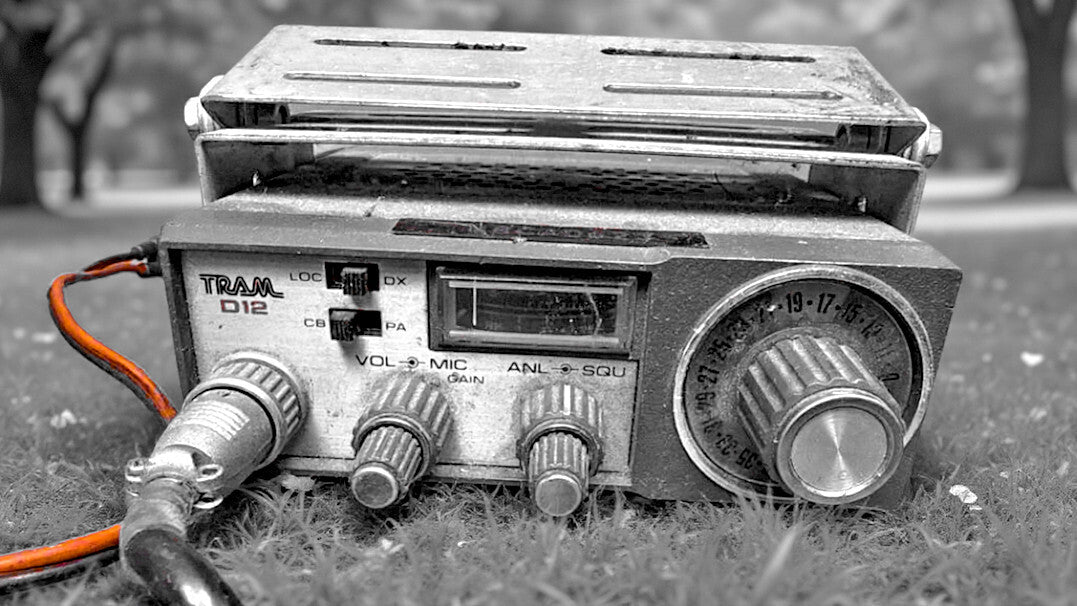
“Untested but powers up” is a middle claim: the board drew current and the pilot lamp or display responded, but it says nothing about receive sensitivity or transmit output. Our Main Board for Surveyor 2400 Mobile CB Radio and Tram D12 untested main board both show this honest labeling.
Watch out: an untested board that fails on first power-up is usually yours to keep. Confirm the return terms before you pay.
Tested vs Untested CB Radio Boards: Cost and Risk Compared
Price tracks verification almost exactly. In our catalog, untested boards are listed at $25.00 to $30.00 and tested assemblies at $40.00 to $45.00. But sticker price is only one line in the real cost equation.
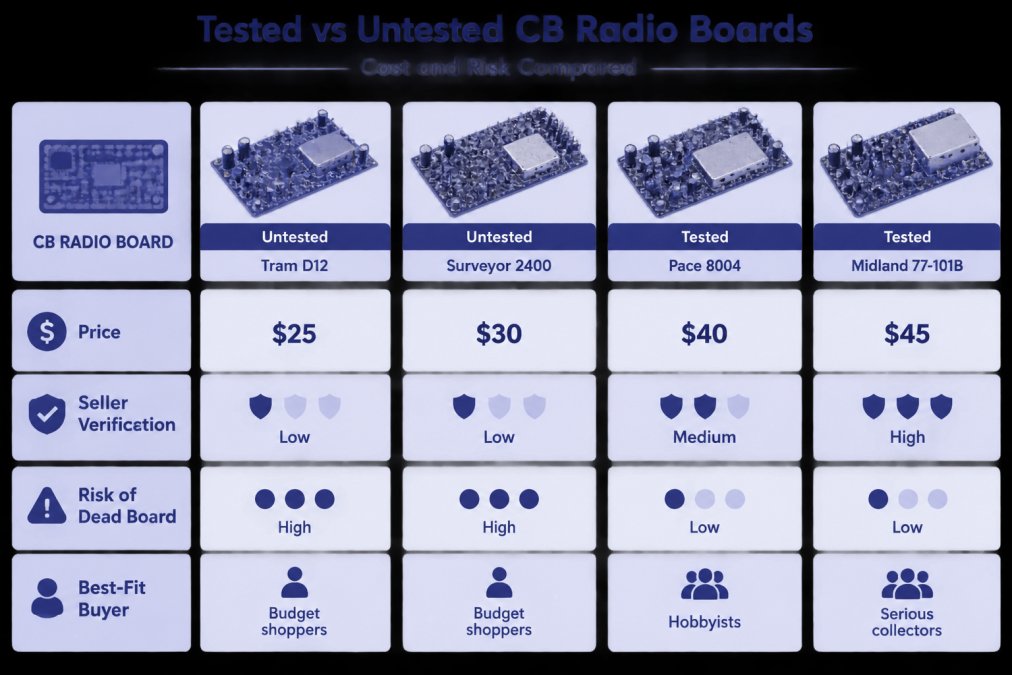
| Factor | Untested Board | Tested Board |
|---|---|---|
| Typical price in our stock | $25-$30 | $40-$45 |
| What the seller verified | Powers up, or nothing | Powered, received, keyed |
| Risk of a dead board | Real and yours to absorb | Low, but not zero |
| Best for | Confident troubleshooters | First-time restorers |
| Time to a working radio | Longer, more diagnosis | Shorter, fewer variables |
The Real Cost Equation
An untested board saves money up front and costs bench hours later; a tested board costs more and removes a variable. Neither is wrong, they suit different people. Run the numbers in this order before you buy.
- Sticker price. Untested boards in our catalog run $25.00-$30.00; tested assemblies run $40.00-$45.00.
- Return terms. Check the return policy before you buy, since it determines who bears the cost if a board arrives dead.
- Your bench time. Diagnosis is not free even when your time is unpaid. A receive failure sends you into the RF section; a transmit failure into the final stage, each with its own parts cost.
- Replacement parts. A dead final transistor, bad capacitor, or cracked trace adds to the untested board’s true cost. Price the common failures for your chassis first.
- Compatibility risk. A board that fits but does not match your connector layout or meter drive is a loss at any price, which is why the fit check comes before the price check.
When the Untested Board Wins
The untested board wins when the price gap exceeds your realistic repair cost and you already own the bench gear to diagnose it. If you restore radios regularly, you will test it anyway, and the savings are real. It also wins when the board is bought for parts, since a good transformer and a dead final still have bench value.
When the Tested Board Wins
The tested board wins when the price gap is smaller than the cost of a failed diagnosis. For a first project, or a radio that belonged to someone you love, buy tested, the extra cost buys a known starting point.
If you want a tested reference point, our Lafayette HB 650 main circuit board is a tested listing you can price against the untested boards in the same catalog.
How to Test a CB Radio Before You Install a Replacement Board
Test the board before it goes anywhere near your radio. Once it is soldered in, you have lost your cleanest diagnostic window.
Here is a general sequence a bench technician can use on any board:
- Inspect under bright light before power. Look for bulged capacitors, cracked solder rings around connector pins, scorch marks, and corrosion from old battery leakage.
- Check for shorts across the supply rails. A multimeter on continuity will catch a dead short before it catches fire.
- Power the board on a current-limited supply. Watch the draw. A board that pulls hard immediately has a fault you have not found yet.
- Confirm receive. Feed a known signal and listen for audio at the speaker output.
- Key the transmit side briefly. Short bursts only, into a dummy load, never into open air.
- Check output power and modulation. A wattmeter and a modulation reading tell you whether the final stage is healthy.
- Reheat suspect joints. Reflow anything that looks cold before final installation.
Watch out: never key a transmitter with no antenna or dummy load attached. You can destroy the final transistors in seconds, and that turns a cheap board into scrap.
CB Radio Test Equipment for Bench Checking a Board
You do not need a full service monitor to check a board. A basic bench gets you most of the way; what matters is the reading each tool produces and what it proves.
- Multimeter for continuity, voltage, and resistance checks
- Current-limited bench supply so a fault does not become a fire
- Dummy load to absorb transmit power safely
That last item matters more than people expect. A board holder and repair fixture keeps a loose board steady while you probe, cutting the chance of a slipped probe shorting two traces.
What Each Reading Proves
A tool only helps if you know what a good reading looks like and what a bad one rules out. That is the part most buying guides skip.
- Continuity across the supply rails. A dead short reads near-zero resistance and rules out powering the board until you find the fault. No short does not prove health, but a short proves it is not.
- Current draw on a limited supply. A board pulling hard immediately has an unfound fault; a steady, modest draw is the first real pass.
- Receive audio from a known signal. Audio confirms the receive chain from front end through audio stage. Silence narrows the fault there, and the signal generator lets you inject at different points to find where it stops.
Reading the Results as a Buyer
When a seller says a board was bench tested, these readings back the claim. A listing stating output power, receive confirmation, and channel lock gives you evidence; one that says only ‘tested’ gives you a label.
If you are testing a vintage tube-type chassis, add an isolation transformer to the list.
Watch out: never key a transmitter with no antenna or dummy load attached. You can destroy the final transistors in seconds, and that turns a cheap board into scrap.
Vintage CB Radio Replacement Boards: Identifying the Right Fit
Fit is where most restoration projects stall. Two boards can look identical and still differ in connector layout, channel selector wiring, or meter drive.
Start with the model number stamped on the chassis, not the badge on the front panel, vintage radios were sold under several names, and a board from one badge may not match another.
The Pace 8004 main circuit board assembly is a good example of how a listing should look: it states what is included, what is excluded, and that cut leads will need reconnection. The Uniden PRO 640e board and front control assembly goes further and shows the attached ribbon cables and microphone connector, which is exactly the detail that decides whether a swap will work.
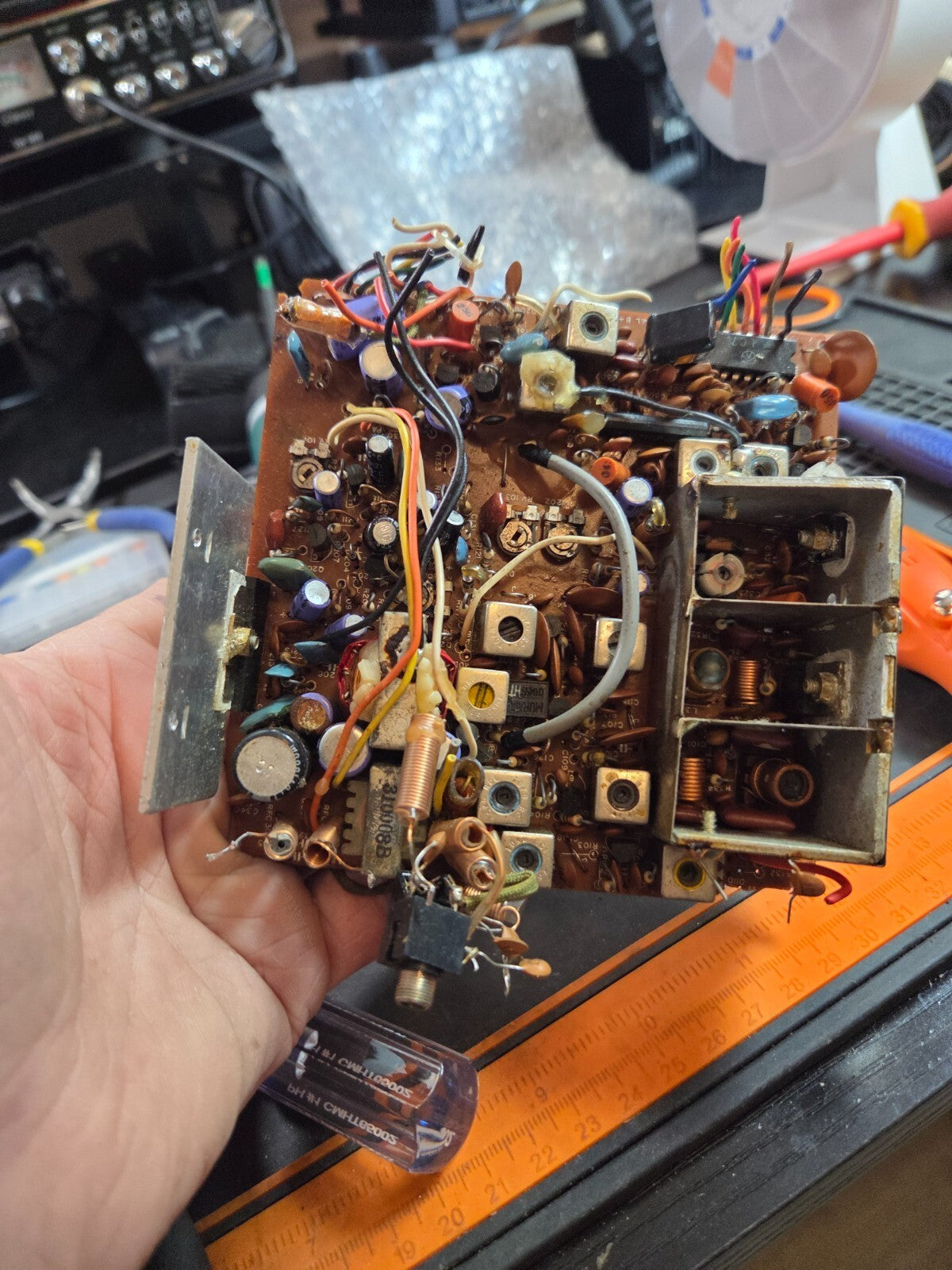
The rule we follow: if the listing does not show the connector side of the board, ask for a photo before you buy.
Used CB Radio Parts Buying Guide: Questions to Ask Before You Pay
Ask these before money changes hands. The answers separate a smooth restoration from a months-long headache.
- What exactly was tested, and how? “Powers up” and “receives and transmits” are different claims.
- Which radio did this come from? A model number and a photo of the donor chassis.
- What is included and what is not? Boards are often sold without the meter, faceplate, or controls.
That return question deserves its own attention. Our guide to the vintage CB radio parts return policy covers what happens when a part turns out wrong or faulty, and it is worth reading before you order from anyone.
A seller who answers all six without hesitation is a seller worth buying from. One who dodges the testing question is telling you something.
Pick the Board That Matches Your Repair Project
Match the board to your skill level and your goal. That is the whole decision.
If you restore radios regularly and own the bench gear, an untested board is a reasonable bet, you will diagnose it anyway.
At SCOTT RADIO & ELECTRONICS, we list every board with its testing status stated plainly, organized by brand and model so you can match the part to your chassis.
Get started with SCOTT RADIO & ELECTRONICS and put the right board in your radio the first time.
Frequently Asked Questions
What does tested mean when buying a CB radio board?
It means the seller powered the board and checked basic functions before removing it from the donor radio. At Scott Radio, tested listings such as the Midland 77-101B chassis assembly ($45.00) and the Pace 8004 board assembly ($40.00) are listed as tested. Tested does not mean every specification was measured on a bench, so ask which functions were checked: power on, receive, transmit, meter movement, and control response. Get the answer in writing before you pay.
Is an untested CB radio board worth buying?
It can be, when the price reflects the uncertainty and you can handle the risk. Untested boards at Scott Radio run $25.00 to $30.00, against $40.00 to $45.00 for tested ones. The Surveyor 2400 board is listed as untested but powers up, which at least confirms the supply section is alive. If you restore radios regularly, keep a parts drawer, and own a multimeter, an untested board is a reasonable gamble. If this is your only board and you need the radio working, pay for tested.
How can you test a CB radio board before installing it?
Start with a visual inspection: look for burn marks, bulging capacitors, cracked solder joints, and corrosion on the board and connectors. Check continuity on the power input with a multimeter. If you have a bench supply, bring the board up slowly and watch current draw. A full check needs a test set or a known-good radio to swap the board into. Never apply full power to a board with visible damage, because a short can take out components that were still good.
What should you ask a seller about a used CB radio board?
Ask four things: which radio the board came from, what testing was done and how, whether any components were removed or cut during harvesting, and what the return policy is if the board does not fit or work. Photos of the exact board you will receive matter more than stock images. A seller who answers these questions specifically, rather than vaguely, is telling you how they handle problems after the sale.