
How much does a GMRS radio license cost in 2026?
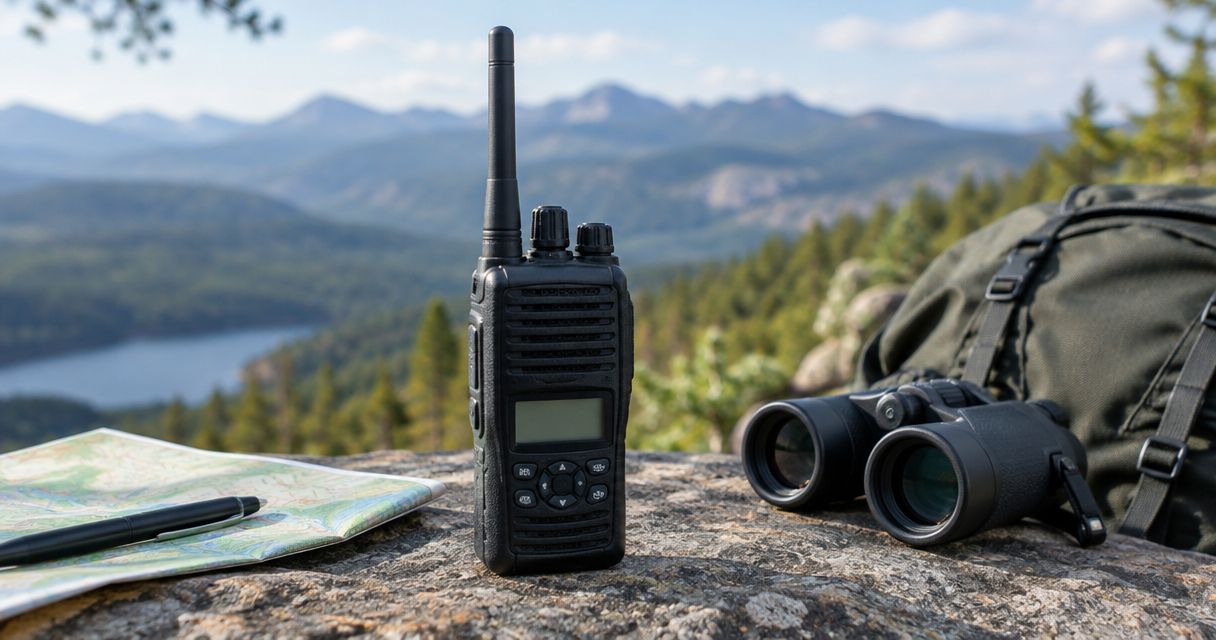
A U.S. GMRS radio license costs $35 for a 10-year term in 2026, with no exam required. That FCC application fee does not include your radio, antenna, installation, or any separate permission needed to use a privately operated repeater. One individual license also covers eligible immediate family members; it is not a separate license fee for every radio.
- The FCC GMRS radio license cost is $35 for 10 years in 2026; no exam is required.
- One individual GMRS license covers eligible immediate family members, not unrelated friends or an entire work crew.
- GMRS, FRS, and CB have different equipment rules; a shared connector or channel number does not establish compatibility.
- Apply through FCC systems, pay the application fee, and wait for the license grant before transmitting on GMRS.
How much does a GMRS radio license cost in 2026?
The FCC application fee for a new individual GMRS license is $35, and the license lasts 10 years. The controlling references are the FCC application fee schedule in 47 CFR § 1.1102 and the GMRS rules in 47 CFR Part 95, Subpart E. These are federal licensing requirements, not a radio retailer’s charges.
If you are sorting out an existing radio before buying accessories, contact Scott Radio & Electronics with its exact model and clear label photos. Identify the radio service first; choosing a matching plug comes later.
| Licensing item | What applies in 2026 | What it means for you |
|---|---|---|
| New individual GMRS application | $35 FCC fee | Pay through the FCC application process |
| License term | 10 years | No annual license payment during that term |
| Examination | No exam required | No written test is part of the application |
| Eligible immediate family | Covered by the individual’s license | Qualifying relatives do not each need a separate license |
| Multiple compliant radios | Permitted under the license and service rules | The FCC does not charge a license fee for each handset |
| Radio equipment | Separate from licensing | Buying equipment does not grant permission to transmit |
The fee buys a license term, not equipment, exclusive channels, or guaranteed repeater access. Keep those distinctions separate when planning your setup.
Why this matters
A handheld radio’s appearance tells you little about its legal operating service. GMRS, FRS, amateur, and CB equipment can all look like ordinary two-way radios, but their authorization requirements differ. Buying a programmable handheld does not make it legal for every frequency it can reach.
For a family choosing radios in 2026, the useful question is not just what the license costs. You also need to establish who will transmit, whether the radios are authorized for the service, and whether your intended communications fit the rules.
The same distinction matters when restoring classic gear. A vintage CB radio does not become a GMRS radio through an antenna change, replacement microphone, or different power supply.
What does the GMRS license cover?
An individual GMRS license authorizes the licensee and eligible immediate family members to operate compliant GMRS stations under the service rules. The license is issued to a person, not to a household address, vehicle, club, or box of radios.
The FCC’s family definition includes a spouse, children, grandchildren, stepchildren, parents, grandparents, stepparents, siblings, aunts, uncles, nieces, nephews, and in-laws. Do not assume that sharing a home, joining a trip, or working for the same company establishes eligibility.
Family use: one license, eligible relatives
Best for: eligible family members coordinating everyday or recreational activities. The family provision is a practical advantage because qualifying relatives can operate under the same individual authorization. The limitation is equally important: unrelated friends are not covered merely because you lend them a radio.
For a mixed group, establish each operator’s authorization before the trip. Put that check alongside charging batteries and agreeing on channels, rather than discovering the issue after everyone arrives.
Multiple radios: no per-handset license charge
Best for: a licensee using compliant handheld, mobile, or base equipment. You do not need a separate individual GMRS license for each radio you own. Every station still has to comply with the applicable equipment, channel, power, and operating rules.
More radios do not expand who your license covers. Handing an extra handset to an unrelated person does not extend your family authorization to that person.
Work crews: check each operator’s authorization
An individual license is not a blanket company license for unrelated employees. Business-related communications do not erase the individual licensing requirement or the family limitation.
Before equipping a crew, identify the operators and compare the relevant radio services. Do not choose GMRS solely because one person already holds a license.
Why your total GMRS setup expense varies
The federal application fee is fixed by the FCC schedule; the equipment and access decisions around it are separate. Use these factors to define your setup before comparing radios:
- Radio format. A handheld, vehicle-mounted radio, and fixed station involve different installation needs. Choose for how you will actually operate.
- Antenna installation. A mobile or fixed antenna requires compatible mounting, feed line, connectors, and weather protection where applicable.
- Power arrangements. Handheld batteries and chargers serve a different purpose from vehicle wiring or a suitable station power supply.
- Repeater permission. A privately operated repeater can require the owner’s permission. A GMRS license does not automatically grant access.
- Operator eligibility. Unrelated operators need their own authorization rather than relying on one person’s family coverage.
- Accessories. Microphones, speakers, charging connections, and mounting hardware must match the actual radio, not just its brand.
Do not treat accessories as interchangeable because the plugs look familiar. Connector dimensions, contact assignments, electrical requirements, and mounting details all matter.
For CB repair and restoration, Scott Radio & Electronics is best for hobbyists choosing model-specific replacement parts. Its CB parts catalog serves a different task from obtaining a GMRS authorization; a replacement board or knob does not change a radio’s service classification.
How do you apply for a GMRS license?
Apply through the FCC’s registration and licensing systems. You need an FCC Registration Number, commonly called an FRN, and an individual GMRS application. Payment confirmation alone is not the license grant.
- Register or sign in. Use your FCC account and obtain or locate your FRN through the Commission Registration System, known as CORES. Avoid creating duplicate records when you already have an FRN.
- Choose GMRS. In the Universal Licensing System, select a new application for General Mobile Radio Service. Check the service name before continuing.
- Review your details. Enter accurate applicant information and answer the required questions. Review the mailing address and other information submitted for the public licensing record.
- Pay the fee. Follow the FCC’s payment instructions associated with your application. Keep the payment confirmation and application reference together.
- Check the grant. Confirm that the FCC has issued the license and locate your call sign before transmitting under the new authorization. Save a copy of the authorization for your records.
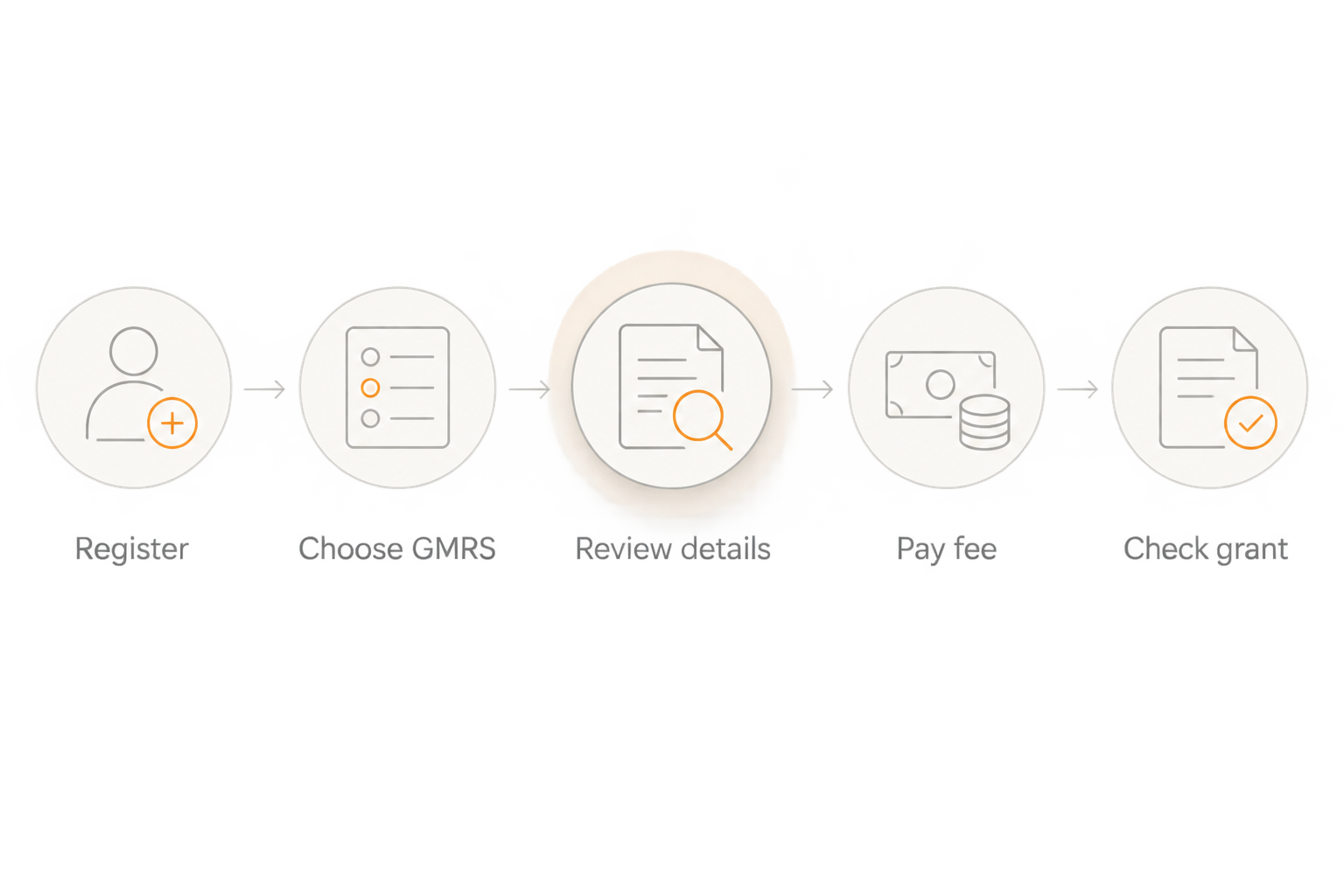
For your 2026 application, read the current FCC on-screen instructions rather than following screenshots from an old tutorial. Interface labels can change without changing the underlying need to register, apply, pay, and confirm the grant.
Keep control of your own FCC account credentials. If someone helps you complete the process, make sure you can later retrieve the authorization, update your information, and handle renewal yourself.
Is GMRS better than FRS or CB for your setup?
Choose the service your group can legally use with compatible equipment. GMRS is not automatically the right replacement for working CB gear, and license-free operation does not make FRS and CB interchangeable.
| Radio service | Best for | Licensing requirement | Practical advantage | Limitation to check |
|---|---|---|---|---|
| GMRS | Eligible families wanting GMRS equipment and repeater capability | Individual FCC license; no exam | Family coverage and permitted repeater operation | Unrelated operators are not covered by one family license |
| FRS | Groups wanting license-by-rule handheld communication | No individual FCC application | No individual licensing process | Certified FRS equipment has service-specific power and antenna restrictions |
| CB | Drivers and hobbyists communicating with other CB users | No individual FCC application | Works within the established CB service | Cannot communicate directly with GMRS radios |
GMRS and FRS share certain channels, but operating permissions follow the equipment and service rules. A certified FRS radio remains FRS equipment; a GMRS handheld does not become license-free simply because you lower its power.
CB operates in a different frequency band from GMRS. If your existing group uses CB, buying GMRS radios means changing the communications arrangement, not merely replacing a handset.
Scott Radio & Electronics sells vintage CB replacement parts, but that does not establish GMRS compatibility for a particular accessory. Match the radio model and the accessory’s stated specifications before ordering.
Does everyone in my family need a GMRS license?
$35 covers a 10-year individual license and eligible immediate family operation, rather than a separate application for each qualifying relative. The FCC’s family definition controls who qualifies.
Unrelated friends and neighbors do not gain coverage by joining a family outing. Check authorization for each person who will transmit, including anyone borrowing your spare radio.
Do I need to take a test for a GMRS license?
No exam is required for a GMRS license. You still need to complete the FCC application, pay the required fee, and receive the grant before operating under that license.
No exam does not mean no operating responsibilities. Read the rules for identification, permitted communications, channels, and equipment before your first transmission.
Does a GMRS license include repeater access?
A GMRS license permits compliant repeater operation under the service rules, but it does not grant access to every privately operated repeater. Ask the owner about permission and operating requirements before programming a repeater for use.
A tone setting is an access-control setting, not proof of permission. Also, privacy tones do not encrypt your conversation or reserve the channel for your group.
FAQ
How much does a GMRS radio license cost in 2026?
A U.S. GMRS radio license costs $35 for a 10-year term in 2026. The FCC application fee is separate from radio equipment, installation, and any privately arranged repeater access.
Is a GMRS license charged every year?
No, a GMRS license has a 10-year term rather than an annual payment schedule. Track the expiration date on your FCC authorization and follow the FCC renewal process.
Can my spouse and children use my GMRS license?
Yes, a spouse and children are among the eligible immediate family members covered by an individual GMRS license. Covered operators must still follow the GMRS operating rules.
Can my friend use my spare GMRS radio under my license?
An unrelated friend is not covered by your individual GMRS license. Lending a radio does not transfer your authorization or make the borrower an eligible family member.
Do I need a GMRS license for every radio I own?
No, an individual GMRS license is not issued separately for each handset or mobile radio. Every radio and operator must still comply with the applicable service requirements.
Can I transmit as soon as I pay the GMRS application fee?
No, wait until the FCC grants your license before transmitting under that authorization. Check the issued license and call sign rather than relying only on a payment receipt.
Does a ham radio license let me transmit on GMRS?
An amateur radio license does not replace a GMRS license. GMRS operation requires the appropriate GMRS authorization and compliant equipment.
Can I use my vintage CB radio on GMRS?
A vintage CB radio is not a GMRS radio and cannot communicate directly with GMRS equipment. Replacing its microphone, antenna, or power cord does not change its authorized radio service.
One last thing
A matching channel number is not proof that two radios belong to the same service. Check the model label, FCC ID, and manufacturer documentation before buying equipment or assuming a license applies.
For a CB restoration, send Scott Radio & Electronics the complete model designation, any visible revision markings, and clear photos of the original part and its connections. Ask about uncertain fit before ordering; do not substitute a visually similar part for a confirmed match. That is a separate decision from GMRS licensing, and keeping the decisions separate prevents an unsuitable purchase.
Related guides
- Two-way radios for emergency preparedness
- CB radio setups for off-road and overlanding
- How far can a CB radio transmit?
- CB radio parts for repair shops and technicians
{“@context”:”https://schema.org”,”@type”:”FAQPage”,”mainEntity”:[{“@type”:”Question”,”name”:”How much does a GMRS radio license cost in 2026?”,”acceptedAnswer”:{“@type”:”Answer”,”text”:”A U.S. GMRS radio license costs $35 for a 10-year term in 2026. The FCC application fee is separate from radio equipment, installation, and any privately arranged repeater access.”}},{“@type”:”Question”,”name”:”Is a GMRS license charged every year?”,”acceptedAnswer”:{“@type”:”Answer”,”text”:”No, a GMRS license has a 10-year term rather than an annual payment schedule. Track the expiration date on your FCC authorization and follow the FCC renewal process.”}},{“@type”:”Question”,”name”:”Can my spouse and children use my GMRS license?”,”acceptedAnswer”:{“@type”:”Answer”,”text”:”Yes, a spouse and children are among the eligible immediate family members covered by an individual GMRS license. Covered operators must still follow the GMRS operating rules.”}},{“@type”:”Question”,”name”:”Can my friend use my spare GMRS radio under my license?”,”acceptedAnswer”:{“@type”:”Answer”,”text”:”An unrelated friend is not covered by your individual GMRS license. Lending a radio does not transfer your authorization or make the borrower an eligible family member.”}},{“@type”:”Question”,”name”:”Do I need a GMRS license for every radio I own?”,”acceptedAnswer”:{“@type”:”Answer”,”text”:”No, an individual GMRS license is not issued separately for each handset or mobile radio. Every radio and operator must still comply with the applicable service requirements.”}},{“@type”:”Question”,”name”:”Can I transmit as soon as I pay the GMRS application fee?”,”acceptedAnswer”:{“@type”:”Answer”,”text”:”No, wait until the FCC grants your license before transmitting under that authorization. Check the issued license and call sign rather than relying only on a payment receipt.”}},{“@type”:”Question”,”name”:”Does a ham radio license let me transmit on GMRS?”,”acceptedAnswer”:{“@type”:”Answer”,”text”:”An amateur radio license does not replace a GMRS license. GMRS operation requires the appropriate GMRS authorization and compliant equipment.”}},{“@type”:”Question”,”name”:”Can I use my vintage CB radio on GMRS?”,”acceptedAnswer”:{“@type”:”Answer”,”text”:”A vintage CB radio is not a GMRS radio and cannot communicate directly with GMRS equipment. Replacing its microphone, antenna, or power cord does not change its authorized radio service.”}}]}
