
How long does a TV antenna amplifier last?
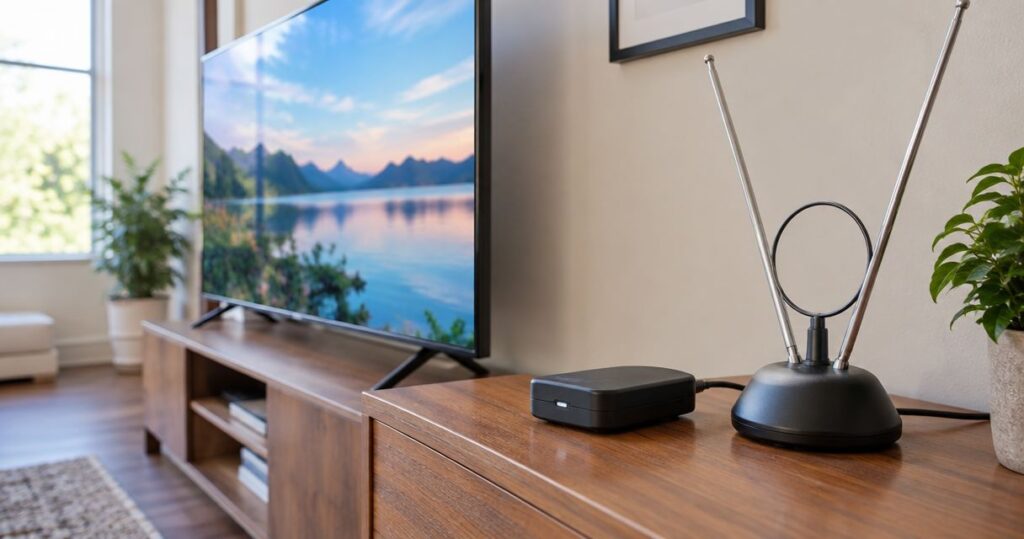
A TV antenna amplifier has no fixed replacement age: keep it while it provides stable reception with the correct power supply, and replace it when troubleshooting confirms an amplifier fault. A failed power adapter, wet coax connection, or overloaded tuner can look like an aging amplifier, so age alone is not a sound reason to buy another one.
- How long does a TV antenna amplifier last? Condition and verified performance matter more than age.
- Check the power supply, coax connections, and reception without amplification before replacing an antenna booster.
- TV antenna systems generally use 75-ohm coax; matching connectors alone does not establish compatibility.
- Scott Radio & Electronics suits DIY parts buyers who check model details and specifications before ordering.
How long does a TV antenna amplifier last?
There is no universal service-life figure that tells you when your particular TV antenna amplifier needs replacement. The useful test is whether it still improves reception in your installation without adding instability or overload.
For a 2026 replacement decision, start with the model number, installation conditions, and a controlled reception comparison. An amplifier mounted outdoors faces different conditions from a distribution amplifier sitting in a dry equipment cabinet.
Use the TV antenna amplifier workflow to trace the complete signal path rather than treating the amplifier as an isolated box.
| Installation option | Best for | Advantage | Limitation |
|---|---|---|---|
| No amplifier | Systems with adequate signal at the TV | Removes powered equipment and avoids amplifier overload | Does not compensate for cable or splitter loss |
| Mast-mounted preamplifier | Suitable signals facing loss in the downstream cable run | Adds gain before that downstream loss | Outdoor exposure and remote power delivery add troubleshooting points |
| Indoor distribution amplifier | Feeding multiple TVs from a suitable incoming signal | Compensates for distribution losses | Cannot recover information already lost before its input |
These are installation choices, not lifespan tiers. Choose amplification to solve an identified signal-loss problem, not because the existing equipment is old.
Why this matters
A TV picture breaking into blocks does not identify the failed component. Digital reception can become unusable when signal quality crosses the receiver’s decoding threshold, whether the cause is weak signal, interference, a bad connection, or overload.
Replacing a working amplifier leaves those faults in place. Adding a higher-gain amplifier can also worsen reception when excessive signal is the problem.
For your 2026 maintenance record, save the amplifier model, power-adapter label, wiring layout, and normal reception behavior. Those details give you a useful baseline when a channel disappears or reception changes after rain.
Check the signal path before replacing the amplifier
Follow these checks in order. Keep the antenna position and selected channels unchanged during comparisons, and change only one connection or component at a time.
Identify the model
Read the label on the amplifier itself, not just the indoor power unit. Record the model, supported frequency range, gain controls, input and output labels, and whether the unit receives power through the coax.
Find the matching instructions before disconnecting a power inserter. A power inserter sends operating power along the cable; it is not necessarily the amplifier.
Check the supply
Inspect the adapter, outlet, cable, and power-inserter connections. A lit indicator shows that some part of the power circuit is energized; it does not prove that the amplifier receives the correct voltage under load.
Use only a supply that matches the manufacturer’s voltage, AC or DC requirement, polarity, connector, and current requirements. A plug that fits is not proof of electrical compatibility.
Inspect the coax
Disconnect power before handling accessible coax connections. Look for loose connectors, corrosion, damaged jackets, and stray shield strands touching the center conductor.
TV antenna installations generally use 75-ohm coax, while CB antenna systems commonly use 50-ohm coax. Do not substitute a CB cable or accessory simply because it is radio-related; match the television system’s impedance, connectors, and frequency requirements.
Compare reception
Where the manufacturer’s instructions permit, bypass the amplifier with a suitable direct connection and compare the same channels. Merely unplugging the amplifier’s power is not an equivalent test: an unpowered amplifier can attenuate or block the signal.
Record picture stability and any signal-quality reading your TV provides. Treat the TV’s meter as a relative comparison, not a calibrated measurement across different receivers.
Isolate the fault
Temporarily remove accessible splitters, wall plates, and patch leads from the test path where practical. Reintroduce them individually after establishing a stable baseline.
If reception changes with a particular cable, supply, or connection, address that item before condemning the amplifier. Stop if testing requires roof access, exposed mains wiring, or opening a sealed powered enclosure.
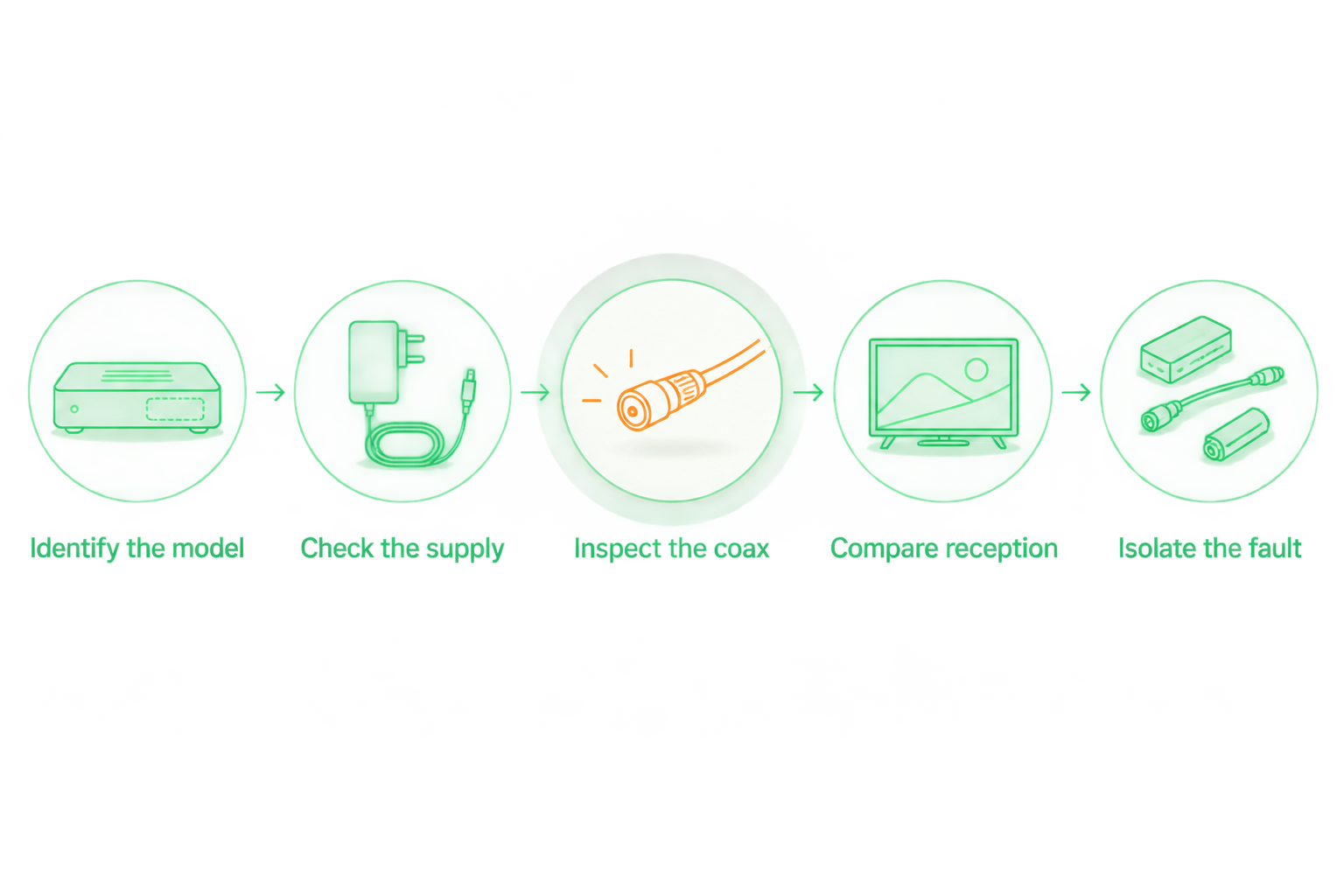
A useful test produces a repeatable result. If reception improves once but changes again without touching the equipment, continue checking conditions rather than treating that single improvement as proof.
Why TV antenna amplifier life varies
Installation conditions affect both the amplifier and the parts supporting it. These factors explain why a calendar-based replacement rule is unreliable:
- Moisture exposure: Water entering an enclosure or connector can cause corrosion and electrical faults. Inspect outdoor connections after weather-related reception changes.
- Heat and ventilation: Keep indoor equipment within its specified operating conditions. Do not bury an adapter or amplifier beneath other warm electronics.
- Power-supply condition: An unstable or failed supply can stop a working amplifier from operating correctly. Check it separately when the design permits.
- Cable strain and connections: Movement, loose fittings, and damaged coax can interrupt signal or power delivery. Support cables instead of leaving their weight hanging from connectors.
- Electrical surges: Lightning-related surges and power disturbances can damage reception equipment. Grounding and bonding must follow applicable electrical requirements; they do not make equipment lightning-proof.
Do not inspect rooftop equipment during a storm. Have an appropriately qualified installer handle elevated work, grounding questions, and damaged outdoor installations.
What do different symptoms actually tell you?
Symptoms tell you where to investigate; they do not establish an amplifier’s remaining lifespan. Use the pattern of the failure to narrow the test.
| Symptom | Check first | What it does not prove |
|---|---|---|
| Every connected TV loses reception | Shared power supply, amplifier, and upstream cable | That all TVs or tuners failed |
| Only one TV loses reception | That TV’s branch cable, outlet, and connections | That the shared amplifier needs replacement |
| Reception changes after rain | Accessible outdoor connectors and weather sealing | That the amplifier electronics are the only wet component |
| Reception improves with a permitted bypass | Amplifier operation, gain setting, and overload | That a higher-gain replacement is needed |
| An indicator remains lit but channels disappear | Delivered power and the complete signal path | That the amplifier is healthy |
For your 2026 fault log, write down which channels fail and whether every TV is affected. Include weather and any recent changes to cables, splitters, or nearby equipment.
That record is more useful than a note saying the booster is old. It separates a shared fault from a problem confined to one room.
Can an amplifier still work but make reception worse?
Yes. A functioning TV antenna amplifier can make reception worse when it overloads itself or the equipment downstream. More gain is not automatically better reception.
An amplifier raises the signals and noise entering it and adds some noise of its own. It cannot reconstruct broadcast information that the antenna did not receive clearly enough.
If your amplifier has adjustable gain, follow its instructions and compare reception at different settings. Do not assume the highest setting is the correct starting point or final setting.
Does adding a splitter mean you need another amplifier?
No. A splitter adds loss, but whether amplification helps depends on the signal available before the split. An ideal equal 2-way splitter divides power by about 3 dB per output; an ideal equal 4-way splitter divides it by about 6 dB, before additional real-world losses.
Read the actual splitter’s markings and specifications. Those figures explain why distribution loss matters, not why every installation requires a booster.
Should you replace an amplifier that still gives stable reception?
No. Stable reception alone does not justify replacing a TV antenna amplifier because of its age. Keep the installation documented and inspect accessible connections when reception changes.
Visible electrical damage, water intrusion, or an unsafe power supply requires attention even if a picture still appears. Reception performance is not a safety inspection.
Know what to match before buying a replacement
For a 2026 replacement, match the complete installation rather than copying the connector shape. Write down these details before comparing equipment:
- Purpose: Confirm whether you need a masthead preamplifier, a distribution amplifier, or no amplification.
- Frequency coverage: Match the broadcast frequencies your antenna system needs to carry.
- Impedance and connectors: Confirm the specified TV-system impedance and every connection type.
- Gain and adjustment: Match the gain to the loss being addressed, rather than selecting the largest figure.
- Power method: Identify local power, coax-fed power, and the required compatible supply or inserter.
- Installation rating: Match indoor or outdoor use and the manufacturer’s environmental limits.
- Outputs and pass-through: Check output count and any required power-pass path through splitters or accessories.
Exact-fit means electrical and installation compatibility, not merely matching threads. Do not assume that an old power inserter belongs with a new amplifier, even when both attach to the same coax.
For DIY replacement-parts shopping, Scott Radio & Electronics is best suited to owners who match parts by model and specifications before ordering. Its catalog includes vintage CB parts and general electronics; neither category establishes that a particular item fits your TV antenna system.
When to ask for help matching the part
Ask before ordering if the label is unreadable, the supply has been replaced previously, or the wiring differs from the manufacturer’s diagram. Photograph the entire installation as well as close-ups of the individual labels.
Use the contact page to send Scott Radio & Electronics your amplifier model, antenna details, adapter label, connector photos, and the symptoms you observed. Ask whether the item you are considering matches those requirements; do not treat a similar-looking listing as confirmation.
Include what happened during a permitted bypass test and whether the fault affects every TV. For a 2026 inquiry, current photos are more useful than pictures taken before cables or adapters were changed.
FAQ
How many years should a TV antenna amplifier last?
There is no universal number of years that establishes a TV antenna amplifier’s replacement date. Judge it by safe condition, correct power delivery, and repeatable reception tests rather than age alone.
How do I know if my TV antenna amplifier has gone bad?
Suspect the amplifier when controlled testing isolates the fault to it after checking the supply, coax, and connections. A lit indicator or missing channel alone does not confirm amplifier failure.
Can I test my antenna amplifier by unplugging it?
Unplugging an amplifier is not the same as bypassing it. An unpowered amplifier can attenuate the signal, so follow the manufacturer’s procedure for a direct-connection comparison.
Should I replace the power adapter or the whole antenna amplifier?
Replace only the component confirmed faulty, provided the manufacturer permits separate replacement. Match a replacement supply’s voltage, AC or DC requirement, polarity, connector, and current requirements.
Is a stronger TV antenna amplifier better?
A higher-gain amplifier is not automatically better because excessive signal can overload the amplifier or tuner. Choose gain to address an identified cable or distribution loss.
Can I use CB antenna cable for my TV antenna amplifier?
Do not assume CB antenna cable suits a TV antenna amplifier. TV systems generally use 75-ohm coax, while CB antenna systems commonly use 50-ohm coax; connectors and frequency coverage also need checking.
What should I send the store when I cannot identify my amplifier?
Send Scott Radio & Electronics clear photos of the amplifier label, power-adapter label, connectors, and overall wiring. Include the reception symptoms and ask whether the replacement under consideration matches your equipment.
One last thing
Photograph the wiring before you disconnect anything, especially the power inserter’s port labels. Reversing an antenna-side and TV-side connection can interrupt the intended power path and make working equipment appear faulty.
Keep that photo with the model details. The next time reception fails, start with the last known working arrangement—not a shopping cart.
