
Do you need a license to use a GMRS radio?
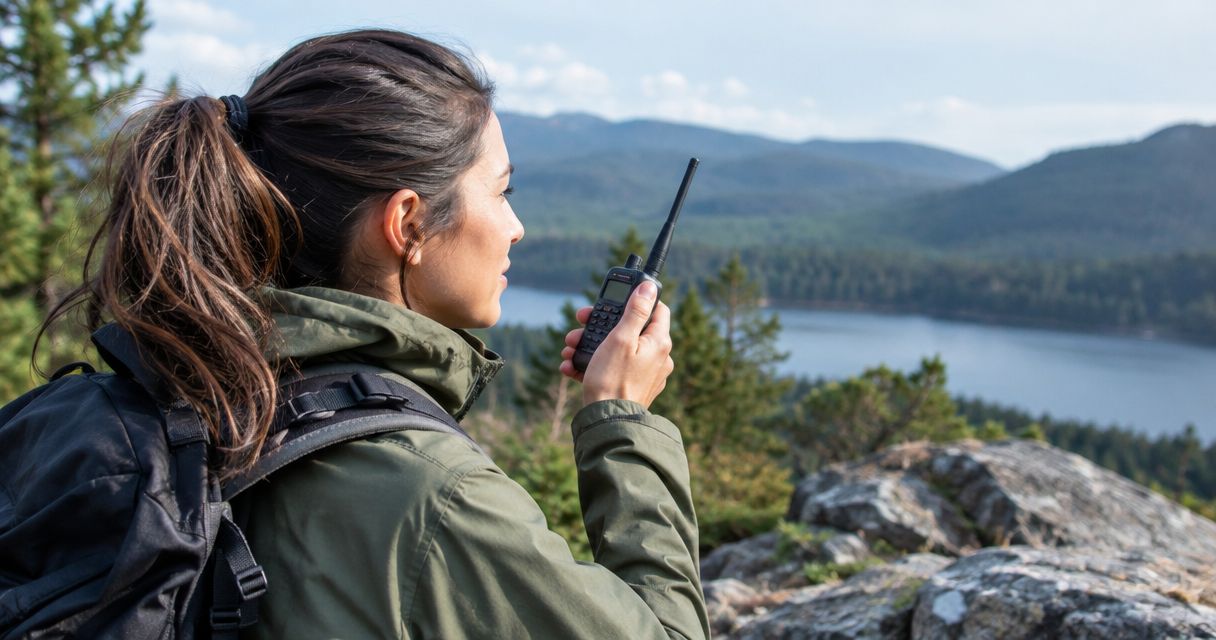
Yes—you need an FCC license to transmit with a GMRS radio in the United States in 2026, but you do not need an exam. The license lasts 10 years and covers the individual licensee and eligible immediate family members. Listening without transmitting does not require a GMRS license, and sharing channels with FRS does not make a GMRS transmitter license-free.
- Do you need a license for a GMRS radio? Yes—the FCC requires one before you transmit in the United States.
- A GMRS license lasts 10 years, requires no exam, and covers eligible immediate family members.
- FRS radios are license-free; a shared channel does not make a GMRS radio an FRS radio.
- Check the radio’s FCC authorization, not just its frequency range, before buying or transmitting.
Why this matters
The licensing question follows the radio service and equipment authorization, not whether the radio is handheld, inexpensive, or used only occasionally. Two radios can communicate on a shared channel while operating under different licensing rules.
That distinction matters when choosing equipment for family trips, vehicle convoys, or emergency planning. If you are still comparing setups, the guide to two-way radios for emergency preparedness provides related planning context. Establish the service first; then match the radio, antenna, power connection, and accessories.
Do you need a license for a GMRS radio?
Yes, transmitting with a GMRS radio requires an FCC GMRS license. You can operate under your own individual license or, when eligible, under an immediate family member’s license. Simply owning the equipment does not authorize transmission.
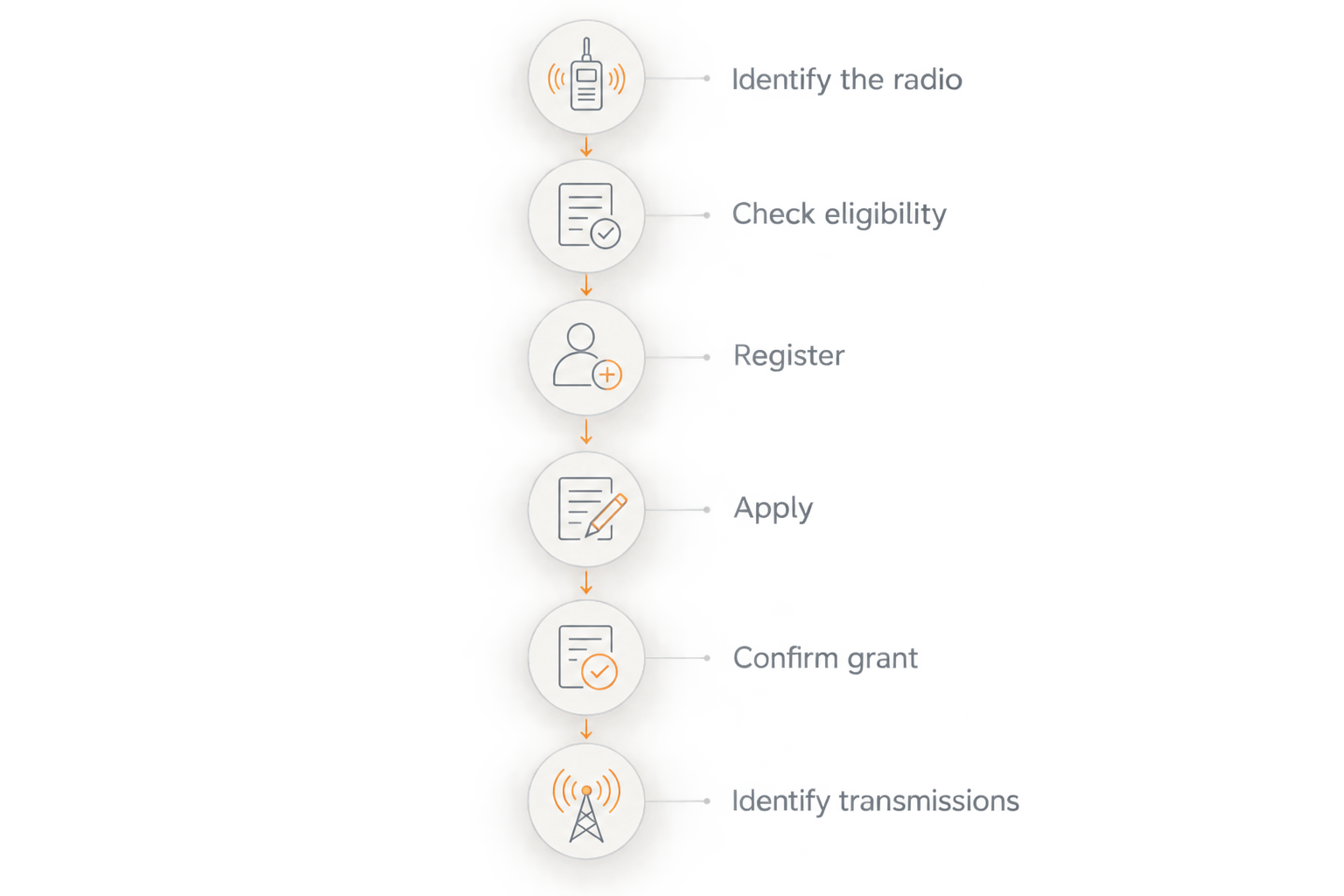
The controlling federal rules are in 47 CFR Part 95, Subpart E, including eligibility under §95.1705 and license terms under §95.1707. For U.S. operation in 2026, the practical application process is:
- Identify the radio. Confirm that the exact model is authorized for GMRS. Read the label, manual, and FCC equipment authorization rather than relying on a marketplace title.
- Check eligibility. An individual applicant must be at least 18 years old and must meet the FCC’s other eligibility requirements.
- Register with the FCC. Obtain an FCC Registration Number through the FCC’s registration system if you do not already have one.
- Apply for GMRS authorization. Use the FCC’s Universal Licensing System and follow its current application and payment instructions.
- Wait for the grant. Confirm that the license is granted and retrieve the assigned call sign before transmitting.
- Set up identification. Keep the call sign with the radio and learn when identification is required.
There is no GMRS knowledge examination. That simplifies the application, but it does not remove your responsibility to understand permitted equipment, channels, and operating practices.
GMRS license: 10 years of authorization
An individual GMRS license has a 10-year term under 47 CFR §95.1707. The authorization belongs to the licensee; it is not a registration attached to one particular handheld.
You do not apply separately for each GMRS radio you use under that authorization. However, every transmitter still needs the appropriate equipment authorization, and your operation must follow the applicable rules.
For a license issued in 2026, use the expiration date shown in the FCC record as your renewal reference. Save the license document somewhere accessible rather than relying on the date you bought the radio.
Best for: eligible families who want GMRS operation without an examination. The limitation is that a family license is not blanket permission for unrelated friends, employees, or everyone riding in a convoy.
GMRS, FRS, CB, or amateur radio: which rules apply?
A shared case design or matching connector does not establish a radio’s service. Use this comparison to separate the licensing requirements before choosing equipment.
| Radio service | Individual license needed to transmit? | Best for | Practical benefit | Limitation |
|---|---|---|---|---|
| GMRS | Yes, or eligible family coverage | Families wanting GMRS handheld, mobile, or repeater operation | No examination; eligible family coverage | License required; repeater access is not automatic |
| FRS | No, when using compliant FRS equipment | Simple local communication without an application | License-free operation | Equipment and antenna restrictions limit setup choices |
| CB | No individual license for compliant U.S. CB operation | Drivers and hobbyists using CB equipment | License-by-rule operation | Does not communicate directly with GMRS |
| Amateur radio | Yes, with the appropriate examination and privileges | Operators pursuing amateur-radio communication and experimentation | Broad technical options within license privileges | An amateur license does not authorize GMRS transmission |
FRS is the straightforward choice when your priority is license-free local communication. GMRS is the choice when you specifically need GMRS capabilities and will handle the licensing requirement.
For classic-radio owners, CB remains a separate path. Scott Radio & Electronics is best for DIY owners matching vintage CB radio replacement parts to their existing radios. That repair focus does not make a CB radio, CB microphone, or CB antenna interchangeable with GMRS equipment.
Does one GMRS license cover your whole family?
A GMRS license covers the licensee and eligible immediate family members under 47 CFR §95.1705. The rule includes a spouse, children, grandchildren, stepchildren, parents, grandparents, stepparents, siblings, and specified in-laws, along with the rule’s other listed family relationships.
Do not substitute “household” or “anyone I know” for the FCC’s eligibility language. A friend does not become covered because you loan them a radio or invite them on a trip.
For a 2026 family setup, write down who will actually operate the radios before ordering equipment. If several unrelated households are participating, each operator needs an applicable authorization; one person’s GMRS license does not cover the entire group.
Children can operate under an eligible family member’s GMRS license. The 18-year minimum applies to the individual applying for the license, not to every family member operating under it.
Why your licensing requirements differ
The licensing requirement changes with the service and operating circumstances—not simply with the distance you intend to communicate. Check these factors:
- Equipment authorization: An FRS-certified radio and a GMRS-certified radio have different operating requirements even where channels overlap.
- Transmit versus receive: Listening without transmitting does not require a GMRS operator license; pressing push-to-talk changes the activity.
- Family relationship: Eligible immediate family members can operate under the licensee’s authorization. Unrelated users need their own applicable authority.
- Operating location: An FCC GMRS license is a U.S. authorization, not automatic permission to transmit in another country.
- Repeater use: A license does not grant access to every privately operated repeater. Obtain permission where the repeater owner requires it.
- Other service licenses: An amateur-radio license does not replace GMRS authorization, and CB’s license-by-rule status does not extend to GMRS.
Choose the service before choosing the accessories. Otherwise, you can end up with a radio that needs a license you have not obtained or an antenna intended for a different band.
Can you use a GMRS radio on FRS channels without a license?
No—a GMRS transmitter still requires GMRS authorization on channels shared with FRS. Selecting a shared channel or a lower-power setting does not change the transmitter’s equipment certification.
FRS and GMRS share 22 channel frequencies, but their equipment and operating rules differ. The relevant requirements appear in 47 CFR Part 95, Subparts B and E; the channel overlap is not an exemption from licensing.
For a used radio in 2026, check the exact model and FCC ID. Older combination-radio labeling can create confusion, so resolve the equipment’s authorization before treating it as license-free.
Do you need a license just to listen to GMRS?
No—you do not need a GMRS license solely to receive GMRS transmissions. Keep the distinction clear: receiving a conversation is different from joining it, calling another station, or testing the transmitter.
A radio check is a transmission. Do not press push-to-talk to find out whether the equipment works before your authorization is in place.
If you are evaluating an unfamiliar used handheld, identify its service and controls before operating it. A radio capable of receiving a frequency is not automatically authorized to transmit there.
What should you check before buying a GMRS radio?
Start with the model label and documentation, not the phrase “two-way radio.” In 2026, the same basic buying discipline applies to a new handheld, a used mobile, or a replacement accessory.
Confirm the exact equipment authorization
Record the manufacturer, complete model designation, and FCC ID. Use the FCC equipment authorization records to confirm the service rather than assuming that programmable frequencies establish legal use.
An amateur or commercial radio that can be programmed to GMRS frequencies is not automatically a lawful GMRS transmitter. Frequency coverage and equipment authorization are different checks.
Match the antenna and connectors
Match an antenna to the intended service and operating band. A connector that screws into place establishes mechanical fit, not suitable antenna tuning.
Check connector type and gender, mounting method, cable routing, and the radio manufacturer’s requirements. Do not carry a CB antenna over to a GMRS installation simply because an adapter connects the cable.
Match power and audio accessories
Read the radio’s stated supply voltage, current requirement, polarity, and connector arrangement before choosing a power supply or cable. Never infer pinout from the number of pins alone.
Apply the same caution to microphones and headsets. A similar-looking plug does not prove matching wiring, speaker connections, or push-to-talk operation.
Ask for help when identification is uncertain
For a CB repair or replacement-part question, contact Scott Radio & Electronics with the complete model designation and clear photos of the radio label, original part, and connection points. Include measurements or electrical markings that are visible on the component.
Scott Radio & Electronics sells vintage CB replacement boards, knobs, meters, speakers, and other electronics. For those CB parts, the useful starting point is the radio you actually own—not a visual resemblance to another model. Licensing and equipment authorization remain separate checks from replacement-part fit.
What operating rules matter after the license arrives?
Your call sign needs to be part of your operating routine. Under 47 CFR §95.1751, GMRS identification generally occurs at the end of a transmission or series of transmissions and at least every 15 minutes during a continuing series.
Learn the full identification rule, including its specific exceptions, rather than treating a nickname as a substitute for the assigned call sign. Keep a readable copy near the controls until using it becomes familiar.
Also check repeater access requirements before transmitting through someone else’s system. A correct channel and access tone do not establish the owner’s permission, and so-called privacy tones do not make your conversation private.
For your 2026 setup, keep the license record, manual, programmed-channel notes, and accessory information together. That makes it easier to distinguish a configuration problem from a licensing or hardware mismatch.
FAQ
Do I need a license for every GMRS radio I own?
No. An individual GMRS license is not issued separately for every radio. Each transmitter must still have the appropriate equipment authorization, and each operator must be covered by an applicable license.
Do I have to take a test to get a GMRS license?
No. The FCC does not require a GMRS knowledge examination. You still need to complete the application process and wait for the license grant before transmitting.
Can my children use my GMRS license?
Yes. Eligible children can operate under a family member’s GMRS license. The applicant must be at least 18 years old, but that minimum does not apply to every covered family operator.
Does my amateur radio license cover GMRS?
No. An amateur-radio license does not provide GMRS operating authority. Obtain GMRS authorization or operate under an eligible immediate family member’s GMRS license.
Can I use GMRS without a license if I stay on low power?
No. A low-power setting does not remove the licensing requirement for a GMRS transmitter. License-free FRS operation requires equipment authorized for FRS and compliance with FRS rules.
Does a GMRS license let me use any repeater?
No. A GMRS license does not automatically grant access to every repeater. Follow the repeater owner’s access requirements and obtain permission where required.
Can I talk directly from a CB radio to a GMRS radio?
No. Standard CB and GMRS radios use different frequency bands and are not directly interoperable. Similar microphone plugs or antenna connectors do not change that.
One last thing
Buying the radio is not the same as receiving permission to transmit. Before your first radio check, confirm the equipment authorization, confirm your license coverage, and put the assigned call sign beside the controls.
The same discipline helps with repairs: identify first, match second, connect last. Keep photos of the original wiring and part markings before removing anything.
Related guides
- Handheld GMRS and FRS two-way radios
- CB radio setups for off-road and overlanding
- How far can a CB radio transmit?
{“@context”:”https://schema.org”,”@type”:”FAQPage”,”mainEntity”:[{“@type”:”Question”,”name”:”Do I need a license for every GMRS radio I own?”,”acceptedAnswer”:{“@type”:”Answer”,”text”:”No. An individual GMRS license is not issued separately for every radio. Each transmitter must still have the appropriate equipment authorization, and each operator must be covered by an applicable license.”}},{“@type”:”Question”,”name”:”Do I have to take a test to get a GMRS license?”,”acceptedAnswer”:{“@type”:”Answer”,”text”:”No. The FCC does not require a GMRS knowledge examination. You still need to complete the application process and wait for the license grant before transmitting.”}},{“@type”:”Question”,”name”:”Can my children use my GMRS license?”,”acceptedAnswer”:{“@type”:”Answer”,”text”:”Yes. Eligible children can operate under a family member’s GMRS license. The applicant must be at least 18 years old, but that minimum does not apply to every covered family operator.”}},{“@type”:”Question”,”name”:”Does my amateur radio license cover GMRS?”,”acceptedAnswer”:{“@type”:”Answer”,”text”:”No. An amateur-radio license does not provide GMRS operating authority. Obtain GMRS authorization or operate under an eligible immediate family member’s GMRS license.”}},{“@type”:”Question”,”name”:”Can I use GMRS without a license if I stay on low power?”,”acceptedAnswer”:{“@type”:”Answer”,”text”:”No. A low-power setting does not remove the licensing requirement for a GMRS transmitter. License-free FRS operation requires equipment authorized for FRS and compliance with FRS rules.”}},{“@type”:”Question”,”name”:”Does a GMRS license let me use any repeater?”,”acceptedAnswer”:{“@type”:”Answer”,”text”:”No. A GMRS license does not automatically grant access to every repeater. Follow the repeater owner’s access requirements and obtain permission where required.”}},{“@type”:”Question”,”name”:”Can I talk directly from a CB radio to a GMRS radio?”,”acceptedAnswer”:{“@type”:”Answer”,”text”:”No. Standard CB and GMRS radios use different frequency bands and are not directly interoperable. Similar microphone plugs or antenna connectors do not change that.”}}]}
