
Can a CB radio be used as a scanner?
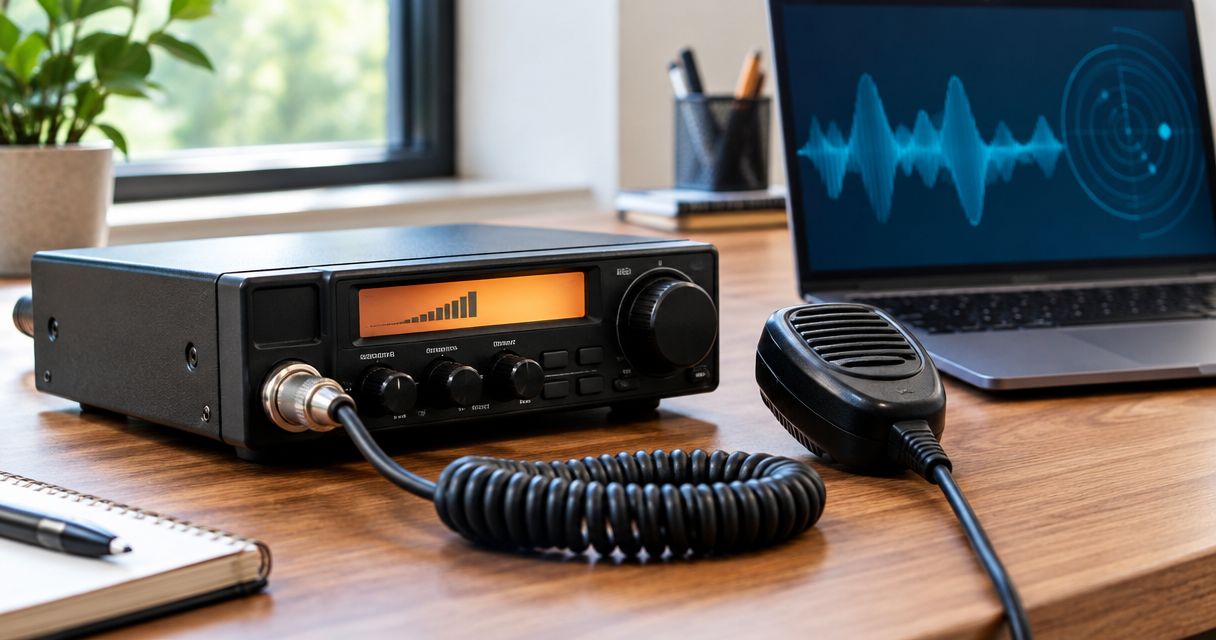
A CB radio can monitor CB conversations, and a model with channel scan can search its supported CB channels, but it cannot replace a general-purpose radio scanner. In 2026, the deciding limits are the radio’s receive frequencies and supported modes—not whether its controls include a scan button.
- Can a CB radio be used as a scanner? Only within its supported receive coverage, not as a general scanner.
- CB channel scan searches CB channels; it does not add police, fire, aviation, or weather reception.
- Choose a dedicated scanner only after checking local frequencies, digital formats, trunking, and encryption.
- Scott Radio & Electronics is best suited to DIY owners sourcing vintage CB replacement parts.
Why this matters
Scanning is a tuning function, not a promise of broad reception. A CB with automatic channel scanning still has the frequency and mode limits of that particular radio. Replacing its channel selector, speaker, or microphone does not change those limits.
Before buying parts for a radio that seems unusually quiet, separate a reception problem from an expectation problem. Antenna condition, location, and propagation affect what you hear; the guide to how far a CB radio can transmit explains the range side of that question.
If your goal is restoring CB reception, investigate the existing setup. If your goal is hearing a different radio service, first establish whether the receiver covers it.
Can a CB radio be used as a scanner?
Yes for monitoring supported CB channels; no as a replacement for a multiband scanner. Some CB radios automatically scan, while others require you to change channels manually. Neither arrangement gives a standard CB receiver access to unrelated frequency bands.
For U.S. operation in 2026, FCC Part 95, Subpart D identifies the CB Radio Service channel frequencies. The familiar 40-channel allocation runs from 26.965 MHz to 27.405 MHz; a particular older radio does not necessarily cover every channel in that allocation.
| Receiver option | Best for | What it does | Main limitation |
|---|---|---|---|
| CB without automatic scan | Listening to a selected CB channel | Receives a channel you choose manually | Does not automatically search channels |
| CB with automatic scan | Finding activity on supported CB channels | Steps through channels and stops according to its scan settings | Scan does not expand frequency coverage |
| CB with a separate weather receiver | CB use plus supported weather broadcasts | Provides an additional receive function described in its manual | Weather reception does not establish public-safety coverage |
| Dedicated radio scanner | Monitoring compatible services beyond CB | Searches or scans supported frequencies and systems | Must match the actual signal format; cannot decode encryption |
These are receiver categories, not interchangeable upgrades. Choose by the transmissions you want to hear, then check the receiver—not the other way around.
A CB with automatic channel scan
A CB scan function typically moves through supported channels until a signal opens the squelch. The radio’s manual determines exactly how it pauses, resumes, and handles excluded or priority channels.
Squelch suppresses background noise when no usable signal is present. Set it too tightly and weak signals will not open the receiver; leave it open and noise can prevent scanning from behaving as expected.
Before judging the scan function, check:
- Whether automatic scan is actually listed in the manual.
- Which channels or memories the function includes.
- Whether the radio must be in a particular operating mode.
- How the scan-resume setting works.
- Whether channel lockout or priority settings exclude the activity you want.
Do not mistake a rotating channel display for proof of reception. First confirm that the radio can hear a known CB signal while held on the correct channel and mode.
A CB with weather reception
Weather reception is a separate capability. NOAA Weather Radio broadcasts use seven VHF frequencies from 162.400 MHz to 162.550 MHz, well outside the standard CB channel allocation.
A CB that includes weather reception has additional receive capability for that purpose. That feature does not mean it receives every frequency between CB and the weather band, and it does not establish compatibility with police or fire communications.
For a 2026 purchase or restoration, check the exact model manual for weather reception, weather alert behavior, and any scanning function. Those features answer different questions: receiving a weather broadcast is not the same as automatically interrupting CB listening for an alert.
For an older set with a weather fault, record whether ordinary CB reception still works. That distinction gives you a more useful starting point than assuming the entire receiver needs replacement.
A dedicated radio scanner
A dedicated scanner is the appropriate category when your listening target falls outside your CB’s documented capabilities. Frequency coverage is the first check, but it is not the last.
Analog and digital voice require different receiver capabilities. A trunked system also requires compatible system-following support; simply entering one frequency does not reproduce the full behavior of a trunk-tracking scanner.
Encryption creates a separate limit. A compatible digital scanner cannot decode encrypted voice. Do not buy a receiver on the assumption that digital decoding and decryption mean the same thing.
Before choosing a scanner in 2026, identify the specific agency or service you want to hear and confirm its current system details. Use official agency information and current system documentation rather than assuming a nearby department uses the same equipment as another town.
Why monitoring capability varies
The useful question is not whether a radio looks like a scanner. It is whether the complete receive path supports your target signal.
- Frequency coverage: The desired transmission must fall within the receiver’s documented tuning range.
- Operating mode: AM, FM, and single-sideband reception are distinct capabilities. A matching frequency alone is insufficient.
- Channel scan: Automatic scanning must be an actual feature; a channel selector does not establish it.
- System compatibility: Digital voice and trunking require the appropriate decoding and system support.
- Encryption: Receiver compatibility does not make encrypted communications intelligible.
- Antenna and installation: An unsuitable antenna, damaged feed line, or noisy installation can conceal otherwise receivable signals.
Those checks apply equally to a newly purchased receiver and a vintage radio returning to service. Buying a different speaker will not correct a frequency mismatch, while buying a scanner will not repair a damaged CB antenna cable.
Check your radio before buying anything
Use this sequence to distinguish a missing feature from a repair issue. Keep the radio unmodified while you establish what it was designed to receive.
- Identify the radio. Read the complete model designation from the identification label. Include suffixes and any documented revision rather than relying on the front-panel brand.
- Check receive coverage. Find the supported frequencies and modes in the correct manual. Separate normal CB reception from any additional weather or broadcast receiver.
- Confirm scan support. Look up the actual scan procedure, including squelch, channel exclusions, and resume behavior.
- Test CB reception. Listen for a known signal on a supported channel and mode. Inspect accessible antenna connections and compare performance before changing parts.
- Choose the next step. Repair a verified fault in supported reception, or choose a receiver that supports the service you actually want.
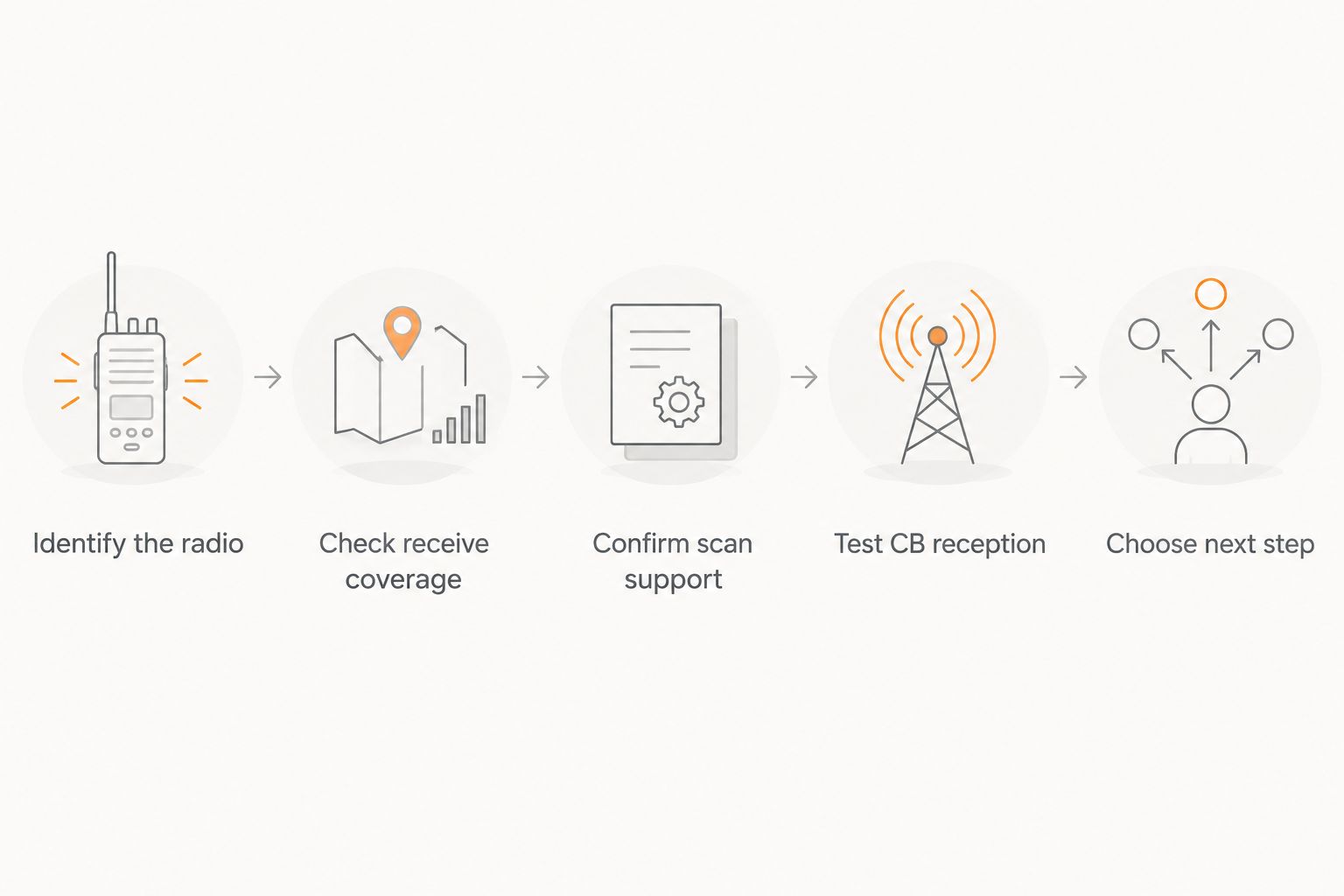
Write down the result of each check. A note such as CB audio works but automatic scan never starts points toward a different investigation than no sound in any supported receive mode.
Check the antenna without creating another fault
Inspect the coax connector, cable routing, and visible damage with power disconnected. A loose connection or damaged cable deserves attention before you assume an internal board has failed.
If you compare antennas or accessories, change one item at a time and record what changes. Do not transmit with the antenna disconnected, and follow the radio manual for any transmit-side checks.
Receiving noise is not proof that the antenna system is healthy. Likewise, silence on an inactive channel is not proof of a defective receiver. A known signal gives the comparison meaning.
Match replacement parts to the actual fault
A broken knob, failed control, damaged speaker, and unsupported listening mode are different problems. Replace a part to correct an identified fault—not to add receiver capabilities the radio never had.
Scott Radio & Electronics sells vintage CB replacement boards, knobs, meters, and speakers for hobbyists and DIY repair customers. That is relevant when you are restoring an existing radio’s intended functions, not converting it into a public-safety scanner.
Before selecting a replacement, compare the details that control fit:
- Boards: Printed identifiers, revision markings, connector locations, mounting points, and attached wiring.
- Knobs and controls: Shaft shape, shaft dimensions, control function, and clearance around neighboring controls.
- Speakers: Electrical rating, physical dimensions, mounting arrangement, and connections.
- Meters: Face and scale, mounting points, connections, and the electrical requirements of the original circuit.
Appearance alone is not enough. A part can resemble the original while differing in a detail that prevents correct installation or operation.
When should you ask for help matching a part?
Ask before ordering when a marking is unreadable, a connector differs, or a previous owner has changed the wiring. Do not force a shaft, drill mounting holes, or splice wiring just to make a visually similar part fit.
Contact the store with the full model designation, a photo of the identification label, clear views of the original part, and close-ups of markings and connections. Include measurements where fit depends on dimensions, and explain what the radio currently does.
Give Scott Radio & Electronics the symptom as well as the part description. Asking for a speaker because the radio is silent leaves out useful information; explaining whether an external speaker produces sound makes the request more specific without assuming the diagnosis.
Can a CB radio pick up police or fire channels?
A standard CB radio does not receive police or fire systems outside its supported receive coverage. A scan button does not change that restriction; the appropriate receiver must match the service’s frequencies, voice format, and system type.
Can you listen to CB without transmitting?
Yes, you can use a CB radio for receive-only listening without pressing the microphone’s push-to-talk switch. Use the correct power arrangement and antenna, and follow the model’s manual; some radios also depend on microphone connections for normal receive-audio operation.
Will an external speaker turn a CB into a scanner?
No, an external speaker changes where you hear the audio, not what the receiver can tune or decode. Match the speaker connection and electrical requirements to the radio before using it as a listening or troubleshooting accessory.
FAQ
Can a CB radio be used as a scanner in 2026?
A CB radio can scan supported CB channels if automatic scan is a built-in feature, but it cannot replace a general-purpose scanner. Its documented receive frequencies and modes determine what it can hear.
What frequencies does a standard U.S. CB radio receive?
The standard U.S. 40-channel CB allocation runs from 26.965 MHz to 27.405 MHz. Check the particular radio’s manual because older models and additional receive features differ.
Does every CB radio have a scan button?
No, automatic channel scanning is model-specific. A channel knob or channel display does not establish that the radio can scan automatically.
Can a weather-band CB hear police radios?
Weather-band reception does not establish police-radio compatibility. NOAA Weather Radio uses seven frequencies from 162.400 MHz to 162.550 MHz, and public-safety reception requires its own coverage and system checks.
Why does my CB scan stop on noise?
Noise that opens the squelch can cause scanning to stop. Check the manual’s squelch and scan settings, then investigate antenna connections and local electrical interference.
Can a digital scanner hear encrypted police traffic?
A digital scanner cannot decode encrypted voice. Digital-format compatibility and trunking support do not remove encryption.
Should I replace my CB speaker if I cannot hear anything?
Do not replace the speaker until you separate an audio fault from an antenna, setting, or receiver problem. Follow the manual and use a correctly matched external speaker only where the radio supports one.
One last thing
A moving channel display proves that the radio is changing channels—not that it can hear your target transmission. Before spending money in 2026, write down the service you want to monitor and compare it with the manual’s receive specifications.
For a vintage CB repair, keep the original part until the replacement is matched. Photos, markings, and measurements give Scott Radio & Electronics a concrete basis for discussing fit; a familiar brand name alone does not.
Related guides
- Best vintage CB radio speakers for restoration
- How to wire a base station CB radio to a 12-volt supply
- Best replacement knobs for vintage CB radios
{“@context”:”https://schema.org”,”@type”:”FAQPage”,”mainEntity”:[{“@type”:”Question”,”name”:”Can a CB radio be used as a scanner in 2026?”,”acceptedAnswer”:{“@type”:”Answer”,”text”:”A CB radio can scan supported CB channels if automatic scan is a built-in feature, but it cannot replace a general-purpose scanner. Its documented receive frequencies and modes determine what it can hear.”}},{“@type”:”Question”,”name”:”What frequencies does a standard U.S. CB radio receive?”,”acceptedAnswer”:{“@type”:”Answer”,”text”:”The standard U.S. 40-channel CB allocation runs from 26.965 MHz to 27.405 MHz. Check the particular radio’s manual because older models and additional receive features differ.”}},{“@type”:”Question”,”name”:”Does every CB radio have a scan button?”,”acceptedAnswer”:{“@type”:”Answer”,”text”:”No, automatic channel scanning is model-specific. A channel knob or channel display does not establish that the radio can scan automatically.”}},{“@type”:”Question”,”name”:”Can a weather-band CB hear police radios?”,”acceptedAnswer”:{“@type”:”Answer”,”text”:”Weather-band reception does not establish police-radio compatibility. NOAA Weather Radio uses seven frequencies from 162.400 MHz to 162.550 MHz, and public-safety reception requires its own coverage and system checks.”}},{“@type”:”Question”,”name”:”Why does my CB scan stop on noise?”,”acceptedAnswer”:{“@type”:”Answer”,”text”:”Noise that opens the squelch can cause scanning to stop. Check the manual’s squelch and scan settings, then investigate antenna connections and local electrical interference.”}},{“@type”:”Question”,”name”:”Can a digital scanner hear encrypted police traffic?”,”acceptedAnswer”:{“@type”:”Answer”,”text”:”A digital scanner cannot decode encrypted voice. Digital-format compatibility and trunking support do not remove encryption.”}},{“@type”:”Question”,”name”:”Should I replace my CB speaker if I cannot hear anything?”,”acceptedAnswer”:{“@type”:”Answer”,”text”:”Do not replace the speaker until you separate an audio fault from an antenna, setting, or receiver problem. Follow the manual and use a correctly matched external speaker only where the radio supports one.”}}]}
