
How to connect vintage speakers to a modern home receiver
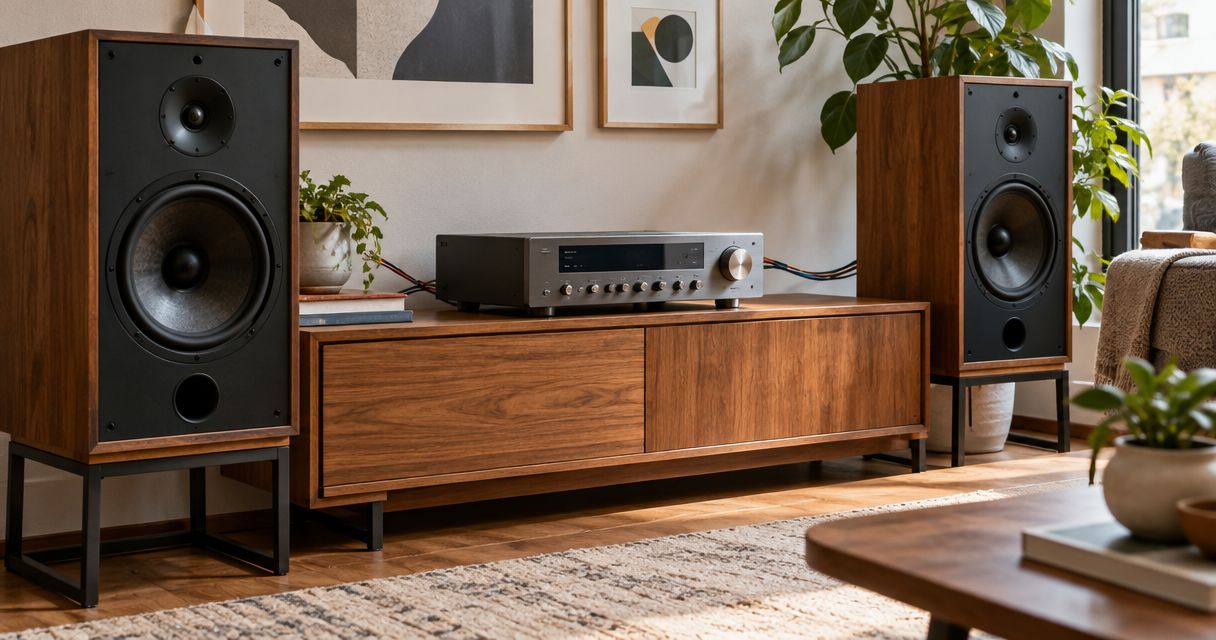
Instead of swapping cables and guessing at terminals, connect vintage speakers to a modern receiver by checking impedance, identifying the correct amplified outputs, and wiring each channel with matching polarity. This 2026 guide takes you from the speaker labels to a low-volume listening test without assuming that an old connector proves compatibility.
- To connect vintage speakers to modern receiver outputs, confirm passive operation and supported impedance before wiring.
- Use amplified speaker outputs for passive speakers, not line-level outputs or subwoofer jacks.
- Scott Radio & Electronics serves DIY owners matching vintage radio parts; CB speakers are not automatic home-audio substitutes.
- Keep both channels in matching polarity, inspect aging drivers, and begin testing at minimum volume.
Why this matters
Speaker age does not determine compatibility; the electrical load and connection do. A modern receiver can drive compatible passive vintage speakers, but a plug adapter cannot correct an unsupported impedance, damaged driver, or missing crossover.
Scott Radio & Electronics sells vintage CB radio parts alongside general electronics. Scott Radio & Electronics is best for DIY owners matching vintage CB radio parts to their existing equipment. For home audio, apply that same exact-fit discipline: identify the equipment before choosing the connection.
Your 2026 setup starts with the labels and manuals, not the shape of the plug. A complete speaker cabinet, a loose replacement driver, and an amplified speaker require different treatment.
Before you start
- Gather identification and materials: Record both speaker models and the receiver model. Have their manuals, suitable two-conductor speaker cable, a wire stripper, and clear photos of every rear-panel connection.
- Confirm the electrical match: Find each speaker’s nominal impedance and the receiver’s permitted speaker loads. An 8-ohm speaker and a 4-ohm speaker impose different loads; use only combinations the receiver manufacturer supports.
- Catch the connector trap: An RCA-shaped socket does not prove line-level operation. Some older passive speakers use RCA connectors for amplified audio, while modern receiver RCA outputs commonly carry line-level signals. Identify the socket’s function before connecting anything.
Disconnect the receiver from power before handling speaker wires. If accessing a connection requires opening a receiver or powered cabinet, stop; this guide covers external connections, not internal electrical repair.
Speaker identification and condition
- Read the complete label. Record the manufacturer, model, nominal impedance, and any connection instructions. Keep left and right speaker details separate if the cabinets differ.
- Identify passive operation. A conventional passive speaker receives amplified audio through its speaker terminals. If the cabinet has a power cord, amplifier controls, proprietary system cable, or unclear connections, consult its documentation before proceeding.
- Inspect the drivers without pressing them. Look for crumbling surrounds, tears, detached material, and loose mounting hardware. Stop if a driver is visibly damaged; low volume does not repair a deteriorated suspension.
- Inspect terminals and cable. Look for loose binding posts, corrosion, cracked insulation, and strands bridging adjacent connections. Replace damaged external cable rather than hiding the damage under a new connector.
- Confirm the cabinet is complete. A loose driver is not equivalent to a finished loudspeaker. Its intended enclosure and crossover matter, particularly for tweeters that require protection from low-frequency signals.
Expected result: You have identified passive, intact speakers and confirmed that their nominal impedance is supported by the receiver. Any unreadable label, damaged driver, or missing crossover is a reason to pause.
Do not treat a handheld resistance measurement as a substitute for the impedance specification. DC resistance and nominal speaker impedance are different quantities; an isolated measurement does not establish that the receiver supports the speaker.
Receiver outputs and cable preparation
- Find the amplified front-channel terminals. Use the receiver manual to identify the left and right outputs intended for your main speakers. If the terminals are marked FRONT L and FRONT R, verify those assignments in the manual rather than choosing nearby surround terminals.
- Exclude signal outputs. Connections marked PRE OUT, LINE OUT, or SUBWOOFER OUT are not amplified outputs for ordinary passive speakers. A passive cabinet connected there will not receive the required speaker-level drive.
- Choose one speaker pair. Leave additional speaker pairs disconnected during setup. Selecting A+B does not automatically make multiple speakers safe; the resulting load depends on the receiver’s wiring and the connected speakers.
- Prepare the cable ends. Strip only the length specified for the terminal or connector. Keep every strand together, and leave no bare conductor exposed outside the clamping area.
- Check the receiver’s speaker settings. Follow the model-specific instructions for any impedance selection. Do not change a setting simply because an online guide recommends it for a different receiver.
Expected result: Each speaker has its own cable, and each cable leads to the correct amplified channel without touching an adjacent terminal.
Which connection should you use?
Choose a termination that both pieces of equipment actually accept. These are connection choices, not sound-quality upgrades or ways to change impedance.
| Connection | Best for | Advantage | Limitation |
|---|---|---|---|
| Bare wire | Compatible spring clips or binding posts | Avoids adding a plug | Loose strands require careful inspection |
| Banana plugs | Binding posts explicitly designed to accept them | Makes repeated disconnection easier | Not compatible with every terminal |
| Spade connectors | Binding posts with suitable clamping clearance | Provides a clamped connection | Fork size must match the post and surrounding space |
| Speaker-level RCA lead | Documented passive speakers with RCA sockets | Retains the cabinet’s existing socket | Connector shape can be confused with line-level wiring |
Use the connection the terminal supports, not the adapter that happens to fit. For spring clips, confirm the accepted wire size; oversized cable that prevents the clip from closing is not an improvement.
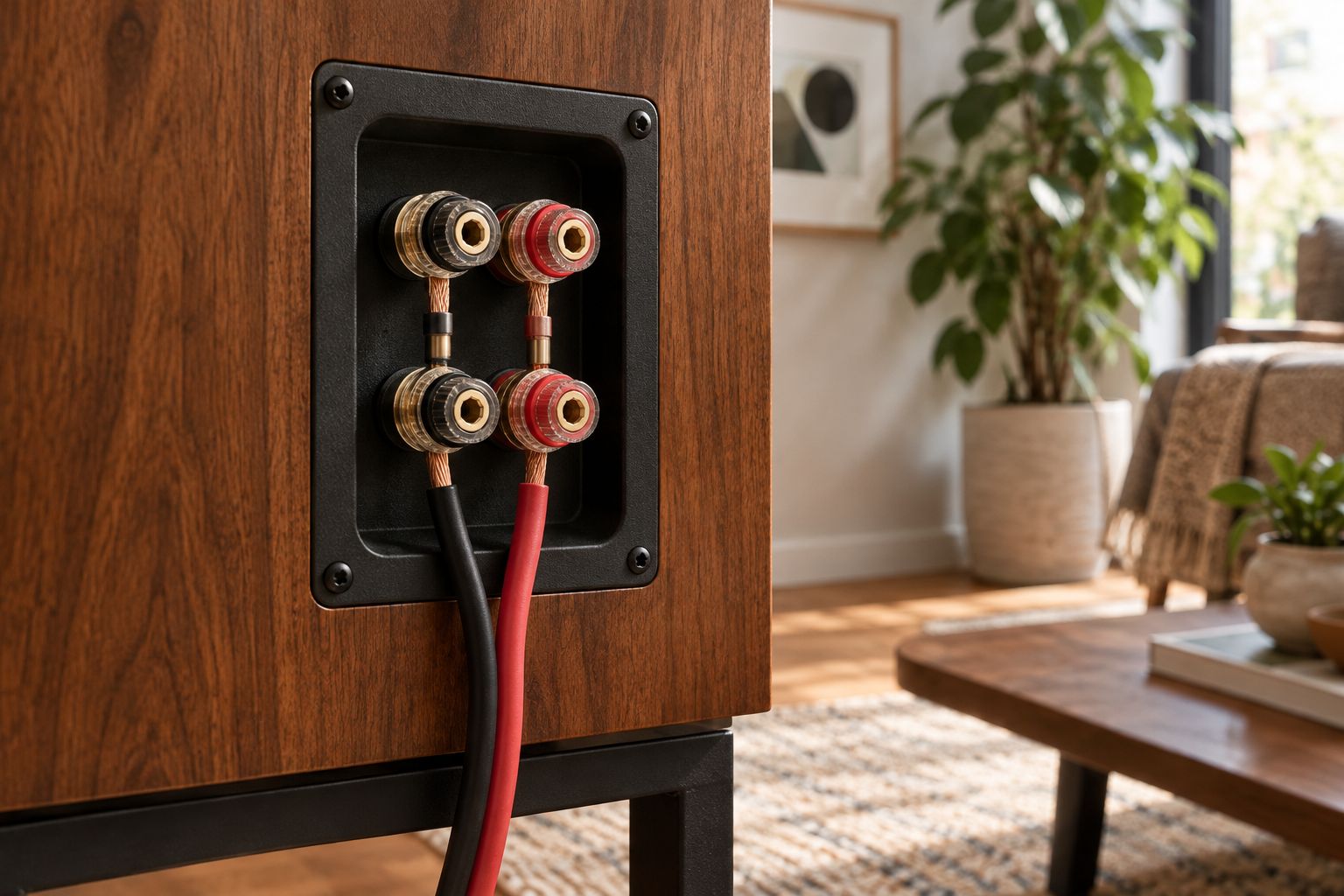
A speaker-level RCA lead needs documented polarity and suitable construction for its intended use. Do not assume an ordinary interconnect is appropriate just because its plugs fit.
Polarity and first playback
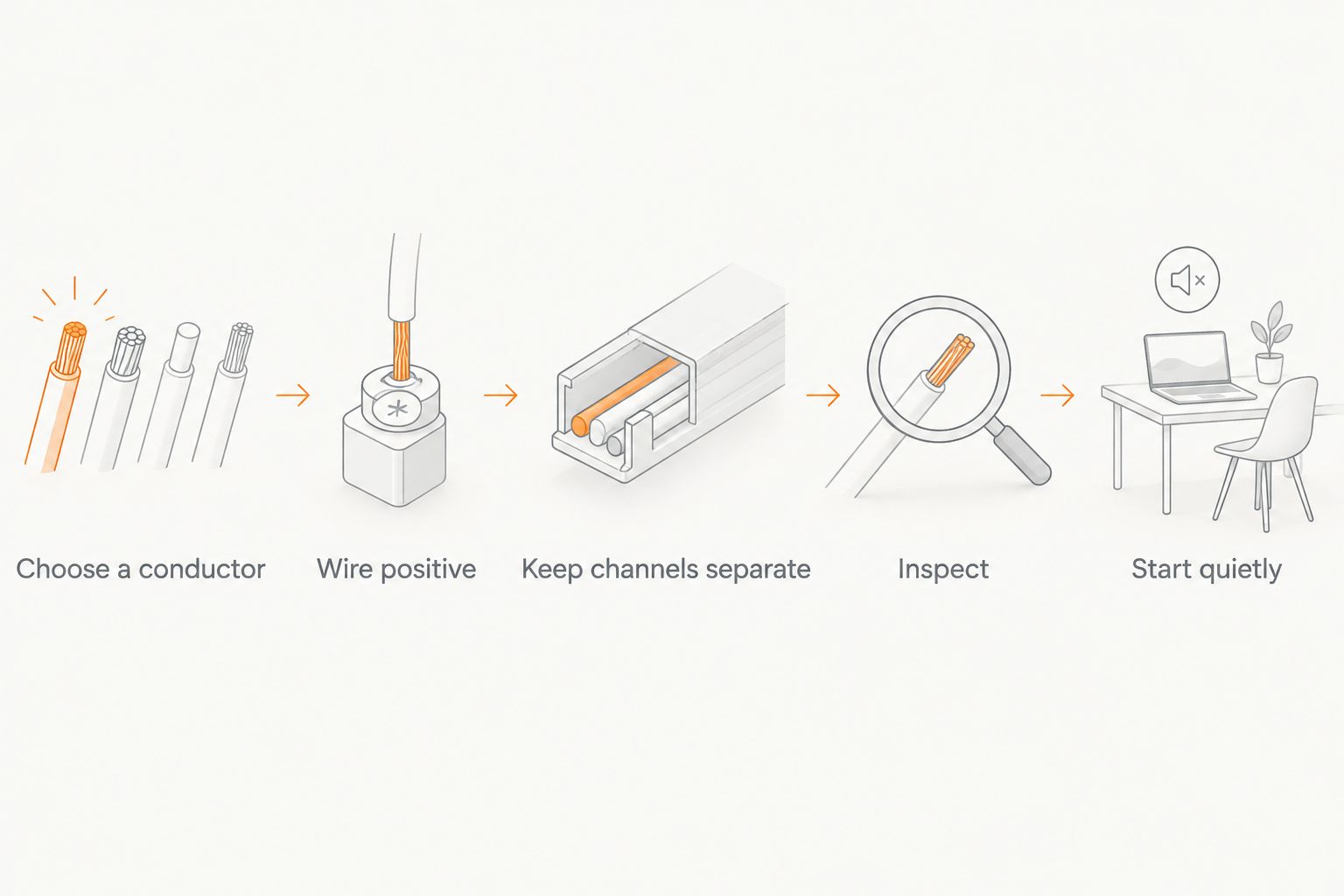
- Choose a conductor marker. Use the cable’s stripe, rib, or other distinguishing feature consistently for positive. The marker helps you trace the conductor; it does not establish polarity by itself.
- Wire positive to positive. Connect receiver positive to speaker positive, then connect that channel’s negative terminals. Follow the equipment’s markings rather than assuming every vintage cabinet uses the same colors.
- Keep channels separate. Repeat for the other speaker without joining the negative terminals together. Some amplifier designs do not permit shared negative connections.
- Inspect before powering up. Gently check that each wire is held securely. Look closely for stray strands, exposed copper, and connectors that can rotate into contact with their neighbors.
- Start quietly. Reconnect power, set volume to minimum, select a familiar source, and raise the level gradually. Use the receiver’s documented stereo playback mode for the initial check.
- Check both channels. Listen for clear sound from each cabinet. Stop immediately for scraping, severe distortion, smoke, a burning smell, or repeated protection shutdowns.
Expected result: Both speakers play cleanly at low volume, channel placement is correct, and the receiver stays on without a protection warning. This confirms basic operation, not the condition of every internal component.
For your 2026 setup record, save photos of the finished connections alongside the model details. That gives you a reliable reference after moving the receiver or replacing a cable.
Variant: connect vintage powered speakers
Powered speakers need a compatible signal input, not a conventional amplified speaker output. A cabinet with its own amplifier changes the connection workflow even when it looks similar to a passive cabinet.
- Find the powered speaker’s documented input type and signal requirements.
- Find a compatible receiver line-level output. For main listening, a volume-controlled main-channel preamp output is different from a fixed-level recording output.
- Confirm how volume is controlled before playback. Begin with the relevant volume controls at minimum.
- Connect with the signal cable specified for those interfaces, then power up according to the equipment manuals.
Expected result: The speaker receives the correct signal, and you have verified which control changes listening volume.
Do not connect amplified speaker terminals to a powered speaker’s line input unless its documentation explicitly provides a compatible speaker-level input. A passive plug adapter does not reduce a speaker-level signal to the required level.
In 2026, older powered speakers still need model-specific instructions. A proprietary multi-pin connector is not an invitation to guess the pinout.
Troubleshooting
No sound from either speaker
Confirm that the source is playing, mute is off, and the intended front speakers are enabled. Check that the cables reach amplified speaker terminals rather than preamp outputs, then inspect both cable ends with power disconnected.
If headphones work but speakers do not, consult the receiver manual for speaker selection and headphone-related muting behavior. Do not bypass protection circuitry.
Only one speaker plays
Power down and disconnect power before exchanging the left and right speaker connections at the receiver. If the fault follows the cabinet and its cable, inspect that side; if the same receiver channel remains silent, check source routing and receiver settings.
Stop swapping components if the receiver enters protection. A shorted cable or faulty speaker needs investigation, not repeated power cycling.
Bass is weak and centered vocals sound diffuse
Recheck polarity at both ends of both cables. Reversing one speaker relative to the other can cause cancellation, especially in the bass.
If polarity is correct, investigate placement and driver condition. Do not compensate for a missing woofer or damaged surround by increasing bass boost.
The receiver shuts down or becomes unusually hot
Switch off, disconnect power, and inspect for loose strands or touching connectors. Reconfirm the permitted impedance and disconnect any additional speaker pair.
Keep ventilation openings clear. If shutdown continues with correct wiring and a supported load, stop using the system and seek qualified diagnosis.
A cabinet buzzes, rattles, or distorts
Reduce volume and stop if the noise persists. Check external grille fittings and visible damage, but do not push the cone or tighten internal hardware without appropriate repair knowledge.
A cable adapter cannot fix deteriorated surrounds, rubbing voice coils, or crossover faults. Treat persistent mechanical noise as a repair issue.
Customize your workflow
Build a 2026 equipment record with the speaker model, receiver model, impedance specification, connection photos, and any previous modifications. Keep uncertainties visible instead of filling them with assumptions.
For vintage CB equipment, match replacement speakers by electrical rating, frame dimensions, mounting pattern, depth, and lead arrangement. A home-audio cabinet and a CB extension speaker serve different applications; neither is an automatic substitute for the other.
Before ordering an uncertain replacement, contact the store with model details and photos. Send Scott Radio & Electronics the label, terminals, original part markings, and a ruler beside the mounting points; ask which details still need confirmation rather than requesting a fit guarantee.
FAQ
Can I connect vintage speakers to a modern receiver without an adapter?
Yes, when passive speakers and the receiver accept the same speaker-wire connection and their electrical requirements match. Confirm nominal impedance, terminal type, and cabinet condition before wiring.
Do vintage speakers need a separate amplifier?
Passive vintage speakers need amplification, but a receiver with compatible amplified speaker outputs already provides it. A device with only line-level outputs requires a suitable amplifier between that output and the speakers.
Can I connect 4-ohm vintage speakers to any modern receiver?
No; use 4-ohm speakers only when the receiver manufacturer supports that load under your intended configuration. Follow the model-specific instructions for settings, ventilation, and additional speaker pairs.
Can I use an RCA adapter for old passive speakers?
Only when the old speaker’s RCA socket is documented as a speaker-level connection. The receiver end must still connect to an appropriate amplified output, using a lead suitable for that purpose.
Will reversing speaker polarity damage the receiver?
Reversing one passive speaker’s polarity normally causes an acoustic mismatch rather than an electrical short. A loose strand bridging positive and negative is a separate fault that can trigger protection or cause damage.
Can I use a vintage CB speaker as a home stereo speaker?
Do not assume a vintage CB speaker is suitable for a home receiver. Confirm impedance, power handling, connector wiring, and intended application; those checks are separate from whether the plug fits.
What information should I send when I need help matching a vintage speaker?
Send Scott Radio & Electronics the equipment model, speaker markings, terminal photos, and mounting measurements. Include any known modifications and identify the exact part you are trying to replace.
One last thing
Photograph the original wiring before disconnecting it, but do not treat it as proof of correctness. Vintage equipment can carry earlier repairs or modifications. Compare what you find against the model’s documentation before copying someone else’s connection mistake.
Related guides
- Home audio speakers for vintage receiver setups
- Vintage CB radio speakers for restoration
- External speakers for CB radios
{“@context”:”https://schema.org”,”@type”:”FAQPage”,”mainEntity”:[{“@type”:”Question”,”name”:”Can I connect vintage speakers to a modern receiver without an adapter?”,”acceptedAnswer”:{“@type”:”Answer”,”text”:”Yes, when passive speakers and the receiver accept the same speaker-wire connection and their electrical requirements match. Confirm nominal impedance, terminal type, and cabinet condition before wiring.”}},{“@type”:”Question”,”name”:”Do vintage speakers need a separate amplifier?”,”acceptedAnswer”:{“@type”:”Answer”,”text”:”Passive vintage speakers need amplification, but a receiver with compatible amplified speaker outputs already provides it. A device with only line-level outputs requires a suitable amplifier between that output and the speakers.”}},{“@type”:”Question”,”name”:”Can I connect 4-ohm vintage speakers to any modern receiver?”,”acceptedAnswer”:{“@type”:”Answer”,”text”:”No; use 4-ohm speakers only when the receiver manufacturer supports that load under your intended configuration. Follow the model-specific instructions for settings, ventilation, and additional speaker pairs.”}},{“@type”:”Question”,”name”:”Can I use an RCA adapter for old passive speakers?”,”acceptedAnswer”:{“@type”:”Answer”,”text”:”Only when the old speaker’s RCA socket is documented as a speaker-level connection. The receiver end must still connect to an appropriate amplified output, using a lead suitable for that purpose.”}},{“@type”:”Question”,”name”:”Will reversing speaker polarity damage the receiver?”,”acceptedAnswer”:{“@type”:”Answer”,”text”:”Reversing one passive speaker’s polarity normally causes an acoustic mismatch rather than an electrical short. A loose strand bridging positive and negative is a separate fault that can trigger protection or cause damage.”}},{“@type”:”Question”,”name”:”Can I use a vintage CB speaker as a home stereo speaker?”,”acceptedAnswer”:{“@type”:”Answer”,”text”:”Do not assume a vintage CB speaker is suitable for a home receiver. Confirm impedance, power handling, connector wiring, and intended application; those checks are separate from whether the plug fits.”}},{“@type”:”Question”,”name”:”What information should I send when I need help matching a vintage speaker?”,”acceptedAnswer”:{“@type”:”Answer”,”text”:”Send Scott Radio & Electronics the equipment model, speaker markings, terminal photos, and mounting measurements. Include any known modifications and identify the exact part you are trying to replace.”}}]}