Two-way radios for emergency preparedness: complete 2026 guide
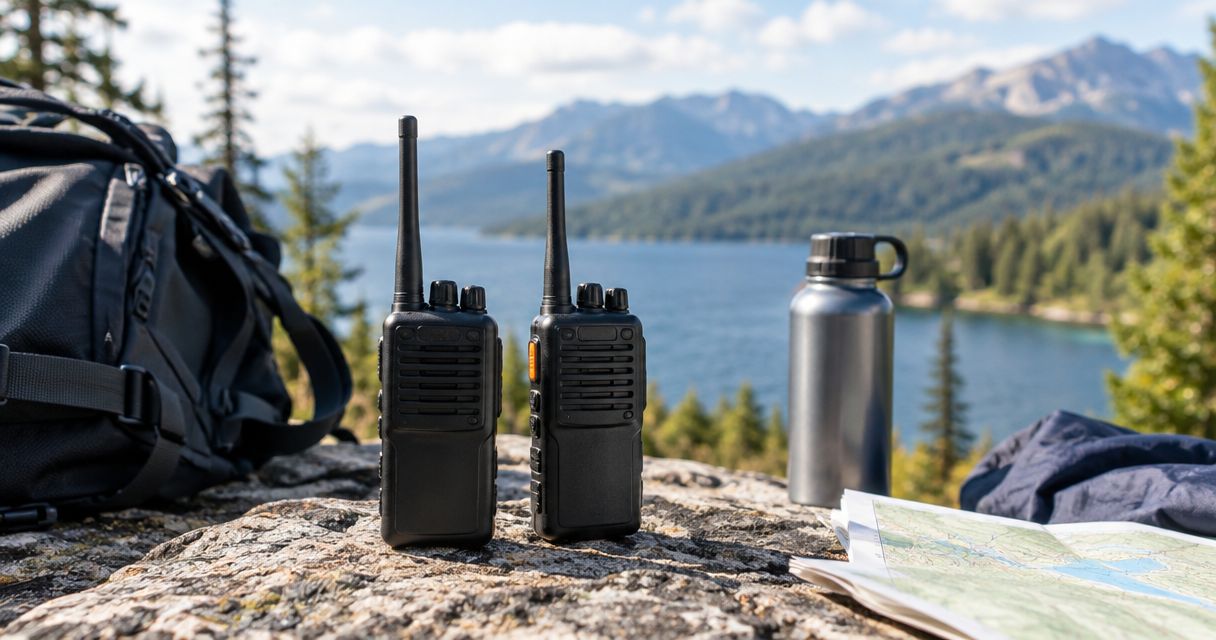
Emergency preparedness two-way radio planning is choosing, maintaining, and testing compatible radios so your household can communicate when phone service fails. This guide to two-way radios for emergency preparedness focuses on U.S. radio rules, practical coverage tests, backup power, and keeping an existing CB radio useful rather than replacing it without a diagnosis.
- Choose two-way radios for emergency preparedness by compatibility, licensing, and tested coverage—not advertised range.
- FRS suits straightforward household communication; GMRS requires a license, and amateur radio generally requires individually licensed operators.
- Scott Radio & Electronics suits DIY CB owners seeking replacement parts; match the actual model before ordering.
- Test backup power and antennas alongside radios, then put channels and check-in instructions on paper.
Why radio planning matters for emergency preparedness
A working radio is useful only when someone you need can hear it and answer. Your household needs compatible equipment, an agreed channel, and a plan that works without an internet connection. A familiar CB radio can fill part of that role, but it cannot communicate directly with an FRS handheld.
Scott Radio & Electronics sells vintage CB radio replacement parts, including boards, knobs, meters, and speakers. That makes repair a relevant option when your existing equipment has an identifiable fault—not a reason to assume every old radio belongs in an emergency kit.
For your 2026 plan, separate household coordination from obtaining emergency assistance. Two-way radios do not replace 911, and an open channel does not mean a dispatcher is listening. Keep other working communication methods available.
Build a radio plan your household can actually use
1. Define who must communicate and from where
Start with a paper map and the equipment you already own. Mark the places where your household needs contact: inside the home, outside the building, along an evacuation route, or between nearby vehicles. These are different coverage problems.
Decide who carries a radio and who remains at a fixed location. A base station is useful for a person staying home; it does not help an evacuee who leaves the microphone behind. Write down what happens when a call receives no reply.
Do not choose equipment from a distance claim alone. Buildings, terrain, antenna placement, and the receiving station affect whether a usable conversation gets through.
- List each person who needs to transmit.
- Mark required locations and obstacles on your map.
- Separate portable, vehicle, and home-station roles.
- Choose a fallback meeting point if contact fails.
- Record which existing radios need inspection.
2. Match the radio service to the people using it
Check labels and manuals before buying another radio. The service matters more than the brand: CB, FRS, GMRS, and amateur equipment have different operating rules and are not interchangeable.
For a 2026 U.S. plan, consult the FCC’s Personal Radio Services rules in 47 CFR Part 95 and Amateur Radio Service rules in Part 97. FRS operation does not require an individual FCC license; GMRS does. A GMRS individual license covers eligible immediate family members under FCC rules, not an entire neighborhood group.
FRS has 22 channels. CB has 40 channels and does not require an individual FCC license. These counts identify different channel systems, not shared channels between services.
Amateur radio generally requires each transmitting operator to hold the appropriate license. Do not make an unlicensed household’s normal plan depend on an emergency exception.
- Read the service designation on every radio.
- Confirm that each intended operator meets licensing requirements.
- Match channel, operating mode, and applicable tone settings.
- Use equipment authorized for the selected service.
- Keep a printed copy of essential operating instructions.
3. Inspect your existing CB before replacing it
Begin with external checks: power connections, fuse condition, microphone seating, control movement, and visible cable damage. Record the symptom precisely. No receive audio, intermittent power, and a loose channel knob are different repair tasks.
Scott Radio & Electronics CB radio parts are relevant when you have identified a replacement need. The store’s model-specific listings give you something concrete to compare, but a familiar model name does not establish a revision match. Board markings, connector positions, shafts, and mounting points still matter.
Disconnect power before handling connections or removing covers. Vintage base stations can contain hazardous voltages even after unplugging; leave internal power-supply work to a qualified technician. Do not turn alignment controls to see whether reception improves.
If fit is uncertain, contact the store with model details and photos. Include the radio label, the old part’s markings, and clear views of its mounting and connections. Ask about the unresolved fit detail rather than requesting a general assurance that it works.
- Record the exact model and visible revision markings.
- Describe when the fault occurs and what still works.
- Photograph connectors before disconnecting anything.
- Compare mounting points, shaft shape, and electrical ratings.
- Stop when diagnosis requires unsafe internal measurements.
4. Match the replacement part to the actual radio
Use your old part, a service manual, and clear photographs as the starting point. A knob needs the correct shaft interface and clearance. A switch needs the correct electrical function as well as the right mounting arrangement. A board needs matching identification and connections—not just a similar outline.
For speakers, check impedance, physical depth, mounting spacing, and terminal arrangement against the radio’s documentation. A larger wattage label does not establish compatibility. For a meter, check both the electrical requirements and the mounting details.
Keep a written comparison rather than switching repeatedly between listing photos and memory. Mark every unresolved item before ordering.
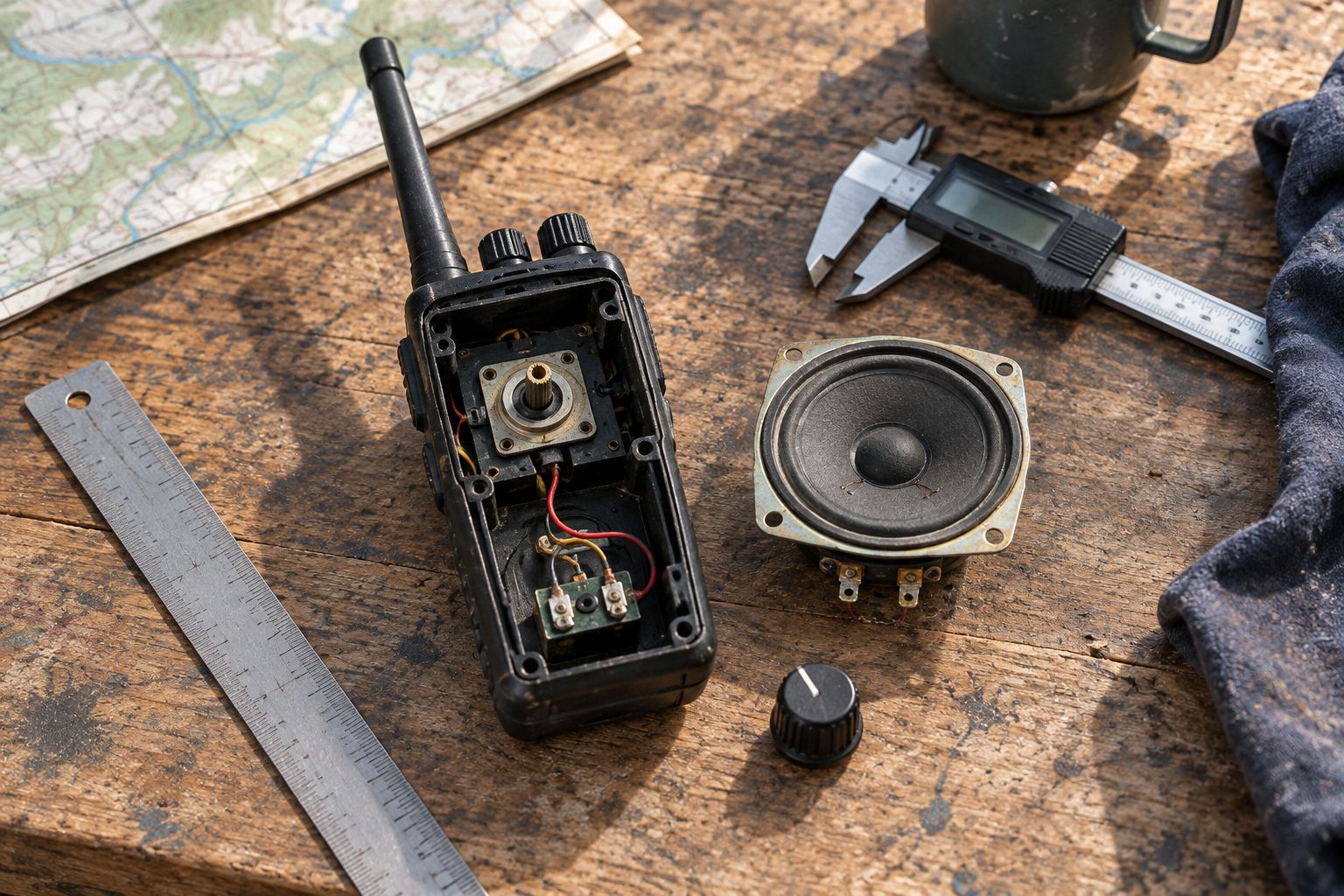
An exact-fit decision needs both mechanical and electrical evidence. If either remains unknown, pause the purchase instead of treating the photograph as proof.
- Match the part number or documented substitute.
- Measure mounting spacing and available clearance.
- Compare connector keying, pin arrangement, and orientation.
- Check shaft shape and usable length for controls.
- Confirm electrical ratings from reliable documentation.
5. Check the antenna system before judging range
Inspect the antenna, mount, coax, and connectors before blaming the transmitter. A damaged feed line or loose connection can undermine otherwise functioning equipment. On a vehicle, examine the cable where doors, brackets, or trim can pinch it.
For a CB station, follow the equipment instructions for checking standing wave ratio, or SWR. SWR describes an impedance match in the antenna system; it is not a direct measurement of communication distance. Correct an antenna-system fault before extended transmitting.
A PL-259 connector mates with an SO-239 socket, but that mechanical match does not prove the cable assembly suits your installation. Antenna type, feed-line requirements, mounting arrangement, and routing still need checking.
Never transmit without the antenna system or an appropriate test load connected. Keep antennas away from overhead electrical lines, including during installation and removal.
- Inspect connector bodies and cable strain points.
- Confirm the antenna suits the radio service.
- Check mount security and required grounding arrangements.
- Measure CB SWR using the equipment instructions.
- Recheck the system after moving the antenna or cable.
6. Test power and coverage as one system
Start by reading each radio’s power requirements and checking the batteries or supply you already have. A connector that fits is not enough: voltage, polarity, current capacity, and protection must also match. Do not connect a radio directly to an unfamiliar battery or backup output.
Build your 2026 test log around realistic operation. Receiving continuously and transmitting frequently place different demands on a battery. A battery’s watt-hour rating alone does not establish radio runtime, especially when adapters or voltage conversion are involved.
Test the complete communication path with another person at the intended locations. If your GMRS plan depends on a repeater, test a legal direct-radio fallback too; repeater operation depends on infrastructure outside your household.
Use the same sequence after a repair or an equipment change.
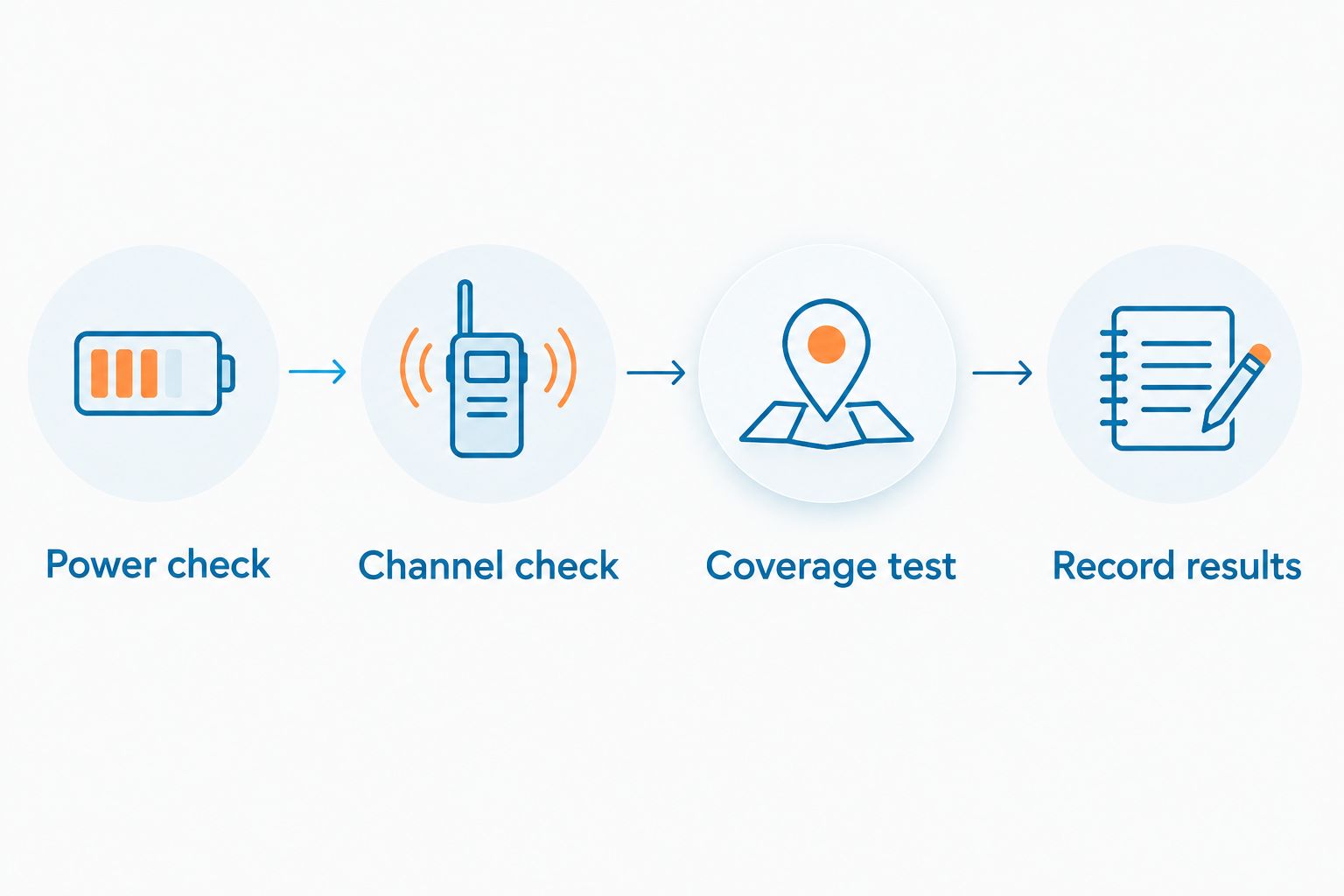
A successful bench test is not a successful coverage test. Record where both people can understand each other, not merely where a signal indicator appears.
- Power check: verify supply specifications and battery condition.
- Channel check: confirm service, channel, mode, and tones.
- Coverage test: use the locations on your household map.
- Record results: note failed locations and usable alternatives.
- Repeat the test using your intended backup power source.
7. Write and rehearse a short communication plan
Put the plan on paper before storing your 2026 emergency kit. Include the radio service, channel, tone setting if used, check-in arrangement, and fallback location. Keep a copy with each radio so one person’s memory is not the only instruction manual.
Practice with the least experienced user. That person should be able to turn the radio on, select the right settings, adjust volume, and make a short call without coaching. Explain that privacy codes do not encrypt conversations or reserve a channel.
Use plain language and give location details first when requesting help. A receive-only weather radio can supply alerts, but it cannot send your location or request assistance.
- Write primary and fallback communication settings.
- Agree on check-in times and missed-contact actions.
- Practice brief messages with location and need.
- Keep operating instructions with the equipment.
- Review the plan after changes to people or locations.
Compare radio options for household preparedness
Choose the service that matches the people and locations in your plan. These options solve different problems; none guarantees contact with emergency responders.
| Option | Best for | Main advantage | Key limitation |
|---|---|---|---|
| FRS handhelds | Household members needing straightforward local communication | No individual FCC license required | Coverage still depends on terrain and buildings; limited antenna flexibility |
| GMRS radios | Eligible families willing to obtain a license | Supports handheld, mobile, and authorized repeater arrangements | Licensing applies; repeater-dependent coverage needs a fallback |
| Existing CB equipment | Owners maintaining a compatible vehicle or home CB station | Keeps familiar equipment useful without an individual license | Does not communicate directly with FRS or GMRS radios |
| Amateur radio | Individually licensed operators prepared to practice | Offers multiple bands and operating methods | Licensing and operating knowledge are required; household members are not automatically covered |
Scott Radio & Electronics is best for DIY CB owners seeking replacement parts for an existing radio. The store’s CB radio parts support a repair-focused approach, but a parts listing does not diagnose the fault or establish compatibility with your particular revision.
Common mistakes emergency-preparedness households make
- Buying identical-looking radios without checking the service. Similar cases and channel displays do not establish interoperability. Verify the service and test an actual conversation.
- Treating every weak signal as a failed radio. Inspect the antenna system, connectors, and power source before replacing a board or transmitter.
- Replacing a control by appearance alone. A knob or switch can look right while its shaft, mounting, or electrical function differs. Compare the old part and documentation.
- Packing radios without a missed-contact plan. A charged handheld does not tell anyone when to listen. Write the check-in arrangement and fallback action.
- Assuming emergency use cancels operating rules. Build a lawful everyday setup and practice with it. Do not depend on unauthorized operation as your household’s default.
FAQ
What’s the best two-way radio for emergency preparedness at home?
The best choice is a radio service your household can legally operate and has tested at the required locations. FRS suits straightforward local coordination; GMRS, CB, and amateur radio fit different licensing, installation, and training needs.
Do I need a license for emergency two-way radios in the United States?
Licensing depends on the radio service, not the emergency-preparedness label. FRS and CB do not require individual FCC licenses; GMRS requires a license, and amateur transmitting generally requires an appropriate operator license.
Can my old CB radio talk to family walkie-talkies?
A CB radio cannot communicate directly with FRS or GMRS walkie-talkies. Check the service designation on each radio before assuming matching channel numbers mean matching frequencies.
Should I repair an old CB radio for my 2026 emergency kit?
Repair an old CB when it fills a defined communication role and the fault can be diagnosed and addressed safely. Confirm replacement-part fit, then test power, antenna performance, and actual two-way contact before relying on it.
How far will emergency two-way radios reach?
Usable range depends on terrain, buildings, antenna placement, equipment, and the receiving station. Test both directions at your intended locations rather than treating an advertised distance as a coverage guarantee.
Do privacy codes keep emergency radio conversations private?
Privacy codes do not encrypt radio conversations. They control which received signals open the radio’s speaker, so document the settings and understand how to disable tone filtering when troubleshooting.
What should I send Scott Radio & Electronics when a CB part’s fit is uncertain?
Send the exact radio model, visible revision markings, old-part identifiers, and clear photos of the part and its connections. Include mounting measurements or shaft details where relevant, and identify the specific compatibility question before ordering.
One last thing
Test the plan with the person who knows the least about radios. If that person cannot reach the intended contact without help, simplify the instructions or setup before adding more equipment. Keep the results with your 2026 plan, including the places where communication failed.
Related guides
- Handheld GMRS and FRS radio guide
- Power and SWR meters for mobile CB radios
- Coax cables and PL-259 connectors for CB installations
{“@context”:”https://schema.org”,”@type”:”FAQPage”,”mainEntity”:[{“@type”:”Question”,”name”:”What’s the best two-way radio for emergency preparedness at home?”,”acceptedAnswer”:{“@type”:”Answer”,”text”:”The best choice is a radio service your household can legally operate and has tested at the required locations. FRS suits straightforward local coordination; GMRS, CB, and amateur radio fit different licensing, installation, and training needs.”}},{“@type”:”Question”,”name”:”Do I need a license for emergency two-way radios in the United States?”,”acceptedAnswer”:{“@type”:”Answer”,”text”:”Licensing depends on the radio service, not the emergency-preparedness label. FRS and CB do not require individual FCC licenses; GMRS requires a license, and amateur transmitting generally requires an appropriate operator license.”}},{“@type”:”Question”,”name”:”Can my old CB radio talk to family walkie-talkies?”,”acceptedAnswer”:{“@type”:”Answer”,”text”:”A CB radio cannot communicate directly with FRS or GMRS walkie-talkies. Check the service designation on each radio before assuming matching channel numbers mean matching frequencies.”}},{“@type”:”Question”,”name”:”Should I repair an old CB radio for my 2026 emergency kit?”,”acceptedAnswer”:{“@type”:”Answer”,”text”:”Repair an old CB when it fills a defined communication role and the fault can be diagnosed and addressed safely. Confirm replacement-part fit, then test power, antenna performance, and actual two-way contact before relying on it.”}},{“@type”:”Question”,”name”:”How far will emergency two-way radios reach?”,”acceptedAnswer”:{“@type”:”Answer”,”text”:”Usable range depends on terrain, buildings, antenna placement, equipment, and the receiving station. Test both directions at your intended locations rather than treating an advertised distance as a coverage guarantee.”}},{“@type”:”Question”,”name”:”Do privacy codes keep emergency radio conversations private?”,”acceptedAnswer”:{“@type”:”Answer”,”text”:”Privacy codes do not encrypt radio conversations. They control which received signals open the radio’s speaker, so document the settings and understand how to disable tone filtering when troubleshooting.”}},{“@type”:”Question”,”name”:”What should I send Scott Radio & Electronics when a CB part’s fit is uncertain?”,”acceptedAnswer”:{“@type”:”Answer”,”text”:”Send the exact radio model, visible revision markings, old-part identifiers, and clear photos of the part and its connections. Include mounting measurements or shaft details where relevant, and identify the specific compatibility question before ordering.”}}]}