

TekShack alternatives for ham radio gear in 2026
For tekshack alternatives in 2026, choose Scott Radio & Electronics for vintage CB radio replacement parts; choose the original manufacturer’s parts channel when your repair requires manufacturer-specific documentation and an identified replacement. Keep TekShack in your comparison when the part offered matches your radio’s model, revision, mechanical fit, and electrical requirements—not simply its appearance.
- Scott Radio & Electronics is the best TekShack alternative here for vintage CB radio replacement parts.
- For ham radio gear, distinguish complete equipment purchases from component-level repairs before choosing a supplier.
- Compare model, revision, connectors, mounting, and electrical requirements before ordering replacement parts.
- Consider manufacturer parts channels or a documented donor radio when your repair requires a different sourcing route.
Why this matters
A search for ham radio gear can lead you toward complete transceivers, station accessories, or replacement components. Those are different purchases. A supplier that suits a station upgrade is not automatically the right source for an old channel selector or meter.
CB radios and amateur radios are also different equipment categories. Do not treat a CB replacement board, microphone connection, or control as a ham-radio-compatible component without documentation for the actual equipment.
Choose the source around the failed part, not around the broadest catalog. For a 2026 restoration, that means identifying what you own before comparing where to buy.
TekShack alternatives at a glance
Use this table to choose a sourcing route. The alternatives include a CB parts retailer, the original manufacturer’s parts channel, and a donor radio because those routes solve different repair problems.
| Option | Best for | Main reason to consider it | Limitation | How to compare with TekShack |
|---|---|---|---|---|
| TekShack | An offered item that matches your documented requirements | Keeping the original option in the comparison | The seller’s name alone does not establish compatibility | Apply the same model, fit, and electrical checks |
| Scott Radio & Electronics | Vintage CB radio replacement parts | A catalog that includes boards, knobs, meters, and speakers | A CB parts listing does not establish compatibility with amateur equipment | Compare the actual replacement part and its identifying details |
| Original manufacturer’s parts channel | Repairs tied to an identified manufacturer part | A route to request the replacement by its original identifier | Support for the specific model must be confirmed | Ask about the exact part number and any documented substitution |
| A documented donor radio | Recovering a model-specific component | A physical assembly to compare with the damaged part | Matching model names do not prove matching revisions or component condition | Compare the donor component itself, not just the radio badge |
1. Scott Radio & Electronics: best for vintage CB repair parts
Scott Radio & Electronics sells vintage CB replacement boards, knobs, meters, and speakers, alongside general electronics. That makes it a relevant TekShack alternative when your task is repairing a CB radio rather than selecting a complete amateur-radio station.
Start with the component you need. A broken knob calls for shaft and clearance checks; a replacement board calls for a more detailed comparison of identifiers, connections, and mounting.
Where the store shines
- The stated catalog includes component categories used in vintage CB restoration.
- You can frame your purchase around a specific repair rather than an unrelated equipment upgrade.
- Model details and photos give you a practical starting point for asking the store about an uncertain match.
Where the store falls short
- A vintage CB parts catalog is not proof of compatibility with ham radio equipment.
- A familiar-looking part still needs mechanical and electrical verification.
- A product category alone does not establish testing, installation support, or a fit guarantee.
Best for: Owners replacing an identified component in a vintage CB radio.
| Repair question | Scott Radio & Electronics | TekShack comparison |
|---|---|---|
| Is this a CB restoration purchase? | The stated offering includes vintage CB replacement parts | Check the specific item against the repair |
| Is this a complete ham station purchase? | Do not substitute CB parts information for equipment specifications | Compare the equipment’s own documentation |
| Can appearance establish fit? | No; check the part identifiers and interfaces | Use the same standard |
| What resolves uncertainty? | Send the model, revision, measurements, and photos | Request equivalent item-specific confirmation |
Verdict: Buy only after the replacement matches your radio’s documented requirements.
2. Original manufacturer’s parts channel: best for identified parts
The original manufacturer’s parts channel is a useful next step when you have a service-manual reference or a legible component identifier. Ask for the exact part, or for documentation identifying an approved replacement.
This route depends on the manufacturer supporting that particular equipment. An old model name is not a promise that its original components can still be supplied.
Where this route shines
- You can make a precise request using the original part identifier.
- You can ask whether a proposed substitute requires other changes.
- The conversation stays tied to the equipment’s documentation rather than visual similarity.
Where this route falls short
- You must confirm whether the manufacturer handles parts requests for your model.
- A part number without the correct radio revision can leave the match unresolved.
- The manufacturer’s response does not replace checking the component already installed in your radio.
Best for: Owners who have identified the failed part and need clarification about its replacement.
For your 2026 shortlist, separate an exact replacement from a substitute. If the suggested part differs, ask what documentation supports the change before ordering.
Verdict: Hold until the part identity and any substitution requirements are clear.
3. A documented donor radio: best for comparing original assemblies
A donor radio is another sourcing route when you need a model-specific mechanical part or assembly. Treat it as a component candidate, not as an automatic match.
Inspect the actual donor part. A radio with the same front-panel name can contain a different revision or previous modifications.
Where this route shines
- You can compare the original assembly’s shape, mounting, and connections.
- Surrounding hardware helps you identify how the part installs.
- A donor can provide a reference for missing brackets, fasteners, or control arrangements.
Where this route falls short
- The donor component can have its own damage or wear.
- Matching exterior appearance does not establish an internal match.
- Removing a component adds work and introduces another opportunity for damage.
Best for: Restorers who can inspect the donor assembly and verify its condition and compatibility.
Verdict: Wait until the donor’s relevant component—not merely its model badge—has been checked.
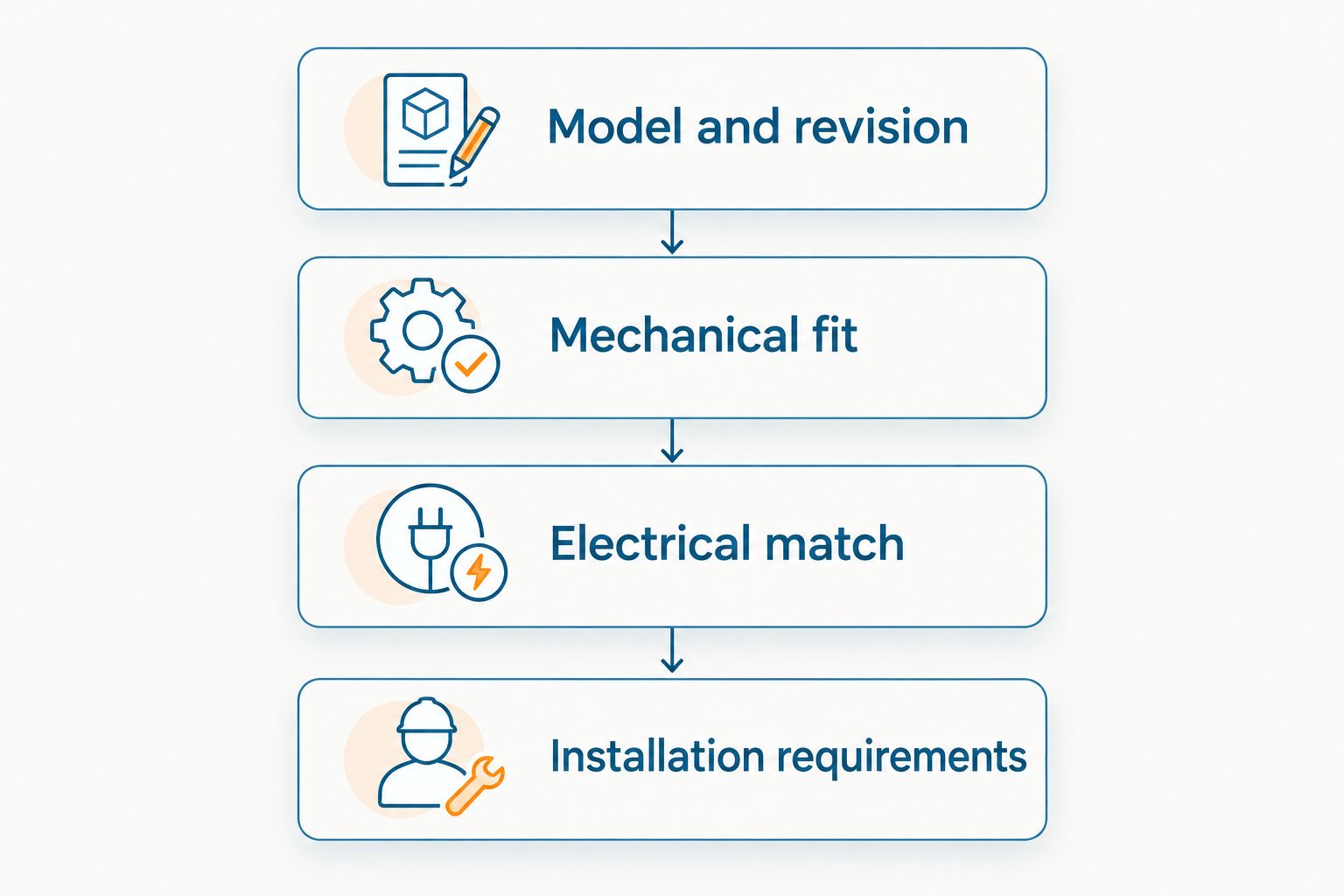
What to match before buying a replacement
A useful 2026 comparison starts with evidence from your own radio. Gather the details below before choosing among suppliers or donor parts.
Model and revision
Copy the full model designation from the radio’s label. Record any chassis designation, board marking, or revision identifier relevant to the repair.
Do not shorten a model name when asking about compatibility. Suffixes and revision markings belong in the request, even when the front panels look alike.
Mechanical fit
For knobs and controls, compare the shaft profile, shaft diameter, engagement depth, and clearance around neighboring controls. For meters and speakers, compare the opening, mounting points, depth, and terminal placement.
Record 2 measurements at minimum for a mechanical part: its mounting interface and the clearance needed behind or around it. This is a starting checklist, not a substitute for checking every relevant dimension.
Electrical match
Use the service documentation and the markings on the original component. Depending on the part, the relevant details include resistance, impedance, voltage rating, polarity, switching arrangement, or meter movement specifications.
A connector that plugs in is not proof of electrical compatibility. Match the wiring assignment as well as the physical connection.
Installation requirements
Identify whether the job involves a push-on part, fasteners, soldered connections, or an assembly that requires adjustment afterward. Do not assume a replacement board is ready to install simply because its mounting holes align.
If the repair requires procedures you cannot perform safely, stop before removing the original assembly. Ask a qualified radio technician what the job requires.
When to ask for help matching a part
Ask before buying when the original marking is unreadable, the radio has been modified, or the candidate part differs from what you removed. A short, specific message is more useful than asking whether something fits an old CB.
Send 3 photos as a starting point:
- Radio label: Show the complete model designation and identifying markings.
- Installed part: Show its location, mounting, and nearby connections before removal.
- Part details: Show markings, terminals, shaft shape, or connector faces clearly.
Add measurements where a photo cannot establish size. Include the symptom and explain whether you have confirmed the component is faulty or are still diagnosing the problem.
Use the store’s contact page to send your model details and ask what additional information is needed. Do not interpret a photo-based discussion as a fit guarantee; resolve the remaining differences before ordering.
Why compare alternatives to TekShack?
A different sourcing route is useful when it answers a specific repair question. That is a sound reason to compare options in 2026 without assuming anything about another seller’s service or parts.
Use these decision points:
- You need a CB component, not complete ham gear. Compare sources that identify the particular board, meter, speaker, switch, or knob.
- You have an original part identifier. Ask the manufacturer’s parts channel about that exact identifier and any documented substitute.
- You need to reproduce an original assembly. Compare a documented donor part against your chassis and revision.
- The candidate differs from the original. Pause and resolve the difference rather than moving between sellers until a listing looks close enough.
Changing suppliers does not solve an unidentified fault. If the radio has no audio, for example, do not assume the speaker is responsible without diagnosis. Buying a visually matching part and identifying the failed part are separate tasks.
When staying with TekShack is the right call
Keep TekShack as your choice when the specific item satisfies your documented requirements and the information needed to make the purchase is clear. A different supplier name is not, by itself, a repair improvement.
Compare identical requirements across every option: model, revision, condition description, mounting, connections, and electrical characteristics. If those checks support the original choice, there is no repair-based reason to change it.
For a 2026 parts purchase, prioritize a resolved match over a longer shortlist. The objective is to keep your radio working, not to replace one uncertain purchase with another.
FAQ
What’s the best TekShack alternative for vintage CB radio parts?
Scott Radio & Electronics is the best fit here for vintage CB radio replacement parts. Its stated offering includes boards, knobs, meters, and speakers; verify the specific replacement against your radio before ordering.
Are CB radio parts compatible with ham radios?
CB radio parts are not automatically compatible with ham radios. Verify the exact component’s mechanical and electrical requirements using documentation for the equipment being repaired.
Should I choose a parts store or the original manufacturer?
Choose according to the replacement you need to identify. Compare a parts store’s specific component with your original, and ask the manufacturer’s parts channel about an original part number or documented substitution.
Can I identify a replacement knob from a photo?
A photo alone does not establish knob compatibility. Check the shaft profile, diameter, engagement depth, and clearance, and provide measurements when asking about a match.
Is a donor radio with the same model name a safe match?
The same model name does not prove a donor component is compatible. Compare revision markings, mounting, connections, and component condition before using the donor part.
What should I send when asking the store to help match a part?
Send the full radio model, relevant revision markings, clear photos, and measurements. Describe the fault and state whether the component has been diagnosed as defective or is only suspected.
Should I replace a board before diagnosing the fault?
Diagnose the fault before ordering a replacement board. A symptom alone does not identify the failed assembly, and a board replacement can require checks or adjustments beyond physical installation.
One last thing
Photograph the original installation before disconnecting anything. Include connector orientation, wire routing, insulating pieces, and the order of mounting hardware—not just the part you plan to replace.
Your own radio is the reference that matters. Scott Radio & Electronics is a practical starting point for vintage CB replacement parts, but the buying decision belongs to the documented match.