

How to Buy Tested Vintage Radio Parts With Confidence
Last Updated: October 30, 2026
Quick Summary
Buy tested vintage radio parts because a seller has already powered up, measured, and confirmed the component works before it ships, while untested vintage electronics often fail the moment they see voltage again. Ask for the test method, equipment, conditions, measured values, and test date so you can verify the claim.
- Tested means the seller applied power and measured the part against expected values, not that it is new.
- Request five pieces of test data: method, equipment, conditions, measured values, and test date.
- A passing test confirms function at one moment, not long-term reliability after heat cycling.
- Match parts on model and chassis revision, connector type, mounting spacing, and ratings.
- The PACE CB-145 tested main circuit board assembly costs $45.00 and needs cut wires reconnected.
Table of Contents
- Why Tested Vintage Radio Parts Are Worth Buying
- How to Test Vintage Radio Components Before You Install Them
- How to Verify a Seller's Test Claims
- Vintage Radio Parts Compatibility: Matching Parts to Your Model
- Vintage Radio Speaker Replacement: What Testing Can and Cannot Tell You
- Cost Versus Risk: When Tested Parts Save You Money
- Ordering the Right Part for Your Restoration
- Frequently Asked Questions
Why Tested Vintage Radio Parts Are Worth Buying
Buying tested vintage radio parts means you get a component someone has already powered up, measured, and confirmed working before it ships. That matters because untested vintage electronics often fail the moment they see voltage again.
Old components sit for decades. Capacitors dry out. Tubes lose emission. A part that looks clean in a photo can be dead on arrival.
What Tested Actually Means
Tested means the seller applied power and measured the part's behavior against expected values, then recorded the result. It does not mean the part is new.
For a tube, that could mean a tube tester reading. For a transformer, a continuity and winding check.
Watch out: "tested" without documentation is just a word. Ask what was measured before you pay.
How to Test Vintage Radio Components Before You Install Them
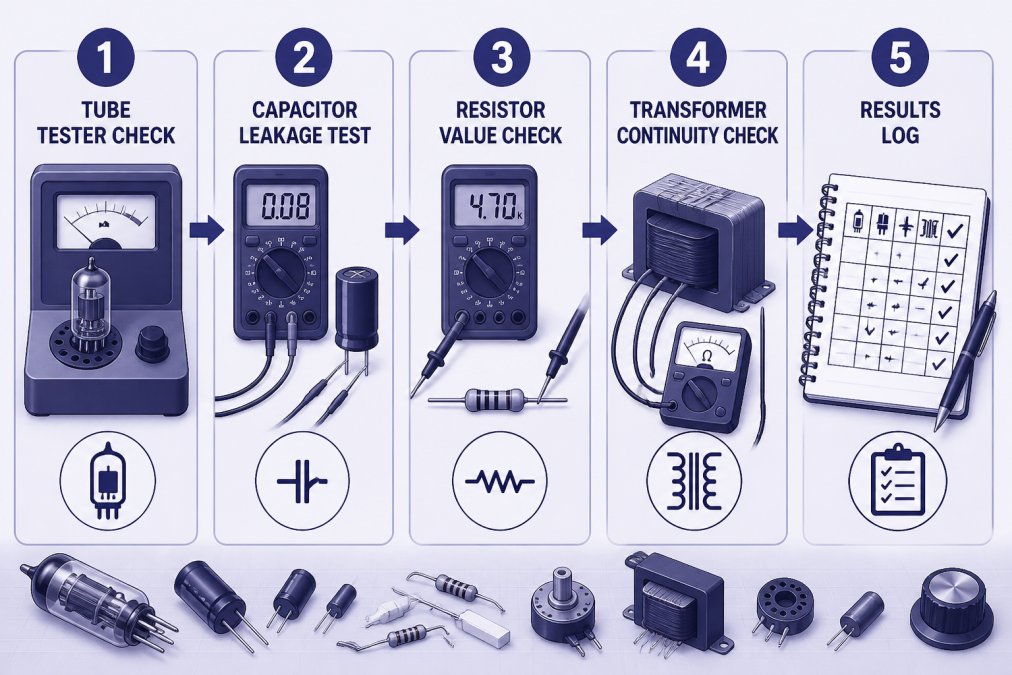
Testing before installation saves you from chasing a fault you introduced yourself. The goal is simple: confirm each part works on the bench, not inside a radio you just reassembled. Here's the order we recommend.
Bench Testing Tubes, Capacitors, and Transformers
- Tubes: Run each one through a tube tester. Check for shorts, gas, and emission. A tube that reads weak may still work, but it will not last.
- Capacitors: Test for leakage and capacitance value. Old electrolytics often drift far from spec.
- Resistors: Measure resistance and compare to the marked value. Look for drift and heat damage.
- Transformers: Check winding continuity and look for shorts between windings.
Log every reading. A simple notebook beats memory when you're three parts deep.
How to Verify a Seller's Test Claims
"Tested" is a claim, not a certification. The only way to know whether a part was actually tested is to ask for data specific enough that a seller who skipped the bench cannot fake it. A credible seller can usually answer these questions directly.
The Five Pieces of Test Data to Request
- Test method. What procedure was used? For a tube, that means a tube tester model and the specific tests run (shorts, gas, emission, mutual conductance). For a capacitor, leakage current at rated voltage and measured capacitance. For a transformer, winding resistance and insulation resistance between windings and to the core. "Checked" is not a method.
- Test equipment. The make and model of the tester matters because different testers measure different things. An emission-only tube tester cannot report mutual conductance, and a handheld multimeter cannot measure capacitor leakage at working voltage. If the seller cannot name the instrument, the reading is not reproducible.
- Test conditions. Voltage, load, and temperature at the time of test. A tube that reads good at half rated plate voltage may fail at full voltage. A capacitor tested at 5 V tells you little about behavior at 450 V.
- Measured values, not verdicts. Ask for numbers: emission in micromhos or a percentage of new, leakage in microamps or milliamps, capacitance in microfarads versus marked value, resistance in ohms versus tolerance. "Tests good" is a verdict; "reads 82% emission, no shorts, no gas" is data.
- Test date. Vintage parts drift. A test from five years ago is a starting point, not a guarantee.
Reading the Answer
A credible reply includes at least the method, the equipment, and a measured value. A weak reply uses words like "tested," "checked," "looks good," or "works" without any of the three.
Questions That Separate Sellers
- "What were the actual readings, and on what equipment?"
- "When was the test run, and was it at rated voltage?"
- "Do you have a photo of the meter during the test?"
- "What is your return window if the part fails on arrival?"
That single exchange tells you most of what you need to know before you pay.
A credible seller can answer these five points directly, so ask for each one before you pay.
| Test data to request | What it covers | Weak answer to watch for |
|---|---|---|
| Test method | Procedure used, e.g. tube tester tests run | "Checked" |
| Test equipment | Make and model of the tester | Cannot name the instrument |
| Test conditions | Voltage, load, and temperature at time of test | No conditions given |
| Measured values | Numbers such as emission percentage, leakage, capacitance | "Tests good" |
| Test date | When the test was run | No date given |
Vintage Radio Parts Compatibility: Matching Parts to Your Model
Compatibility is where most online orders go wrong. A board that fits one chassis revision may not fit the next. Model number alone is not enough. You need the exact revision and connector layout.
Match on these points:
PACE CB-145 Main Circuit Board Assembly CB Radio Parts Tested →
- Model and chassis revision
- Connector type and pin count
- Mounting hole spacing
- Voltage and current ratings
We organize parts by brand and model to help you find a fit.
Vintage Radio Speaker Replacement: What Testing Can and Cannot Tell You
A bench test answers a narrow question: does this part function right now, under the conditions the seller applied? It does not answer the question most restorers actually care about, will it still work after installation, heat cycling, and a year of use? That distinction matters for every part type, and speakers are a good place to see it clearly.
What a Speaker Test Confirms
- The voice coil is continuous and not open.
- The speaker produces output when driven.
- There are no obvious rubs, rattles, or dead spots in the cone travel.
- The frame and magnet assembly are intact.
What a Speaker Test Cannot Confirm
- Cone durability. Paper cones embrittle with age. A cone that passes a bench test can tear the first time it sees full excursion. Testing does not measure remaining flex life.
- Exact tonal match. A replacement speaker that tests good may not match the original's response. Impedance and sensitivity can differ even when the part number matches.
- Voice-coil corrosion. A coil can read continuous and still have corrosion that fails after a few thermal cycles.
- Surround condition over time. Foam and cloth surrounds degrade; a test at one moment does not predict when the surround will give out.
The Same Limits Apply to Every Part Type
This is the part of buying tested parts that listings rarely explain. A passing test establishes function at a point in time; it does not establish long-term reliability. The limits differ by component:
- Tubes. A tube tester can show emission, transconductance, shorts, and gas. It cannot predict cathode depletion rate, grid emission that appears only after hours of operation, or mechanical microphonics that show up only under vibration. A tube that reads strong today can go soft in months.
- Capacitors. Leakage and capacitance tests at rated voltage catch many failures, but they do not predict electrolyte dry-out rate in electrolytics or dielectric absorption in old paper types. A capacitor that passes today can drift out of spec under heat.
- Resistors. A resistance measurement confirms value at the test temperature. It does not confirm power-handling margin or long-term drift under load. Carbon-composition resistors in particular drift with age and heat.
- Transformers. Continuity and insulation-resistance checks catch opens and gross shorts. They do not predict winding insulation breakdown under full voltage stress, and they do not detect incipient inter-winding leakage that appears only when hot.
What to Do With This
Use test data to rule out dead-on-arrival parts and to judge seller credibility. Then plan for the limits: replace aged electrolytics and paper capacitors as a matter of course, check tubes again after a few hours of operation, and treat any tested part as a known starting point rather than a finished repair.
Cost Versus Risk: When Tested Parts Save You Money
The question is whether the premium beats the risk of a failed untested part. Usually, it does.
An untested part that fails costs you the part price plus your time, plus the risk of damage to nearby components.
The premium for tested parts reflects the work of testing them. For a simple, cheap part, untested may be fine. For a model-specific board, tested wins.
Ordering the Right Part for Your Restoration
Ordering correctly comes down to matching the listing to your radio, then confirming the seller stands behind the fit. Here's how to do it:
- Confirm your model and revision.
- Compare the listing photos to your part.
- Check the return terms before checkout.
- Ask about fit coverage if anything is unclear.
The PACE CB-145 main circuit board assembly at $45.00 is a tested main board; its listing notes that cut wires require reconnection. Smaller parts follow the same logic: a tested SO-239 antenna connector socket runs $5.00, a tested transformer is $10.00, and a tested signal power meter is $35.00.


Frequently Asked Questions
What does tested mean when buying vintage radio parts?
Tested means the seller ran the component through at least one check before listing it, but the word covers a wide range. For a vacuum tube, it usually means a tube tester measured emission, gain, and leakage. For a transformer, it means continuity and winding checks. For a circuit board, it means a power-on check in a working chassis. Ask which test equipment was used and what the results were. A vague tested label is worth less than a specific one.
Are tested vintage radio parts worth the extra cost?
Often yes, because the price gap is smaller than the cost of a failed repair. An untested transformer that shorts out can take other components with it, and a dead tube found after reassembly means another teardown. At Scott Radio & Electronics, tested PACE CB-145 parts run from $5.00 for an SO-239 antenna socket to $45.00 for a main circuit board assembly,
How do I check whether a replacement part is compatible with my vintage radio?
Start with the model number and chassis revision, not just the brand. Compare the part number, mounting pattern, pin layout, and voltage ratings against your radio's service manual or schematic. Photographs of the actual part help: connector shape, wire colors, and mounting holes reveal mismatches quickly. If you are unsure, ask the seller to confirm the donor model. A part pulled from a different revision of the same radio may not fit.
Can untested vintage radio parts damage a radio?
Yes. A shorted capacitor or a transformer with a failing winding can pull excessive current through surrounding components, and in the worst case damage the power supply or output stage. Aged electrolytic capacitors are a common culprit because they degrade in storage even when unused. Testing before installation, or buying parts the seller already tested, limits that risk and protects the work you have already done on the chassis.
Restoring a vintage CB radio shouldn't feel like a gamble. At SCOTT RADIO & ELECTRONICS, we test every part before it ships, organize our inventory by brand and model, and keep founder Jack Scott personally involved in the customer experience. Browse our tested components, find the exact fit for your radio, and add to cart with confidence.
