

CustomCBRadios Alternative for Restoration Parts
Table of Contents
- Why Serious Restorers Look Beyond CustomCBRadios for Restoration Parts
- What to Check Before Buying Any Restoration Parts
- CB Radio Restoration Parts by Model: Why Fit Comes First
- Replacement CB Radio Circuit Boards: What to Expect from a Used Board
- CB Radio Repair or Replace: A Decision Framework for Vintage Rigs
- CB Radio Repair and Tuning Services: When to Send It Out
- Restoration Cost, Shipping, and Return Policies Compared
- Frequently Asked Questions
Last Updated: October 17, 2026
Why Serious Restorers Look Beyond CustomCBRadios for Restoration Parts
Most vintage CB radio projects stall for the same reason: the right part is hard to find, and the wrong part is easy to buy. If you are hunting for a CustomCBRadios alternative for restoration parts, the real question is not which store has the biggest catalog.
Community forums and repair videos cover diagnosis well. They rarely cover the buying decision: condition, cut leads, tested status, and return terms. That gap is where restorations fail.
Below, we break down what to verify before checkout, how fit varies by model and era, and when to repair versus replace.
What to Check Before Buying Any Restoration Parts
The first thing to confirm is condition, not price. A restoration part is any original component pulled from a donor radio and offered for reuse, and its value depends entirely on how it was removed and verified.
Tested vs. Untested Parts
"Tested" should mean the part worked in a radio before removal, not that it looks intact. Ask three questions:
- Was the part tested in a powered radio, or only inspected?
- Were the leads cut during removal, and will they need reconnection?
- Does the listing say "parts lot only," meaning no complete radio is included?
A tested main board with documented removal is worth more than an untested one at half the price. Untested parts are a gamble, and vintage electronics rarely reward gambling.
Photos, Cut Leads, and Fit Verification
Photos are your fit check. Compare mounting holes, connector shapes, and meter frames against your own chassis before ordering. Cut leads are normal on salvaged assemblies, but you must plan to reconnect and re-solder them. If a listing shows one blurry photo, treat it as a warning sign rather than a bargain.
CB Radio Restoration Parts by Model: Why Fit Comes First
CB radio restoration parts by model exist because manufacturers changed chassis layouts constantly across the 1970s and 1980s. A control from one production run may not match the next, even under the same brand name.
Our catalog groups parts by brand and model so you can match your radio before you buy. For example, the Midland 77-101B main circuit board chassis assembly at $45.00 is a tested original with rear connectors and wiring attached, and it fits that model only. The same applies to the channel selector display assembly at $30.00 and the signal power meter at $35.00.


Fit beats price every time. A cheap part that needs modification usually costs more in bench hours than a correct one.
Replacement CB Radio Circuit Boards: What to Expect from a Used Board
Replacement CB radio circuit boards are salvaged originals, so expect honest wear and plan for reconnection work. A used board is not a plug-and-play module.
Here is what a realistic used-board purchase includes:
- The board and chassis as pictured, with attached connectors and wiring
- Tested-and-working status confirmed before disassembly
- Cut leads on some assemblies that require re-soldering
Ask whether the board was tested in a live radio. If the seller cannot answer, assume it was not. For alignment-sensitive sections, a board swap often means a realignment afterward, which is a separate cost.
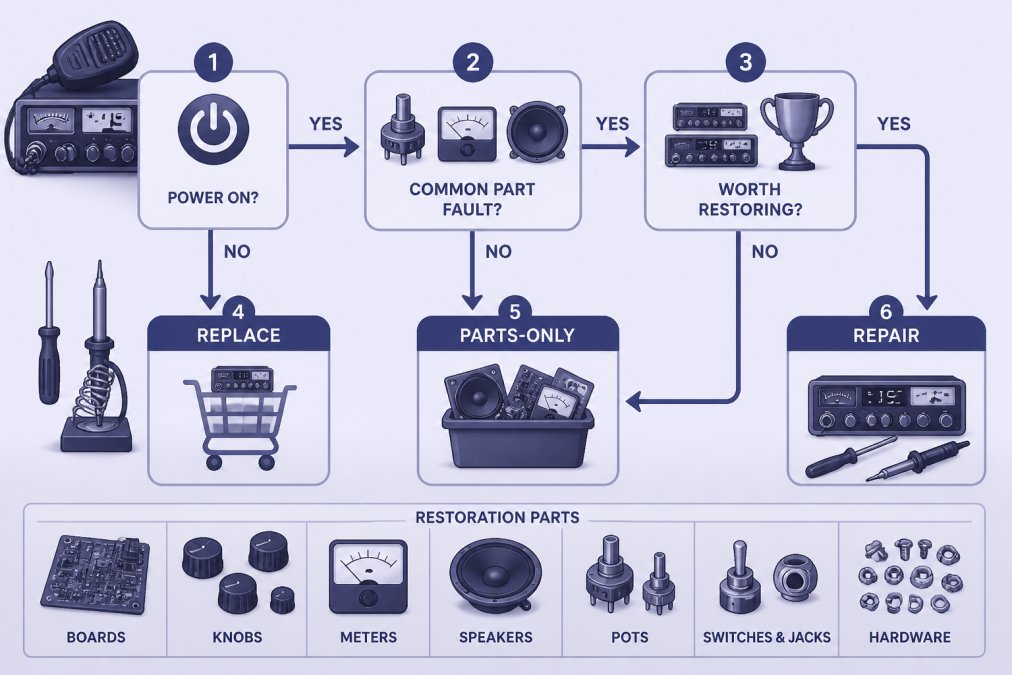
CB Radio Repair or Replace: A Decision Framework for Vintage Rigs
The repair-or-replace call comes down to fault type, model value, and parts availability, but the deciding factor most restorers skip is the total cost of ownership. A $45.00 tested board plus bench time can still beat a $200.00 replacement radio, or it can lose badly once you count alignment.
Step 1: Classify the fault before you price anything
- Powers on, one control fails. A rotary control potentiometer pair runs about $20.00 and swaps in minutes. Repair is almost always correct.
- No power, unknown fault. Diagnose first. Buying parts to guess at a power fault is how projects stall.
- Board fault with a tested replacement available. A tested main board at roughly $45.00 plus reconnection labor usually beats sending the radio out for component-level troubleshooting.
Step 2: Put a number on each path
A transparent cost framework is the part competitors leave out. Build three estimates:

| Path | Typical cost components | When it wins |
|---|---|---|
| DIY part swap | Part price ($20.00-$45.00) + your bench hours + shipping | Fault is a known common part and you can verify fit |
| Send-out repair | Shop labor + return shipping + alignment if needed | Fault is intermittent, alignment-sensitive, or beyond your bench |
| Replace the radio | Purchase price of a comparable working unit | Common model with heavy corrosion or a fault that exceeds the radio's value |
Most practitioners find the break-even sits where shop labor plus shipping approaches the price of a working replacement of the same model. Below that line, repair usually wins; above it, parts-only or replacement does.
Step 3: Weigh model value and cosmetics
A rare model with good cosmetics justifies restoration even at a higher total. A common model with a cracked case and corrosion usually does not, no matter how cheap the part. Cosmetics drive resale and pride of ownership; a clean faceplate and intact bezel are worth more than a marginal parts savings.
Step 4: Decide, and write the decision down
| Situation | Best move | Why |
|---|---|---|
| Powers on, one control fails | Replace the part | Cheap, common fix |
| No power, unknown fault | Diagnose first | Avoid parts guessing |
| Rare model, good cosmetics | Restore | Value justifies cost |
| Common model, heavy corrosion | Parts-only | Cost exceeds value |
| Board fault, tested part available | Repair | Tested board solves it |
| Intermittent or alignment fault | Send out | Needs bench equipment |
The framework matters more than any single rule. Diagnose before you buy, price all three paths, and let the fault type and total cost drive the decision.
Midland 77-101B Main Circuit Board Chassis Assembly Tested CB Radio Parts →
CB Radio Repair and Tuning Services: When to Send It Out
CB radio repair and tuning services make sense when the fault is beyond component swapping. Alignment and calibration require test equipment most hobbyists do not own.
Send the radio out when:
- The fault is intermittent and hard to reproduce
- You need alignment after a board or component swap
- The radio needs a peak-and-tune or power output check
Be cautious with unauthorized modification. So-called golden screwdriver mods often push power output past safe limits and damage finals. Ask any shop whether they align to spec or just turn up the power.
Restoration Cost, Shipping, and Return Policies Compared
This is the section the ranking results do not cover. Most pages tell you how to diagnose a fault or find a repair shop; almost none compare restoration-parts sources part by part, which is exactly what the keyword asks for. Use this as a buying framework you can apply to any supplier, including us.
Part-by-part availability and compatibility
Restoration parts are not one market. Availability and fit vary by component type:
| Component | What to verify | Compatibility risk |
|---|---|---|
| Main circuit board | Model number, connector layout, attached wiring | High, chassis layouts changed between production runs |
| Channel selector display | Mounting frame, connector shape | Medium, display assemblies differ by era |
| Signal power meter | Meter frame and movement type | Medium, meter scaling varies by model |
| Rotary control potentiometer | Shaft length, value, mounting | Low to medium, pairs are often model-specific |
| Front bezel faceplate | Cutouts for controls and meter | Low, cosmetic but fit-critical |
| Speaker and microphone | Connector type, impedance | Medium, older radios use nonstandard connectors |
| Knobs, switches, cases | Shaft type, thread, mounting holes | Low cost, high annoyance if wrong |
A model and generation compatibility guide is the single most useful tool a restorer can keep. Match the part to your exact chassis before checkout, not after.
Condition, authenticity, and quality tiers
Not all parts are equal, and the listing should tell you which tier you are buying:
- New-old-stock (NOS): original unused parts, often in original packaging. Best authenticity, highest price, and stock is unpredictable.
- Tested used original: pulled from a donor radio and verified working before removal. The practical sweet spot for most restorations.
- Untested used: a gamble. Worth it only for scarce parts or as a parts lot.
Ask whether a part was tested in a powered radio or only inspected. A tested main board with documented removal is worth more than an untested one at half the price.
Shipping, returns, and stock reliability
These decide whether a mistake is recoverable:
| Factor | What to check | Why it matters |
|---|---|---|
| Part price | Listed per item in USD | Budget baseline |
| Tested status | Stated in the listing | Avoids repeat buys |
| Stock reliability | Whether the exact part is in hand or sourced | Prevents stalled projects |
| Shipping | Carrier, tracking, and packaging for fragile assemblies | Lost or damaged parts cost bench time |
| Returns | Policy on wrong-fit parts and who pays return shipping | Protects your spend |
| Communication | Response before purchase | Signals after-sale support |
Check the Federal Trade Commission's guidance on return policies to understand what sellers must disclose. A seller who will not answer a fit question before the sale rarely answers one after.
What our pricing looks like
Our parts range from $20.00 for a tested rotary control potentiometer pair to $45.00 for a tested main circuit board, with a front bezel faceplate at $30.00 and a channel selector display assembly at $30.00. Every listing is organized by brand and model so you can match your chassis before you buy. Founder Jack Scott personally oversees the customer experience, so questions about fit get a real answer before you order.
Frequently Asked Questions
What are good alternatives to CustomCBRadios for vintage CB radio parts?
Look for a supplier that sells used original restoration parts by brand and model, tests each part before removal, and shows the actual item in photos. Scott Radio & Electronics lists components such as a tested Midland 77-101B main circuit board and chassis assembly at $45.00, a rotary control potentiometer pair at $20.00, and a signal power meter at $35.00. The key is matching the exact model and production era, not just the part type.
How do I make sure a replacement CB radio part fits my model?
Match the brand, model number, and production era on the listing to the label inside your radio. Check the photos for connector shape, mounting holes, and lead length. A tested Midland 77-101B channel selector and display assembly, for example, is specific to that chassis and has cut leads that need reconnection. If the listing shows a different board layout or knob shaft, it will not fit even if the description sounds close.
Is it better to repair or replace an old CB radio?
Repair usually wins when the fault is a single accessible part, such as a scratchy potentiometer, a dead meter, or a cracked faceplate, and the rest of the radio is sound. Replace or part it out when the main board is damaged beyond component-level repair or the chassis is corroded. A $20.00 to $45.00 part is often cheaper than a replacement radio, but only if the rest of the unit tests clean.
What should I check before buying used CB radio restoration parts?
Ask four things: was the part tested before removal, does the listing show the exact item, are the leads cut or intact, and what is the return policy. Confirm the part number matches your radio model. On a tested Midland 77-101B front bezel faceplate at $30.00, for example, expect age wear and pitting as pictured. Buy from a seller who answers fit questions before you pay, not after.
Can vintage CB radio circuit boards still be repaired or replaced?
Yes, on both counts. Component-level repair is possible when the fault is a capacitor, solder joint, or trace, and a technician can often bring a board back. When the board is cracked or badly damaged, a tested used replacement board is the practical route. A tested Midland 77-101B main circuit board and chassis assembly at $45.00 is one option, but verify the connector layout matches your radio before ordering.
Vintage CB restoration rewards patience and the right supplier. If you are tired of guessing whether a part fits, SCOTT RADIO & ELECTRONICS stocks tested components organized by brand and model, backs them with founder-led customer care, and prices them clearly so you can plan a restoration instead of gambling on it. Browse the catalog by your radio's model and add the right part to your cart with confidence.