

CB Radio Repair Parts Fit Guarantee: What to Know
Table of Contents
- What a CB Radio Repair Parts Fit Guarantee Actually Covers
- How to Identify the Correct Part Before Ordering
- CB Radio Replacement Parts by Model: Getting the Right Fit
- Vintage CB Radio Parts Compatibility: What You Need to Verify
- CB Radio Repair Parts Return Policy: Protection and Costs
- Understanding CB Radio Repair Cost and Part-Level Warranties
- Common Mistakes When Ordering Replacement Parts
- Why Guarantee Terms Matter for Vintage Radio Restoration
- Frequently Asked Questions
Last Updated: October 12, 2026
What a CB Radio Repair Parts Fit Guarantee Actually Covers
A CB radio repair parts fit guarantee is a seller's commitment that replacement components will work with your specific radio model. It protects you if a main circuit board, channel selector, or other component doesn't function as advertised or doesn't physically fit.

Scope varies between sellers. Some cover only defective parts that fail immediately; others extend protection to compatibility issues. At SCOTT RADIO & ELECTRONICS, we organize inventory by brand and model to eliminate guesswork.
A genuine fit guarantee addresses three areas: manufacturing defects or pre-shipment damage, the part's tested condition, and your recourse if it doesn't work as described. The best guarantees spell out return procedures, timelines, and who pays return shipping.
Many sellers use vague language like "tested and working" without explaining what testing means. Did they power it on? Verify it in your exact model? Measure electrical outputs? A part can power on but still fail in your equipment due to subtle compatibility issues or partial component failure.
How to Identify the Correct Part Before Ordering
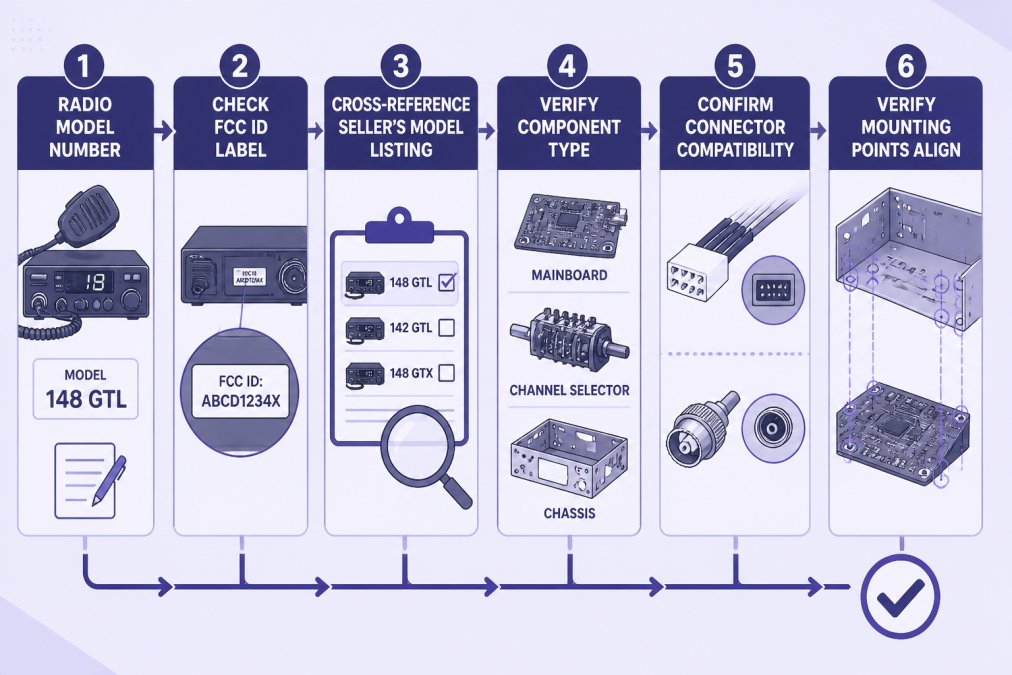
Identifying the right part starts with three pieces of information: your radio's brand name, model number, and the specific component you need. Most CB radio models print the model number on the faceplate or chassis.
Write down your radio's exact model number before shopping. The difference between a Midland 77-101 and a Midland 77-101B is critical, these radios use different circuit board configurations. One part fits perfectly; the other won't work at all.
Next, identify which component you're replacing. CB radios typically need one of these parts:
- Main circuit board (the core processing component)
- Channel selector assembly (controls frequency selection)
- Meter or display assembly (shows signal strength or frequency)
- Speaker or speaker connector
- Knobs or control elements
- Rear panel connectors
Check the seller's product photos against your radio. Open the cabinet and compare the part you need to replace: do the connector types match? Do the mounting brackets align?

Many sellers list inventory by model number, making this step straightforward. At SCOTT RADIO & ELECTRONICS, each listing includes high-resolution photos of the exact component, removed from a specific radio model.
CB Radio Replacement Parts by Model: Getting the Right Fit
Different radio models require different replacement parts, and compatibility is not forgiving. A main circuit board from a PACE CB-145 will not function in a Lafayette HB-750, even though both are vintage CB radios from roughly the same era.

Circuit design is the primary compatibility factor. Each manufacturer engineered radios differently: component placement, connector types, voltage requirements, and signal routing all vary. A part that works in one model can damage another if forced into place.
To find the right part, match three criteria: brand, model number, and component type. Start by locating your radio's FCC ID label on the chassis or rear panel.
Common vintage CB radio models include the Midland 77-101B, Midland 13-857, PACE CB-145, Lafayette HB-750, and Uniden PC 76XL, each requiring distinct replacement parts. SCOTT RADIO & ELECTRONICS stocks tested main circuit board assemblies for these exact models, each priced at $45.00.
Verify that any part you order includes the exact components you need. Some listings bundle multiple components; others sell individual pieces. If you need only a channel selector, don't pay for a complete circuit board assembly.
Vintage CB Radio Parts Compatibility: What You Need to Verify
Vintage radio restoration requires careful attention to component compatibility. A part from a 1975 radio may look similar to a 1982 radio but have completely different electrical specifications.
The most common compatibility issue is crystal frequency. Older CB radios used individual crystals to set transmit and receive frequencies. If you're replacing a channel selector assembly, the crystals must match your radio's frequency configuration, or it won't work even if it physically fits.
Connector compatibility matters equally. Vintage CB radios use various connector types, some proprietary, others standard. A rear panel connector from one model may have different pin configurations than another, and forcing an incompatible connector can damage both the part and your radio's chassis.
Heat sink and mounting bracket compatibility also determines whether a part will work. Main circuit boards in vintage radios use specific brackets, and a board from one model may have different mounting points than your chassis, fitting into the cabinet but not aligning with the mounting holes.
Before ordering, verify these specific details:
- Does the seller confirm the part was removed from your exact radio model?
- Do the connector types in the photos match your radio's connectors?
- Are mounting brackets visible and do they match your chassis?
- Does the part include all attached components shown in the photos?
Sellers who provide multiple high-resolution photos from different angles make this verification possible. If a listing shows only one or two photos, ask for more before purchasing. A few minutes verifying compatibility prevents wasted money and project delays.
CB Radio Repair Parts Return Policy: Protection and Costs
A return policy protects you when a part doesn't work as expected. The best policies address three scenarios: the part is defective, doesn't fit your radio, or arrived damaged.
Many online sellers offer no-hassle returns within 30 days, enough time to install, test, and determine whether the part works. Some require you to pay return shipping; others cover it.
Ask about the seller's return process before purchasing. Can you initiate a return through their website or by email? How long do refunds take after they receive the part? Do they inspect returned parts before issuing refunds?
Compatibility-related returns deserve special attention. If a part doesn't fit your radio, whose responsibility is that? Some sellers charge a restocking fee; others accept it as a compatibility issue and offer full refunds.
Midland 77-101B Main Circuit Board Chassis Assembly Tested CB Radio Parts →
The most transparent sellers state their return policy clearly on the product page, specifying whether returns are free or charged, the return window, and whether they inspect returned parts.
Document the part's condition when it arrives. Take photos showing it as received and any shipping damage. This protects you if a dispute arises about whether the part was defective when shipped or damaged in transit.
Understanding CB Radio Repair Cost and Part-Level Warranties
CB radio repair costs vary depending on whether you replace a part yourself or pay a technician. Ordering the part directly and installing it yourself saves labor expense.
Part-level warranties differ from repair service warranties. A repair service warranty covers the technician's work, if the repair fails within a specified period, the shop fixes it free. A part-level warranty covers the component itself: if it fails due to a manufacturing defect, the seller replaces or refunds it.
Most sellers of vintage CB radio parts offer part-level warranties only, guaranteeing the part was tested and working when shipped. They don't warrant that your installation will succeed or that the part will work indefinitely.
When comparing repair costs, consider the total expense: part cost plus installation labor plus any return shipping if the part doesn't fit. Understanding these costs upfront prevents surprises.
The most valuable warranty covers fit compatibility. If a part doesn't fit your radio, a seller who covers return shipping or refunds the part cost without a restocking fee provides real protection, more valuable than a vague "satisfaction guarantee" that requires you to pay to send the part back.
Common Mistakes When Ordering Replacement Parts
The most frequent mistake is ordering without verifying the exact model number. Sellers list parts by model number for a reason, it eliminates guesswork.
Another common error is assuming all parts of the same type are interchangeable. A channel selector from a 1975 radio is not a drop-in replacement for a 1982 model, even from the same brand.
Ordering without examining photos is a third major mistake. A part listed as "tested and working" might show visible corrosion, burnt components, or damaged connectors. If the photos reveal damage you're not comfortable with, choose a different seller or part.
Many buyers ignore return policies until they need them, when it's too late to negotiate. Read the return policy before purchasing.
Failing to document the part's condition upon arrival is another costly mistake. If a part arrives damaged and you don't photograph it immediately, the seller can claim the damage occurred during installation, not shipping. Photograph everything when the package arrives.
Finally, some buyers order multiple parts at once without verifying compatibility. If one doesn't fit, the entire project stalls. Order one critical part first, verify it works, then order additional components. This staged approach prevents wasted money on incompatible parts.
Why Guarantee Terms Matter for Vintage Radio Restoration
Vintage radio restoration is a long-term investment. You're investing time, effort, and money into equipment that may be decades old, and a strong fit guarantee protects that investment.
The emotional value of vintage radio restoration is significant. Many restorers work on radios with personal history, equipment their parents or grandparents used.
Guarantee terms also reflect the seller's expertise and quality standards. A seller who guarantees fit compatibility has sourced parts carefully, verified they work, and documented which radio model each came from.
Compare this to sellers who offer minimal information and vague guarantees. They may source parts from mixed lots, test them generically, and list them by broad category, prioritizing volume over accuracy.
The best guarantee terms address your actual concerns: Does this part fit my radio? If it doesn't, what happens next? Will I lose money? How long will a refund take?
At SCOTT RADIO & ELECTRONICS, we organize inventory by brand and model to eliminate compatibility uncertainty. Our founder, Jack Scott, personally oversees the customer experience.
Vintage CB radio restoration demands precision and reliability. Our tested main circuit board assemblies, channel selectors, and other components are priced at $45.00 each, with detailed photos and model-specific listings that eliminate guesswork. Add to cart.
Frequently Asked Questions
How do I know if a CB radio repair part will fit my specific model?
The safest approach is to verify three details before ordering: your exact radio model number, the FCC ID (found on the back or inside the radio), and the specific component you need (mainboard, channel selector, speaker, etc.). Match these against the part listing photos and description. Reputable sellers organize parts by brand and model to help you cross-reference. If you're unsure, contact the seller with your model number and photos of your radio before purchasing. Many vendors offer photo-based verification to confirm fit before you commit.
What should a CB radio parts fit guarantee cover?
A solid fit guarantee should cover compatibility errors on the seller's side, meaning if you ordered the correct part for your model and it doesn't fit, the seller takes responsibility. The guarantee should specify whether it covers return shipping, replacement at no charge, or a full refund. It should also clarify the timeframe (typically 30 days from receipt) and any conditions, such as whether the part must be unused. Part-level warranties typically cover defects in function (tested parts that fail after installation), while fit guarantees address compatibility alone. Read the terms carefully to understand which applies to your purchase.
Can I return a CB radio part if it turns out to be the wrong fit?
Yes, most reputable sellers allow returns for incompatible parts, but the specifics vary. A no-hassle return policy should cover return shipping or offer a refund minus shipping costs. Some sellers charge a restocking fee if the part was used or damaged after delivery. Always verify the return window (typically 30 days) and whether the seller requires photos or proof of the incompatibility before processing a return. Check the policy before you order. If a seller has no clear return policy listed, ask about it directly, this is a major red flag for vintage radio parts shopping.
How do I compare CB radio repair cost and warranty options across sellers?
Request a repair quote or parts estimate from multiple vendors and compare three factors: base price, what the warranty covers (fit, function, or both), and return costs if something goes wrong. A $45 mainboard from one seller might include a 30-day fit guarantee with free returns, while the same board elsewhere costs $40 but has no return option. Calculate the true cost by adding potential return shipping if the part doesn't fit. Cheaper isn't always better if you're left without recourse.