
Which Coax Cable Is Best for CB and Ham Radio?
Quick Summary
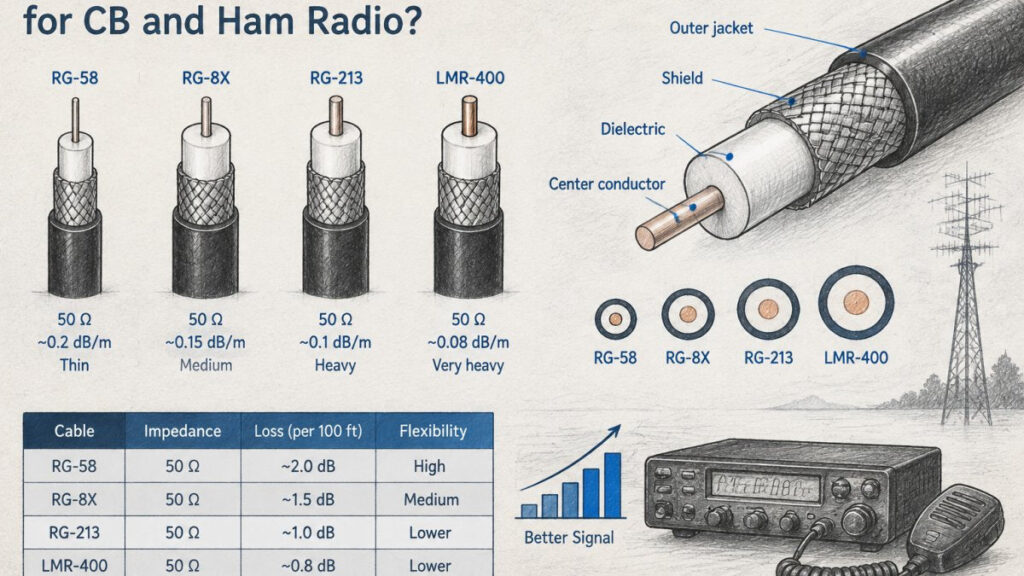
The best coax cable for CB and ham radios depends on run length, band, and power. RG-58 suits short mobile runs, RG-8X offers a flexible all-round compromise, and LMR-400 or RG-213 suit long base-station feedlines. Match the cable to your setup and connector.
- Thicker coax generally loses less signal over a given distance but is stiffer and costlier.
- RG-58 is thin and light but has the highest loss, so it suits short runs.
- RG-8X is flexible with lower loss, a practical pick for mobile and short base runs.
- LMR-400 performs well over longer runs and holds up outdoors, but costs more.
- Losing 3 dB halves your power, so long runs and high bands magnify cable loss.
Table of Contents
- CB Coax Cable Types Compared: RG-58, RG-8X, RG-213 and LMR-400
- Ham Radio Coax Cable Loss by Frequency and Cable Length
- Choosing Coax for Mobile Radio Antennas Versus a Base Station
- CB Coax Cable Connectors: PL-259, Weatherproofing and Install Errors
- Durability, Cost and Value for Off-Road and Outdoor Runs
- Picking the Right Coax Cable for Your Radio and Your Run
- Frequently Asked Questions
How Coax Cable Choice Affects Your CB or Ham Signal
Your coax cable is the link between your radio and your antenna, and it quietly decides how much of your transmitter’s power actually leaves the antenna. A cheap or mismatched cable can cost you range before you ever touch the radio.
A coax cable is a shielded transmission line built to carry radio-frequency energy with minimal leakage. Most CB and ham installations use 50-ohm coax, and the cable’s loss, flexibility, and connector type determine whether your signal reaches the antenna intact. Choose the wrong one and you lose power on every transmission.
Most operators assume the thickest cable is always best. That is not quite true. A thicker cable generally loses less signal over a given distance, but it is stiffer, costs more, and is harder to route through a vehicle. The right coax cable is the one that balances loss, flexibility, and length for your specific setup.
Your choice matters most in three situations: long cable runs, high-power operation, and installations where the cable must flex, such as a mobile setup that shifts with every bump. Get the coax right and you protect the signal you already paid for.
CB Coax Cable Types Compared: RG-58, RG-8X, RG-213 and LMR-400
The common CB and ham choices fall into a few families. RG-58 is thin, light, and easy to route, which makes it popular for short mobile runs. It also carries the highest loss of the group, so it suits short distances better than long ones.
RG-8X sits between RG-58 and the larger cables. It is flexible and noticeably lower loss than RG-58, making it a practical all-round pick for mobile and short base-station runs. Many operators choose it when they want a compromise between size and performance.
RG-213 is a heavier, lower-loss cable often used for longer feedlines and higher-power stations. The trade-off is stiffness and weight, which can make it awkward in a tight vehicle install.
LMR-400 is a low-loss cable with a large center conductor and a durable jacket. It performs well over longer runs and holds up outdoors. It costs more and is less flexible than RG-8X, so it fits best where the performance gain justifies the bulk.
Watch out: Do not buy the cheapest jumper and assume it will match a long feedline. Mixing cable grades in one run adds loss at every joint.
Ham Radio Coax Cable Loss by Frequency and Cable Length
Loss in coax is not fixed. It rises with frequency and with cable length, so a run that works at CB frequencies can cost you noticeable power on higher ham bands. Every extra foot of cable adds loss, and the effect grows at higher frequencies. The practical way to compare cables is to look at attenuation in decibels per 100 feet at the frequencies you actually use, then scale to your run length.
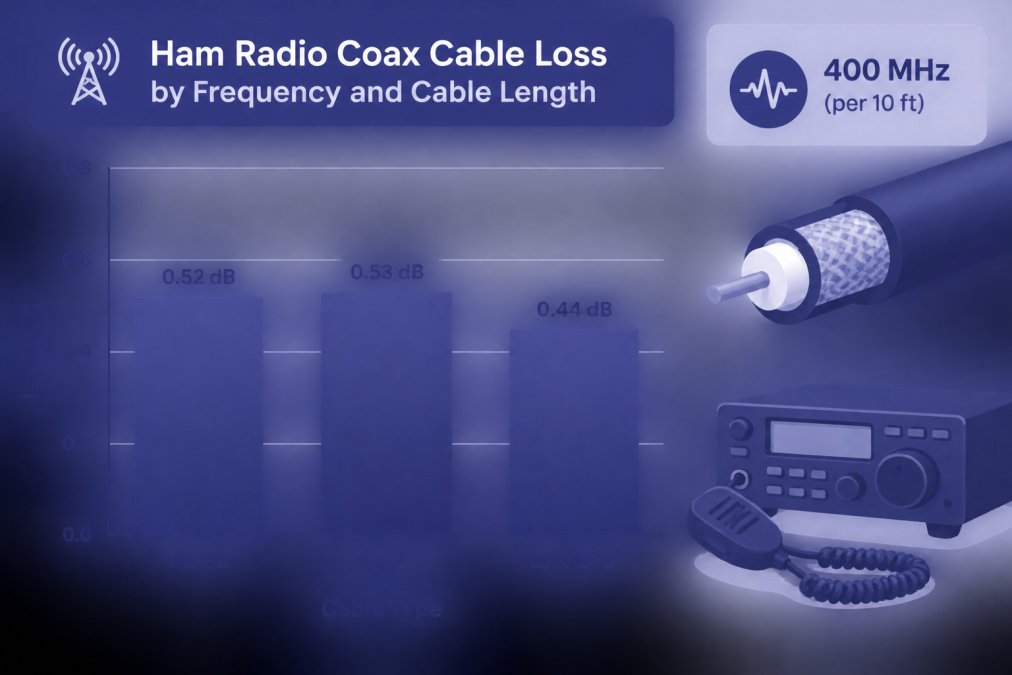
Attenuation figures are published by cable manufacturers in dB per 100 feet (or dB per 100 meters), and they are the honest basis for comparison. The table below uses typical published values for common 50-ohm cables at CB (27 MHz) and common amateur frequencies. Treat these as representative figures to compare cable families, and confirm against the specific manufacturer’s data sheet before you design a critical installation.
The higher the band and the longer the run, the more the cable choice matters.
A decibel is a logarithmic ratio. Losing 3 dB cuts your power roughly in half, and losing 6 dB cuts it to about a quarter. That is why a cable that is fine for a short CB jumper can be a poor choice for a long 2 m or 70 cm feedline. It also explains why a low-loss cable on a short run may buy you very little: if the run is 10 feet, the difference between RG-8X and LMR-400 at CB frequencies is a fraction of a decibel.
The practical lesson is simple: shorten the run where you can, and step up to a lower-loss cable when the run is long or the band is high. Losses that look small on paper add up over a 50-foot feedline. For CB work, RG-8X is often adequate; for 2 m and 70 cm base stations with long runs, LMR-400 or RG-213 is the better investment.
Watch out: Do not compare cables using a single frequency or a single length. A cable that looks good at 27 MHz may be a poor performer at 440 MHz, and a short jumper’s loss tells you almost nothing about a 75-foot feedline.
Choosing Coax for Mobile Radio Antennas Versus a Base Station
Mobile and base-station installations place different demands on coax. A mobile cable has to bend around door frames, survive vibration, and fit through a tight firewall grommet. A base-station feedline runs longer, stays in one place, and can afford a stiffer, lower-loss cable.
For mobile use, flexibility and short length matter most. RG-8X and a flexible LMR-240 type cable work well because they route easily and keep loss manageable over a vehicle-length run. Keep the mobile cable as short as your layout allows.
For a base station, lower loss pays off. A longer feedline benefits from LMR-400 or RG-213, especially if you run higher power. The stiffer cable is acceptable because it stays put once installed.
Many operators split the difference and use a flexible jumper for the last few feet at the radio, then a low-loss main run. That keeps routing easy without sacrificing much signal.
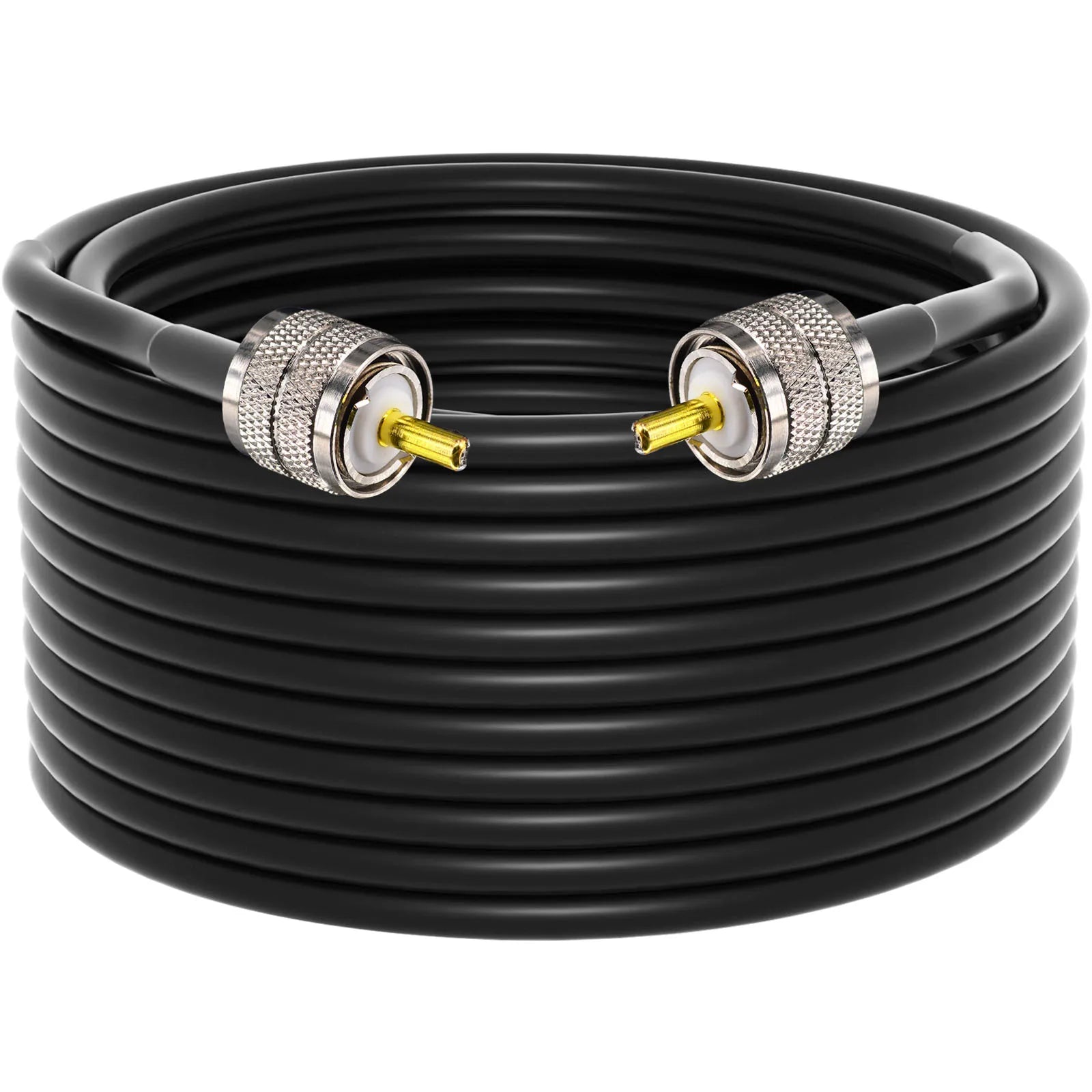
Our product catalog includes CB Coax Cable 49.2FT LMR240 UHF Male to UHF Male 50 Ohm Coax Low Loss for CB and Ham Radio, SWR Meter, priced at $79.00.
CB Coax Cable Connectors: PL-259, Weatherproofing and Install Errors
The connector is where many installations fail. The PL-259 (also called a UHF connector) is the connector most CB operators encounter, and it is widely used on CB and ham radios. It is a 50-ohm connector with a threaded coupling, and it is common on CB radios, many HF ham transceivers, SWR meters, and antenna tuners. It is not a precision constant-impedance connector at VHF and UHF, but it is rugged and widely compatible, which is why it persists.
Connector compatibility matters. A PL-259 mates with an SO-239 socket, which is the female counterpart found on most CB radios and many ham rigs. Some ham equipment uses Type-N or BNC connectors, especially at VHF and UHF, and adapting between types adds a connection point and potential loss. The cleanest approach is to match the connector to the radio and antenna rather than stacking adapters.
Installation quality drives performance. A poorly installed PL-259 can add loss, cause intermittent signal, or let moisture into the cable. The common failure modes are mechanical and electrical: stray braid strands shorting to the center conductor, a center pin that is too short or too long, a connector that is not fully seated, and a shield that is not properly grounded to the connector body.
Weatherproofing matters for any outdoor run. Moisture ingress is one of the most common causes of coax failure, and it usually starts at the connector. A practical sealing sequence is to wrap the connector with self-amalgamating silicone tape, then cover that with a layer of electrical tape, and secure the cable so the connector is not under strain. Heat-shrink tubing at each connector also seals the joint against water and helps prevent the connector from pulling loose under flexing. The LMR-240 listing includes a 6 cm heat-shrink section.
Grounding and strain relief are part of the connector job. The shield must be fully grounded to the connector body, and the cable should be supported so the weight of the run does not hang on the connector. Bend radius matters too: coax should not be bent tighter than the manufacturer’s minimum bend radius, because a sharp bend can deform the dielectric and change the cable’s impedance. A common pattern is to leave a service loop at the radio and at the antenna so the connector is not the strain point.
Common installation errors include stripping too much or too little jacket, leaving braid strands that short to the center conductor, and over-tightening the connector. Each error can raise your SWR, which reflects power back toward the radio. Soldering the center pin and the shield braid properly, rather than relying on a crimp that is not fully seated, is the difference between a connection that lasts and one that fails in the field.
Watch out: A connector that looks tight can still be wrong. Check for stray braid strands, confirm the shield is fully grounded, and verify the center pin length before you key the mic. A quick continuity and SWR check after installation catches most of these mistakes before they cost you signal.
Durability, Cost and Value for Off-Road and Outdoor Runs
Outdoor and off-road installations expose coax to sun, moisture, vibration, and abrasion. Look for a UV-resistant, weatherproof outer jacket, which is standard on most current CB and ham cables but worth confirming on any listing you buy.
Cost should be judged over the life of the installation, not just the price tag. A cheap cable that degrades or fails in a year costs more than a durable one that lasts. A durable jacket and solid connectors protect the value of your radio and antenna.
Picking the Right Coax Cable for Your Radio and Your Run
Start with your run length, your band, and your power level. Short mobile runs suit RG-8X or a flexible low-loss jumper. Longer base-station feedlines benefit from LMR-400 or RG-213. High-power and outdoor installations reward the lower-loss, weatherproof options.
Match the cable to the connector and check that both ends are installed cleanly. Then verify the system with an SWR meter once everything is connected. That final check catches most installation mistakes before they cost you signal.
The CB Coax Cable 49.2FT LMR240 UHF Male to UHF Male 50 Ohm Coax Low Loss for CB and Ham Radio, SWR Meter is available at $79.00.
Frequently Asked Questions
What is the best coaxial cable for CB radio?
For most CB installations, a 50-ohm cable with low loss and a PL-259 connector works best. RG-8X is a common, flexible choice for mobile setups and short runs. For longer runs or higher-power use, LMR-240 or LMR-400 keeps more of your signal, since their larger center conductors and double-shield construction reduce loss. Match the cable length to your install, avoid stretching it, and check that the connectors are weatherproofed before you mount the antenna.
Are all CB coax cables the same?
No. Cables differ in center conductor size, shielding, jacket material and attenuation. RG-58 and RG-8X lose more signal than LMR-240 at the same length, and LMR-400 performs better still on long runs. Flexibility, UV resistance and connector quality also vary. Compare the listed loss figures and intended use before buying, rather than assuming two cables with the same connector will perform the same way.
What connectors do CB and ham radio coax cables use?
The most common connector is the PL-259, a UHF male connector used on many CB and ham radios, meters and antenna analyzers. Many jumper cables are sold with UHF male-to-UHF male ends. Connector quality matters: a poorly crimped or unsealed PL-259 can add loss and corrode. Use heat-shrink tubing at each connector, which helps seal the joint and keeps the connector from pulling off with bending or strain.
How does coax cable length affect radio performance?
Signal loss increases with cable length and with frequency, so a longer run of a lossy cable can waste a meaningful share of your transmitted power before it reaches the antenna. A short jumper of RG-8X may be fine, but a long run to a base-station antenna is better served by LMR-400 or a similar low-loss cable. Keep runs as short as practical and avoid tight bends, which can affect both loss and cable life.
