
How far can a GMRS radio reach?
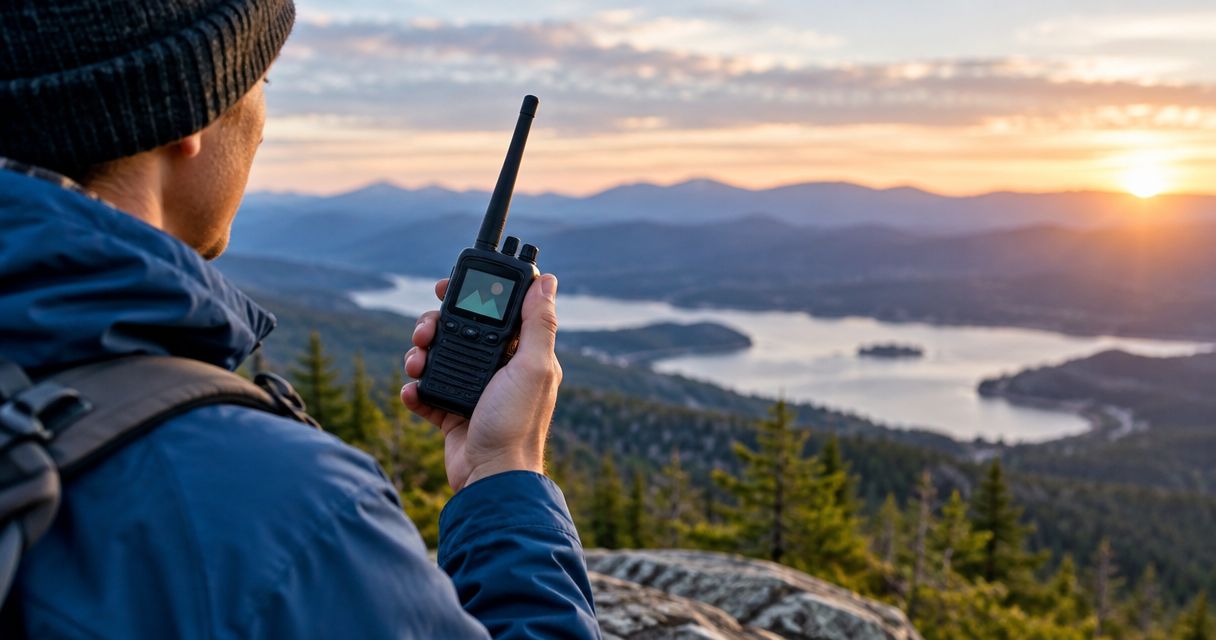
A GMRS radio has no fixed mileage limit: its usable reach depends on antenna height, terrain, buildings, and whether you communicate directly or through a repeater. Plan around the actual radio path, not a distance printed on a box. A stronger transmitter does not remove a hill or guarantee that the other radio can answer.
- How far can a GMRS radio reach? Antenna height, obstructions, and repeater access determine usable coverage.
- GMRS handhelds suit nearby groups; vehicle-mounted antennas improve placement but do not eliminate terrain blockage.
- A GMRS repeater extends communication only when both operators can reach it and have permission to use it.
- FCC equipment authorization matters: a programmable amateur radio is not automatically legal for GMRS transmission.
How far can a GMRS radio reach?
A GMRS radio reaches as far as its signal remains readable at the receiving antenna. There is no single mileage figure that describes a handheld inside a vehicle, a mobile radio with an outside antenna, and a station communicating through an elevated repeater.
Use this comparison to choose the right arrangement for your route in 2026. These are operating differences, not promised coverage distances.
| GMRS arrangement | Best for | Main advantage | Main limitation |
|---|---|---|---|
| Handheld to handheld | People walking or working nearby | Portable communication without a vehicle installation | Low antenna height and body shielding restrict the path |
| Mobile to mobile | Vehicles traveling together | An outside antenna clears the passenger compartment | Hills, bends, and separation still interrupt communication |
| Elevated fixed antenna | Communication from a home or fixed location | Height improves clearance over nearby obstructions | Installation requires suitable mounting, cable, and grounding |
| Repeater-assisted communication | Groups operating within an accessible repeater’s coverage | An elevated relay connects stations without a good direct path | Both stations must reach the repeater and follow its access rules |
Choose handheld GMRS for portability, an outside mobile antenna for vehicle use, and repeater operation for a suitable relay path. None replaces testing where you actually operate.
Why this matters
A radio that works across an open field can fail between vehicles separated by a ridge. Buying more transmitter power before identifying the obstruction leaves the main problem untouched.
The same matching discipline applies to repair parts. Scott Radio & Electronics is best for DIY CB radio owners choosing model-specific replacement parts. Keep that CB repair task separate from GMRS equipment selection: a connector that fits does not establish the right frequency band or legal radio service.
For a 2026 trail trip or property setup, define the communication job first. Decide who needs to talk, where each person will be, and whether communication must work without outside infrastructure.
Handheld GMRS: best for people on foot
A handheld gives you communication while walking, working around a property, or leaving a vehicle. Its practical advantage is simple: you can carry the complete station with you.
Its limitation is antenna position. A radio clipped against your body, buried in a pack, or held inside a metal vehicle has a less favorable path than an upright radio in the open.
Before replacing a handheld, try these checks:
- Hold the antenna upright and away from your body.
- Move clear of a vehicle’s metal bodywork when safe.
- Step out from behind a large building or local obstruction.
- Confirm that both radios use matching channel and signaling settings.
- Check the battery condition and the manufacturer’s antenna instructions.
Best for: nearby groups that need portable communication. The trade-off is that convenient carrying positions are not always good transmitting positions.
Do not judge a handheld only by whether you hear another station. Hearing a stronger station does not prove that your handheld can transmit back clearly.
Mobile GMRS: best for vehicles traveling together
A mobile installation moves the antenna outside the passenger compartment. That matters because the vehicle body no longer surrounds the antenna in the same way it does a handheld used inside.
A suitable outside antenna gives you more control over mounting position, cable routing, and clearance. The installation adds work, however: you must match the antenna, mount, feed line, connector, and power connection to the equipment.
Under FCC Part 95, Subpart E, GMRS mobile, base, and repeater stations can operate at up to 50 watts transmitter output on the main channels where that limit applies. That is a regulatory ceiling, not a statement that every GMRS radio produces that power or that every channel permits it.
Best for: vehicle groups that want a permanent radio installation. The limitation is unchanged terrain: a mobile radio cannot make a blocked path clear simply by transmitting harder.
When planning a 2026 installation, check the radio manual before buying accessories. A CB antenna and a GMRS antenna are not interchangeable just because their cables can connect.
Repeater-assisted GMRS: best for an elevated relay path
A repeater receives a transmission and retransmits it from another frequency. When its antenna has a useful elevated location, the repeater provides a path between operators who cannot communicate directly.
The important distance is each operator’s path to the repeater. Two people close together can still have different access if one stands behind a ridge and the other has an open path.
Before relying on a repeater, establish:
- Whether the repeater owner permits your use.
- Whether your radio supports GMRS repeater operation.
- The correct channel pair and access-tone settings.
- Whether both operators can communicate through it from the planned locations.
- What direct channel you will use if the repeater becomes unreachable.
Best for: operators with access to a suitably located GMRS repeater. The drawback is dependence on equipment and coverage outside your own radios.
A repeater listing is a starting point for checking access, not proof of coverage. Test the actual locations before treating the repeater as part of your communication plan.
Why GMRS range varies
GMRS uses frequencies in the 462 MHz and 467 MHz bands. At these UHF frequencies, antenna position and the surrounding landscape strongly affect the usable radio path.
These factors explain why an advertised distance cannot describe every installation:
- Antenna height: raising an antenna improves clearance over nearby obstacles and extends the radio horizon.
- Terrain: ridges, valley walls, and intervening high ground obstruct a direct path.
- Buildings: construction materials and the number of structures between stations affect signal strength.
- Antenna installation: the correct antenna, mounting arrangement, connectors, and feed line determine how effectively the station transmits and receives.
- Radio settings: channel choice, supported power settings, squelch, and signaling settings affect whether communication succeeds.
- Repeater path: an elevated relay helps only where your station can reach it and receive its output.
More power addresses only part of that list. Fix a poor antenna location or blocked path before treating transmitter output as the main problem.
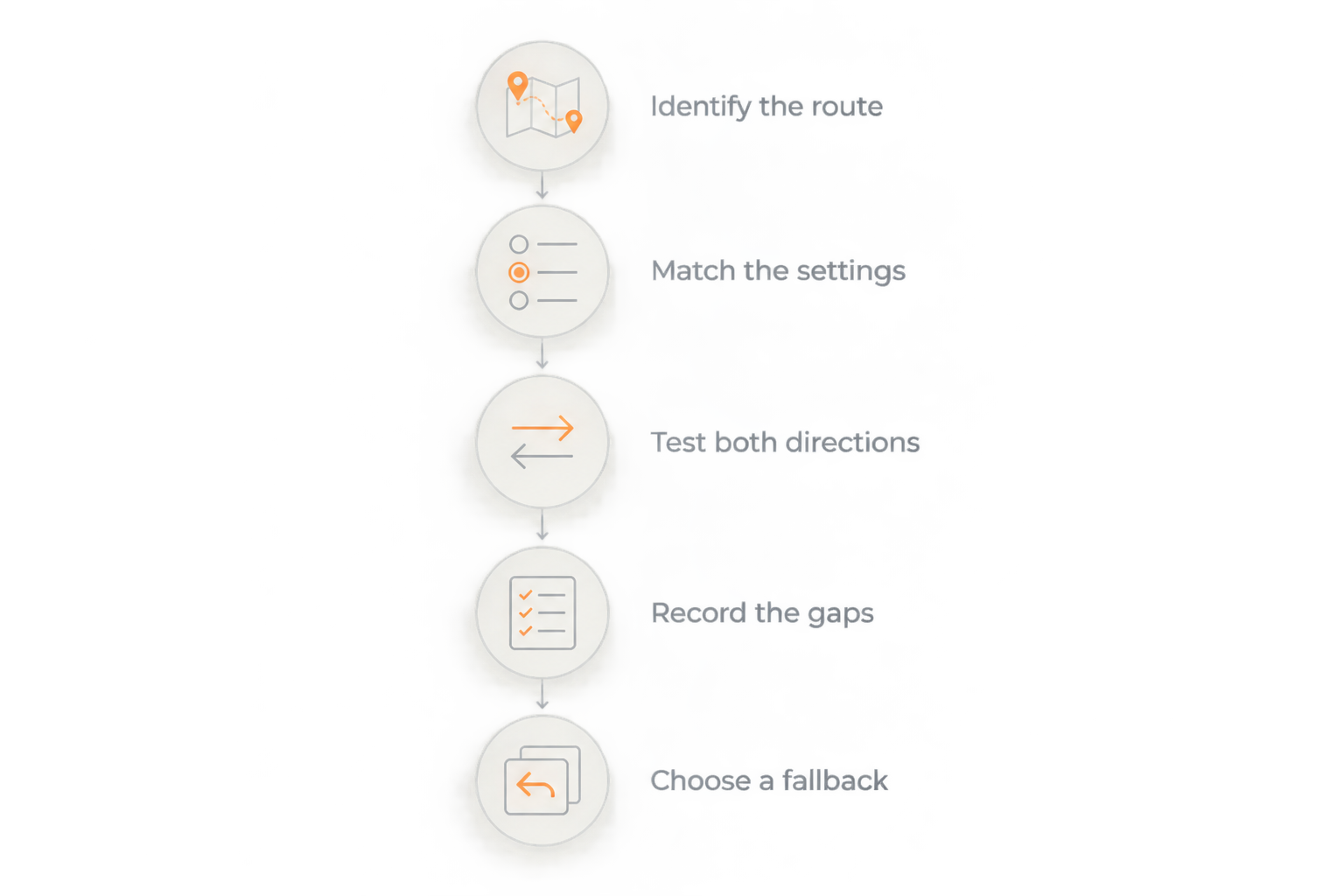
How do you check GMRS coverage before a trip?
Test coverage with the equipment and positions you intend to use. An indoor check across a room does not answer whether separated vehicles can communicate around a hillside.
Identify the route
Mark places where communication matters: a trail junction, work area, campsite, entrance gate, or turnaround. Include the locations most likely to put buildings or terrain between operators.
Match the settings
Confirm the same direct channel at both radios. Check signaling tones and squelch settings against the manuals; a tone mismatch can hide received audio even when a signal reaches the radio.
Test both directions
Have each operator transmit and repeat a short message. Record whether both people understand the message rather than relying only on a signal indicator.
Record the gaps
Note the exact locations where communication becomes unclear. Repeat the check from a safe alternative position to separate a local obstruction from a wider coverage problem.
Choose a fallback
Agree on a direct channel, check-in procedure, and safe meeting location. If you use a repeater, include a plan for losing access to it.
Keep the test conditions relevant. A handheld tested outside a parked vehicle does not establish coverage for that same handheld tucked beside a seat while driving.
What should you match before buying an antenna or cable?
Start with the exact radio model and its manual. A listing that says radio antenna or two-way radio cable does not establish compatibility.
Use this checklist for a 2026 replacement or installation:
- Frequency coverage: confirm that the antenna supports the GMRS frequencies you will use.
- Connector type: match the connector at each end, including its physical configuration.
- Mounting requirements: check whether the antenna requires a particular mounting surface or ground plane.
- Cable specification: choose feed line appropriate for UHF use and the planned cable run.
- Physical clearance: account for doors, roof racks, garages, and nearby metalwork.
- Manufacturer instructions: follow the equipment’s installation and adjustment requirements.
Avoid adding adapters simply to join mismatched parts. Every connection needs a sound mechanical fit, and outdoor connections also need suitable weather protection.
For CB replacement parts, Scott Radio & Electronics focuses on the same essential question: what matches the radio you actually own? Do not carry a CB part’s stated fit over to GMRS equipment without documentation.
Does higher wattage always mean longer GMRS range?
Higher wattage does not guarantee longer usable GMRS range. The permitted 50 watts on applicable main channels cannot eliminate terrain blockage, poor antenna placement, or a weak return path.
Channel restrictions matter too. FCC rules limit the handheld-only GMRS interstitial channels 8–14 to 0.5 watt ERP, so a radio’s highest advertised power is not available on every channel.
For U.S. operation in 2026, apply FCC Part 95, Subpart E, including section 95.1767 on transmitting-power limits. Check the radio manual for its supported settings rather than assuming every model offers the regulatory maximum.
Do privacy codes make a GMRS radio reach farther?
Privacy codes do not increase GMRS range or make a conversation private. CTCSS and DCS settings control which received signals open the speaker; they do not strengthen your transmission.
If a radio receives a signal but stays silent, compare the tone settings before assuming the radios are too far apart. Matching channel numbers alone does not resolve every settings mismatch.
Can a CB or ham radio replace a GMRS radio?
A CB radio cannot communicate directly with a GMRS radio because the services use different frequency bands. A programmable amateur radio is not automatically authorized for GMRS transmission either.
Check the exact model’s FCC equipment authorization, not just a frequency entry shown on its display. For U.S. use, GMRS also requires the appropriate FCC license; amateur licensing does not substitute for it.
FAQ
How far can a GMRS radio reach without a repeater?
Direct GMRS reach depends on antenna height, terrain, buildings, and installation quality rather than a fixed mileage limit. Test both directions along your actual route before relying on coverage.
Will a GMRS radio work over a mountain?
A mountain between stations can block direct GMRS communication. A suitably located repeater offers an alternative only if both stations can reach it.
Is mobile GMRS better than handheld GMRS for a convoy?
A properly installed mobile GMRS station is better suited to vehicle use because its antenna sits outside the passenger compartment. A handheld remains useful when you leave the vehicle, but neither arrangement guarantees coverage around terrain.
Does a GMRS repeater guarantee coverage?
A GMRS repeater does not guarantee coverage at every location. You need permission where required, compatible settings, and a usable path between each radio and the repeater.
Can I use my CB antenna for GMRS?
Do not use a CB antenna for GMRS unless its manufacturer explicitly specifies suitable GMRS operation. Matching connectors do not establish the correct frequency coverage.
Do I need a license to use GMRS in the United States?
Yes, transmitting under the GMRS rules requires an FCC GMRS license. Check current FCC requirements and the exact radio’s authorization before operating.
What should I try first when my GMRS radio stops reaching another radio?
First confirm matching channel and tone settings, then check battery condition and antenna connections. From a safe location, try a clearer antenna position and test communication in both directions.
One last thing
Receiving a distant station is not proof that the station can hear you. Make every coverage check a conversation, not a listening test.
If your separate project involves restoring a CB radio, contact Scott Radio & Electronics with the full model designation, revision markings, and clear photos of the original part and its connections. Include measurements or electrical ratings where marked, and ask for help before buying when fit remains uncertain.
Related guides
- How far can a CB radio transmit?
- Two-way radios for emergency preparedness
- CB radio setups for off-road and overlanding
{“@context”:”https://schema.org”,”@type”:”FAQPage”,”mainEntity”:[{“@type”:”Question”,”name”:”How far can a GMRS radio reach without a repeater?”,”acceptedAnswer”:{“@type”:”Answer”,”text”:”Direct GMRS reach depends on antenna height, terrain, buildings, and installation quality rather than a fixed mileage limit. Test both directions along your actual route before relying on coverage.”}},{“@type”:”Question”,”name”:”Will a GMRS radio work over a mountain?”,”acceptedAnswer”:{“@type”:”Answer”,”text”:”A mountain between stations can block direct GMRS communication. A suitably located repeater offers an alternative only if both stations can reach it.”}},{“@type”:”Question”,”name”:”Is mobile GMRS better than handheld GMRS for a convoy?”,”acceptedAnswer”:{“@type”:”Answer”,”text”:”A properly installed mobile GMRS station is better suited to vehicle use because its antenna sits outside the passenger compartment. A handheld remains useful when you leave the vehicle, but neither arrangement guarantees coverage around terrain.”}},{“@type”:”Question”,”name”:”Does a GMRS repeater guarantee coverage?”,”acceptedAnswer”:{“@type”:”Answer”,”text”:”A GMRS repeater does not guarantee coverage at every location. You need permission where required, compatible settings, and a usable path between each radio and the repeater.”}},{“@type”:”Question”,”name”:”Can I use my CB antenna for GMRS?”,”acceptedAnswer”:{“@type”:”Answer”,”text”:”Do not use a CB antenna for GMRS unless its manufacturer explicitly specifies suitable GMRS operation. Matching connectors do not establish the correct frequency coverage.”}},{“@type”:”Question”,”name”:”Do I need a license to use GMRS in the United States?”,”acceptedAnswer”:{“@type”:”Answer”,”text”:”Yes, transmitting under the GMRS rules requires an FCC GMRS license. Check current FCC requirements and the exact radio’s authorization before operating.”}},{“@type”:”Question”,”name”:”What should I try first when my GMRS radio stops reaching another radio?”,”acceptedAnswer”:{“@type”:”Answer”,”text”:”First confirm matching channel and tone settings, then check battery condition and antenna connections. From a safe location, try a clearer antenna position and test communication in both directions.”}}]}
