Vintage CB Radio Parts: Model vs Brand Search
Last Updated: November 13, 2026
Quick Summary
The fastest way to find vintage CB radio parts is to search by exact model number first, since model matches give the most reliable fit. Brand searches widen results but require you to verify compatibility yourself before buying.
- Confirm the exact model number from the radio’s label or chassis before searching.
- Model searches are best for board-level parts and components with mechanical fit requirements.
- Brand searches help when the model is unknown or when looking for components shared across a product line.
- Verify compatibility by comparing shape, mounting points, connectors and board markings against your photos.
- Treat a listing as unconfirmed unless it states the donor radio or a verified cross-model fit.
Table of Contents
- Searching Vintage CB Radio Parts by Model vs by Brand
- Side-by-Side Comparison: Model Search vs Brand Search
- CB Radio Model Number Identification From the Label and Chassis
- Vintage CB Radio Circuit Board Identification and Part Numbers
- Vintage CB Radio Parts Compatibility: How to Verify Fit
- How to Find Vintage CB Radio Parts: A Lookup Workflow
- Choosing Your Next Vintage CB Radio Part at Scott Radio & Electronics
- Frequently Asked Questions
If you are trying to revive a vintage CB radio, the fastest way to find the right part is to know whether you are searching by model or by brand.
Vintage CB radio parts is a niche category, and fit is not always verified for every model a seller lists. That is why the search method matters. A part listed under a brand name may come from a different model in the same product line, with a different chassis layout or channel board.
Searching Vintage CB Radio Parts by Model vs by Brand
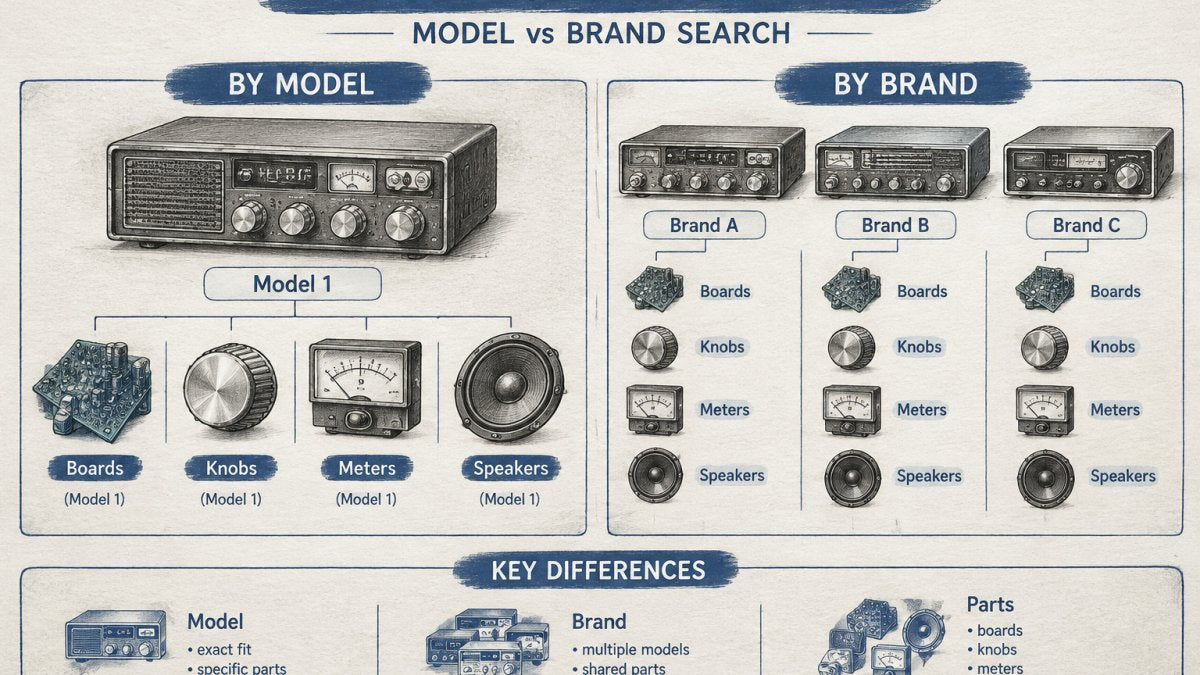
Searching by model means entering the exact model number of your radio, such as “Realistic TRC-418” or “Uniden PC-55.” Model-level searches narrow results to parts that were removed from that specific radio, which makes compatibility easier to judge.
The difference is not just result volume. It changes what you can verify before you pay. A model search lets you compare a listing against a known donor radio.
When a model search wins
Use the model number first when any of these are true:
- You need a board-level part. Main boards, channel boards and PLL boards are usually specific to a model or a narrow model family, and a board from a sibling model can differ in connector position or channel programming even when it looks identical.
- You need a part with a mechanical fit. Faceplates, bezels, meter movements and control assemblies depend on mounting holes, shaft length and connector layout, all of which vary by chassis.
- The radio is unmodified. If the label matches the chassis and the internals look original, the model number is reliable evidence and a model search keeps you close to it.
- You are restoring to original condition. A part pulled from the same model is the closest thing to the original part you can buy used.
When a brand search wins
Use the brand name first when any of these are true:
- The model is unknown or the label is gone. A brand search is a discovery tool: it shows you which model families exist and which parts are commonly listed, so you can identify the radio before you buy.
- You need a shared component. Knobs, bezels, switches, lamps and some connectors were reused across a product line, so a brand search surfaces parts that may fit several models. Treat “may fit” as unconfirmed until you check it.
- The exact model search returns nothing. A brand search widens the net to related models, then you verify each candidate against your radio.
- You are comparing prices. Brand searches show more listings, which makes it easier to see how a part is priced across a product line before you commit.
The trade-offs that matter
Fit confidence is the biggest difference. A model search keeps you closer to the original part; a brand search requires more checking on your side.
Risk follows confidence. Ordering by brand without verification raises the chance of a wrong part, and used parts often cannot be returned once installed.
Our recommendation is to search by model first and treat brand searches as a fallback.
Side-by-Side Comparison: Model Search vs Brand Search
The table below summarizes the main trade-offs. Use it to decide which approach fits your situation, then use the cross-reference structure underneath it to record what you find.
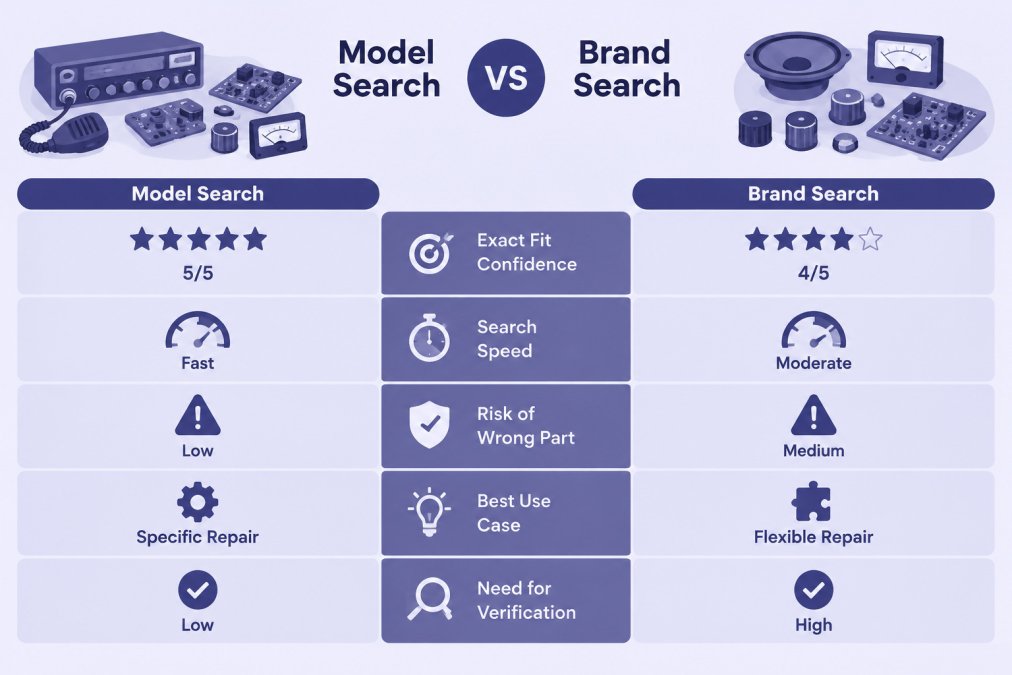
| Factor | Model Search | Brand Search |
|---|---|---|
| Fit confidence | High when the model matches | Lower; verify every listing |
| Result volume | Fewer, more targeted results | More results, many irrelevant |
| Risk of wrong part | Lower | Higher |
| Best use case | Confirmed model, board or control replacement | Unknown model or shared components |
| Verification needed | Compare markings and connectors | Confirm the model before buying |
| Evidence you can rely on | Donor radio stated in the listing | Your own comparison against photos |
| Typical failure mode | Part not listed under your model | Part listed under a sibling model that does not fit |
The biggest difference is risk. A model search keeps you closer to the original part, while a brand search requires you to do more checking yourself. If you are unsure which approach to use, begin with the model and only widen the search when the first results do not match your radio.
A cross-reference structure you can fill in
Competitors describe compatibility in prose. A more useful approach is to build a small cross-reference record for your radio as you search. You do not need a published matrix to do this; you need four columns and the discipline to fill them in.
| Brand | Model family | Chassis or board identifier | Part and confidence |
|---|---|---|---|
| Example brand | Exact model number | Board or part number read from the board | Part name, plus whether the match is confirmed or unconfirmed |
Fill the first two columns from the label and chassis. Fill the third from the board itself, because board numbers travel better than model names when you compare across a product line. Fill the fourth only after you have compared shape, mounting points and connectors.
Confidence levels, not yes-or-no answers
Treat compatibility as a scale rather than a yes-or-no answer:
- Confirmed: the listing states the donor radio is your exact model, or states a verified cross-model fit.
- Probable: the board or part number matches a known shared component and the mounting looks the same in your photos.
- Possible: the brand and model family match but the board number or connector layout has not been checked.
- Unconfirmed: only the brand matches. This is where most wrong-part orders begin.
A brand search rarely gets you past “possible” on its own. A model search can get you to “confirmed” when the listing names the donor radio. That is the practical reason to start narrow.
What to do when the radio is ambiguous or modified
A radio that has been modified or rewired may no longer match its original label. In that case, compare the physical layout, connectors and markings against your photos rather than relying on the model number alone.
Watch out: a brand search on a modified radio can surface a part from the original model that no longer fits the modified chassis, so verify against the radio as it is now, not as it left the factory.
CB Radio Model Number Identification From the Label and Chassis
Before you search, identify your radio’s model number. Most vintage CB radios carry a label on the back or underside of the chassis.
If the label is worn or missing, check the chassis itself. Some manufacturers stamp the model number on the metal housing, and circuit boards often carry a board or part number.
Watch out: a radio that has been modified or rewired may no longer match its original label.
Vintage CB Radio Circuit Board Identification and Part Numbers
Circuit boards are often the hardest parts to match. Once you have the part number, you can see where rare CB radio boards are actually sourced.
Product listings describe each part as removed from a specific donor radio. For example, the Realistic TRC-418 Main Circuit Board Assembly was removed from a TRC-418, so its model match is clear. Compare mounting holes, connector counts and visible component markings before you buy.
Vintage CB Radio Parts Compatibility: How to Verify Fit
Compatibility checking is the step most buyers skip. A part can look right and still fail to fit or function. Before ordering, work through these checks:
- Confirm the exact model number from the label or chassis.
- Compare the physical shape, mounting points and connector layout with your radio.
- Check any markings or part numbers on the board or component against the listing.
- Confirm the part is listed for your model, not a related one.
Many radios in the same product line share knobs, bezels or switches, so a part that fits one model may also fit another. Verify each shared part individually.
The description for the Uniden PC-55 Front Panel Control Assembly, for instance, notes that compatibility with other models has not been verified. Treat that statement as the default for any part whose listing does not confirm a match.
How to Find Vintage CB Radio Parts: A Lookup Workflow
Here is a practical sequence you can follow:
- Identify the exact model number from the label, chassis or manual.
- Search by model first. Note the listings that match your model.
- Check each listing’s description for the donor radio and what is included.
- Compare the part against your photos for shape, connectors and markings.
- If nothing matches, search by brand to find shared components, then repeat the verification steps.
For example, if you need a faceplate for a Midland radio, start with the exact Midland model number. You can also look at a real main board listing for a specific model to see how a lookup result is presented. The Midland 77-094 Front Faceplate Bezel is listed as removed from a Midland 77-094, so a model match is clear.
Choosing Your Next Vintage CB Radio Part at Scott Radio & Electronics
Once you have identified your model and verified fit, choose the part that solves your problem. The current catalog includes a range of components removed from donor radios:
- The Browning R-27 Variable Tuning Capacitor is listed at $30.00 for Browning R-27 owners.
- The Lafayette Comstat 25B Channel Dial Disc is listed at $15.00 for the Comstat 25B.
- The Midland 77-094 Front Faceplate Bezel is listed at $25.00 for the Midland 77-094.
- The Realistic TRC-418 Main Circuit Board Assembly is listed at $40.00 for the TRC-418.
If you are looking for a board by component type rather than model, you can browse scanner-style boards currently available.
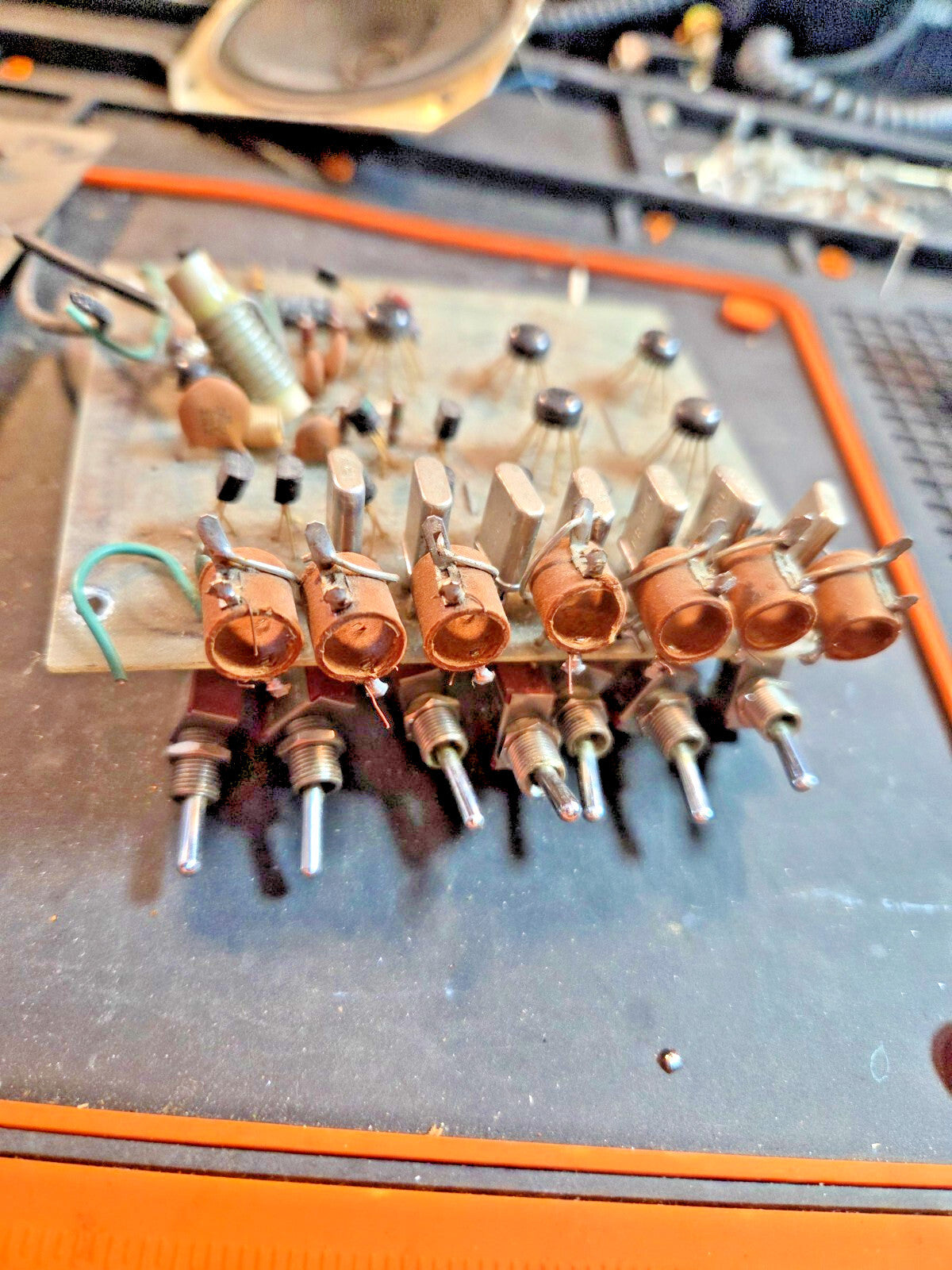
Each part is a used original replacement from a donor radio that the seller reports was tested before disassembly.
Vintage CB radio parts are worth searching carefully. Start with your exact model, verify every detail against your radio, and only widen the search when you have to.
Frequently Asked Questions
Should I search for vintage CB radio parts by model or by brand?
Search by exact model whenever you can read the model number on the label or chassis. Model searches return parts built for your radio, so fit confidence is highest. Brand searches are useful when the model number is missing, worn or unclear. They surface a wider range of candidates, but each one needs checking against your radio before you buy. Many brands used different circuit boards across their model lines, so a brand match alone does not confirm compatibility.
How do I find the model number on a vintage CB radio?
Check the rear panel, the bottom cover and the inside of the top cover first. Many radios have a paper or metal label with the model number and serial number. If the label is gone, look for a stamped number on the chassis or on the main circuit board. Photograph every marking before you search, because worn labels are easy to misread. Compare what you find against the brand’s catalog or a service manual to confirm the exact model.
How can I confirm a replacement part fits my vintage CB radio?
Compare the part’s board number, connector layout, mounting holes and markings against the radio you are repairing. Measure the physical dimensions if the listing gives none. Check whether the seller states compatibility with other models, and note when it does not. Confidence is highest when the part came from the same model and the same board revision. When you cannot match the markings, treat fit as unverified and ask the seller before ordering.
Can radios from the same brand use different circuit boards?
Yes. A single brand often used different circuit boards across models, product years and channel-board options. Two radios with the same brand name can have boards that look similar but differ in connectors, component values or mounting points. That is why brand-level searches carry more risk than model-level searches. Always confirm the board identification before buying.